Andhra Pradesh Community Managed Natural Farming: The Women Rewriting Farming
In the Indian state of Andhra Pradesh, a quiet agricultural revolution is unfolding, led by farmers, women’s collectives, and a belief that the plants and soil already know what to do.
Listen to the article
ANDHRA PRADESH, India.
It is the morning of Ugadi, the Telugu calendar new year for the Indian state of Andhra Pradesh. In a courtyard in a rural village, a group of farmers and their families are drinking glasses filled with Ugadi Pachadi. The traditional mixture tastes like a contradiction: sweet jaggery, sour tamarind, bitter neem flowers, chili heat, salt, and tangy green mango. Each of the six flavors is meant to represent an emotion that the coming year may bring—joy, sorrow, anger, fear, disgust, and surprise. The ritual is a reminder that life is rarely ever one thing.
In parallel to the new year celebrations, these farmers have gathered to talk about crops, soil, and the coming season. Many of them have spent years navigating the uncertainties of modern agriculture: volatile markets, rising input costs, erratic weather, and soil that seemed to become less productive each year. The conversation eventually turns to how dramatically things have changed in the past decade—in a positive way.
This transformation stems from Andhra Pradesh Community Managed Natural Farming, or APCNF, an initiative of the Government of Andhra Pradesh, initiated and led by Vijay Kumar Thallam since 2016. Over the past ten years, 1.8 million farmers have joined APCNF. In Andhra Pradesh, they have recruited 61% of all villages and 30% of all farmers. Their goal is to cover all villages and have 4 million farmers in the State by 2030.
“When you count by farmers, ours is the largest scaled natural farming program in the world” says Vijay Kumar. “And it is women,” he emphasizes, “who form the core of this transformation.”
Many APCNF farms resemble layered gardens: papaya trees rising above rows of eggplant, red banana plants casting shade over herbs and beans, climbing beetle leaf vines winding around bamboo supports. Crop residues cover the ground, forming mulch that protects the soil from sun and erosion while slowly decomposing into organic matter.

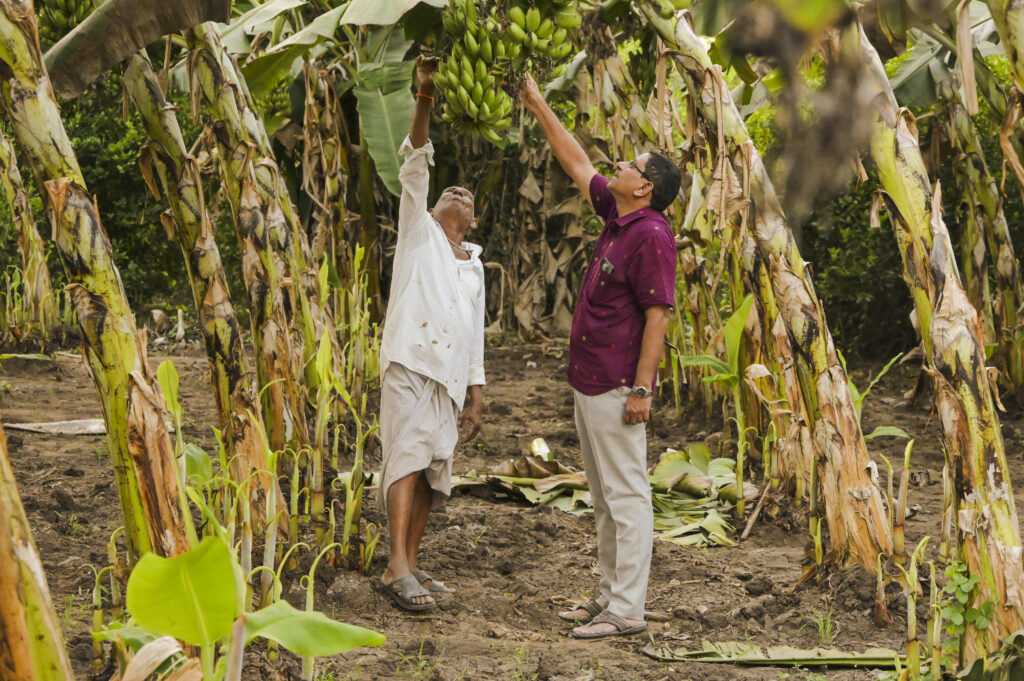
The overall impression is less of a single cropping system engineered for efficiency and more of a small ecosystem gently managed by the farmer. While the premise is simple—soil contains all the nutrients plants need to grow—natural farming is also a highly structured and scientifically backed approach. Rather than supplying crops with external nutrients—organic or synthetic—natural farming focuses on creating a rich soil microbiome teeming with diverse microbes that unlock nutrients and make them available to the plants. Keeping the soil microbiome healthy increases yields, is better for biodiversity, and helps regulate the water cycle and soil temperature.
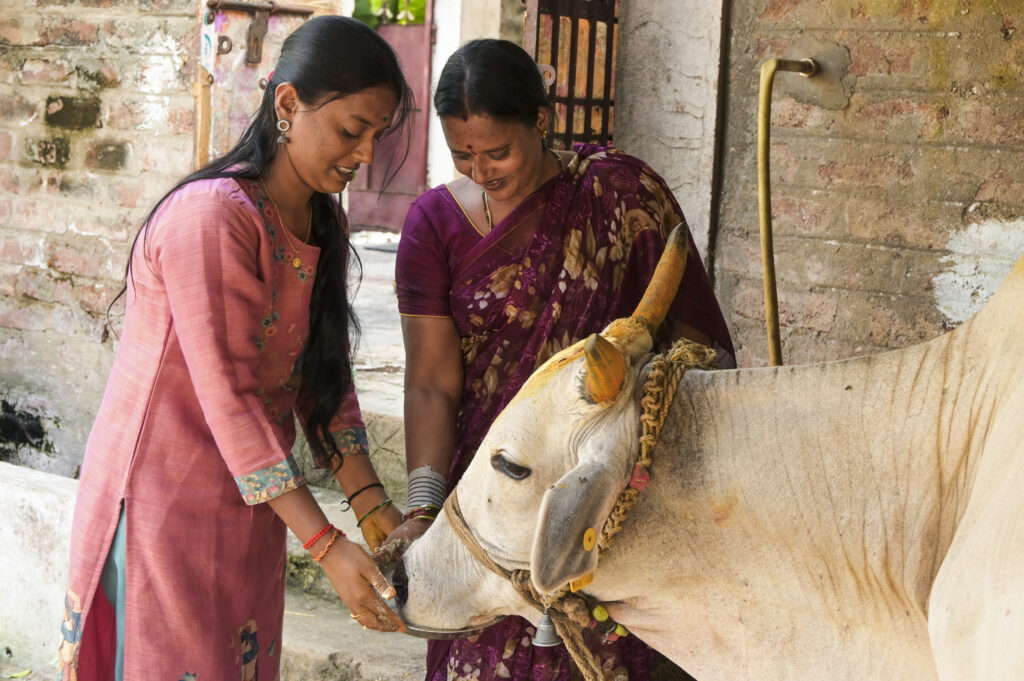
Natural farming is grounded in nine ecological principles that facilitate a rich soil microbiome. These include not tilling the soil and keeping the soil continuously covered with crops for all 365 days of the year. Planting a diverse range of crops is crucial, as is the rule of no chemical inputs. Farmers prepare bio stimulants using cow dung and other farm materials and apply other plant-based mixtures to deter pests. Methods such as Pre Monsoon Dry Sowing (PMDS) further optimize nutrient delivery to crops and enable farmers to harvest produce during the dry season, when resources are typically scarce.
For some observers encountering a natural farming system for the first time, its simplicity can be surprising. The techniques are based on modern science, but they have been converted to farmer friendly practices, explains K Gopichand, Senior Thematic Lead for Transformation at APCNF. “Natural farming,” he says, “is a vast subject—you can keep digging into it.
For many farmers, the shift toward natural farming began not with environmental ideals but with immediate personal concerns. Across India’s chemically intensive farming regions, farmers often talk about the physical toll of pesticide use.
“When we sprayed chemicals,” Suvarna Tejaswini Chintha of Kolakaluru village recalls, “the smell stayed in our heads. You would feel dizzy after working in the fields.”
Other farmers developed skin problems, and many of the women expressed general concern for their family’s health.
Economic pressure also played a role. Chemical agriculture demands a steady stream of purchased inputs, including fertilizers, pesticides, hybrid seeds, and irrigation systems that are often financed through loans, the cost of which increase over time. As soils degrade and pests develop resistance, farmers need increasing amounts of these inputs just to maintain yields.
“Farmers first change for their health,” Vijay Kumar explains. “The second reason is economics.”
Natural farming inputs are either homegrown or at the very least low cost, meaning farmers save on the avoided purchase of expensive chemical inputs. That, combined with the higher and more stable yields associated with natural farming, results in higher net incomes for farmers. Chintha shares how with her increased income, she was able to invest in her family´s education by sending her children to a better school. “And with some money remaining, I was also able to buy a small piece of gold jewelry,” she adds with a smile.
The origins of change
Vijay Kumar didn’t originally set out to transform agriculture. In the early 2000s he worked with women’s Self-Help Groups (SHGs) across Andhra Pradesh—community savings networks in which members contribute small amounts that others can borrow in times of need, while empowering women with knowledge and support systems. Over time the network grew to include 8.5 million women (90% of rural women) in Andhra Pradesh, forming one of the largest grassroots financial systems in the world. The work in Andhra Pradesh inspired work across the country and today in India 100 million rural women are organized.
As time passed, Vijay Kumar also saw how economic vulnerability was deeply wedded to agricultural loans. During one meeting with members of SHGs, a woman asked him, “We are not making any money, can you do something?” The business of agriculture, they told him, simply was not working anymore. Costs were increasing, profits were disappearing.
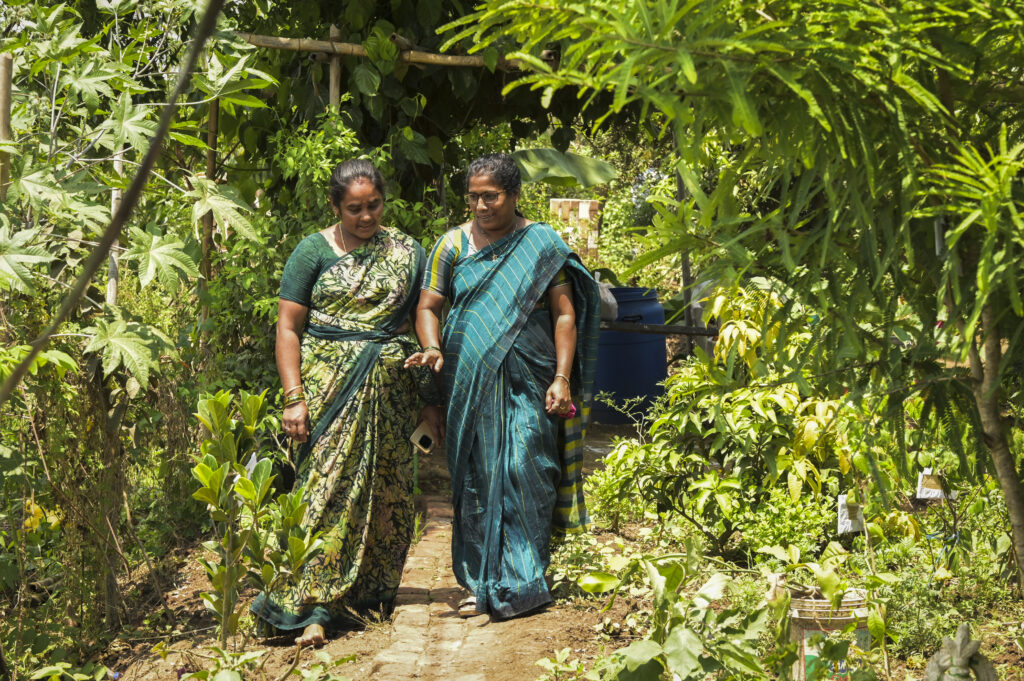
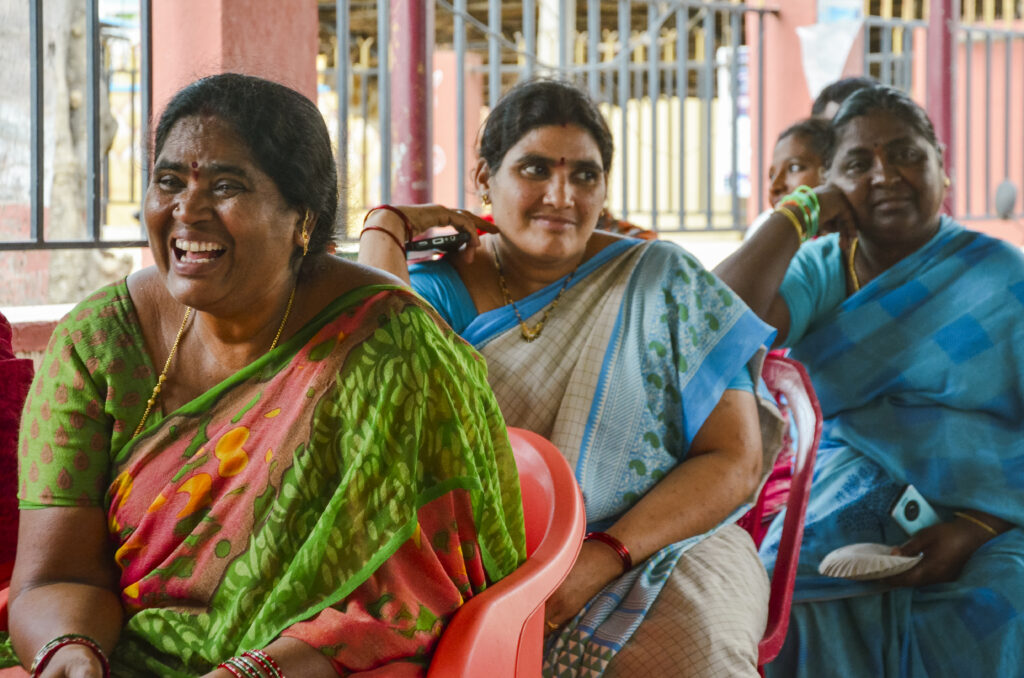
Closer examination of the numbers revealed the scale of the problem: roughly seventy percent of loans within SHGs were going toward agriculture. “If farming remained unprofitable,” Vijay Kumar explains, “entire communities would remain fragile.”
Vijay Kumar began searching for alternatives, coming across natural farming practices already tested by a few NGOs in India. In one case, the Center for Sustainable Agriculture, an NGO led by Dr. Sanghi had successfully introduced non-chemical pest management in a single village—but it had taken them eight years to make that change.
“The technology is not complicated,” Sanghi told Vijay Kumar. “Getting people together is more difficult.” Organizing communities, Vijay Kumar realized, was exactly what the women’s self-help group network already did. “Getting people together is our strength,” he replied.
Drawing on networks of SHGs already active across the state, Vijay Kumar envisioned a model that combined ecological principles with local social structures, allowing farmers themselves to drive change. Women, smallholders, and landless farmers were to be the focus, to change the narrative around who the face of farming leadership could and should be.
A bottom-up, top-down transition
SHGs became the logical choice for disseminating knowledge about natural farming. The groups could act as a communication pipeline, a space where the earliest adopters of natural farming could share their experiences and encourage other families to follow in their steps.
“If one woman tried something and it worked,” Vijay Kumar says, “ten others would try it the next season.”
SHGs already formed federations within villages. The next challenge was finding a means to join the dots between different villages, and to connect them all with APCNF at large. In this way, the growing knowledge about natural farming could flow in multiple directions. As Kumar explains it, “We needed a bridge—a human connector.”
The idea for a structured network of Community Resource Persons (CRPs) was thereafter born. CRPs are farmers demonstrating best practice, identified and trained by APCNF to support the different stages of the transition to natural farming. They join SHG meetings, supply educational materials and videos, and typically establish demonstration plots in villages where they practice natural farming themselves. By being selected from within the communities they support, CRPs carry credibility in a way regular government agents may lack. When neighbors see CRPs cultivate crops without chemical inputs, it builds the confidence needed for them to try the approach on their own land. The CRPs are in regular communication with APCNF’s district offices, allowing them to report back on what is happening on the ground and what is needed.

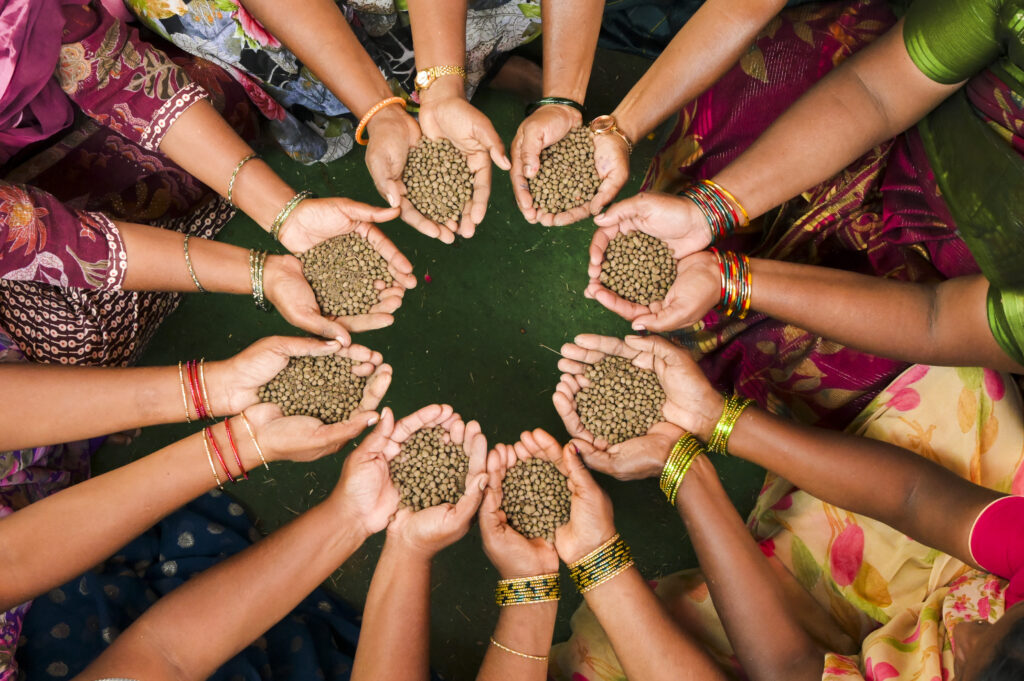
As natural farming spreads within a village, extra layers of the APCNF system are organically added. Vijaya Lakshmi Tadiboyina has been practicing natural farming for 5 years, successfully cultivating over 86 varieties of plants on her 1.2 hectare plot. She can now meet both her family’s needs and sell additional produce for a small premium. In 2024 she used her saved income to open a Bio Resource Centre (BRC), where she produces and sells natural farming inputs. Not all farmers have the means or motivation to create the inputs themselves, so these centers remove this barrier to entry. Tadiboyina explains how just the prior evening, one SHG member finally persuaded her husband to buy some products and “give natural farming a go” in their kitchen garden.
Fostering a spirit of innovation and experiential learning are also core tenets of APCNF. All farmers are encouraged to make experimentation a regular feature of their natural farming practice. In training plots and village fields, farmers consistently gather to examine soil, compare planting methods, and discuss the results of experiments conducted on their own land.
In tandem, the affiliated Indo-German Global Academy for Agroecology Research and Learning (IGGAARL Academy) invites interested farmers to enroll into a ‘Farmer Scientist’ course. Farmers take part in agricultural courses over eight semesters and formalize their homegrown experiments into research theses that can be shared more widely, investigating some of the most pressing farming issues in India. Farmers at the Academy are referred to as “Farmer Scientists,” a term emphasizing the legitimacy of their work, and that the process of experimentation is not confined to laboratories or research institutes.
“All farmers are scientists,” Vijay Kumar says, “but most scientists don’t farm.”
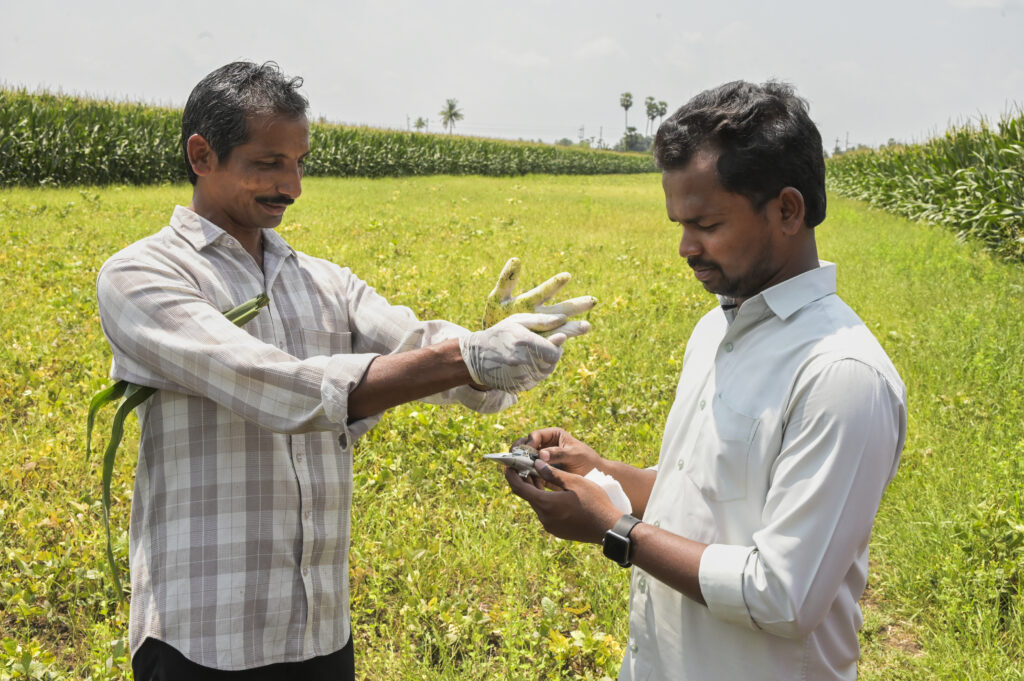
One such Farmer Scientist is Prudhvi Raj Dusari , a tenant farmer. Checking the Brix value (total dissolved solids) of the leaf sap, he makes meticulous notes in his journal. Dusari has been a student of the IGGAARL Academy since 2023. “My dream,” he says, “is to one day own my own plot of land where I can practice and share the benefits of natural farming. And ultimately, transform my whole village!”
This careful system of organization, weaving together both bottom-up and top-down leadership, remains one of the most striking features of APCNF. The program is funded and implemented by Rythu Sadhikara Samstha (RySS), a state backed non-profit, but has remained centered on continuously developing capacity at a grassroots level. Political will and finance combine with community trust and mobilization to form a recipe for change.
Today APCNF encompasses 3.5 million women organized into 340,000 SHGs, 12,825 village SHG federations, 10,000+ CRPs, 1000+ Farmer Scientists, 2000+ BRCs and a network of 11,000 demonstration farms.
While the program´s focus remains on Andhra Pradesh, APCNF also supports farmer networks in 22 other Indian states. With the blueprint in hand, the plan is for their reach to grow. “If we solve India’s problems, then we have solved 20% of the world” says Vijay Kumar. International interest has been sparked, with delegations from 58 countries visiting APCNF. RySS is also supporting natural farming projects in Sri Lanka, Zambia and Indonesia.
Healthy soils, healthy people
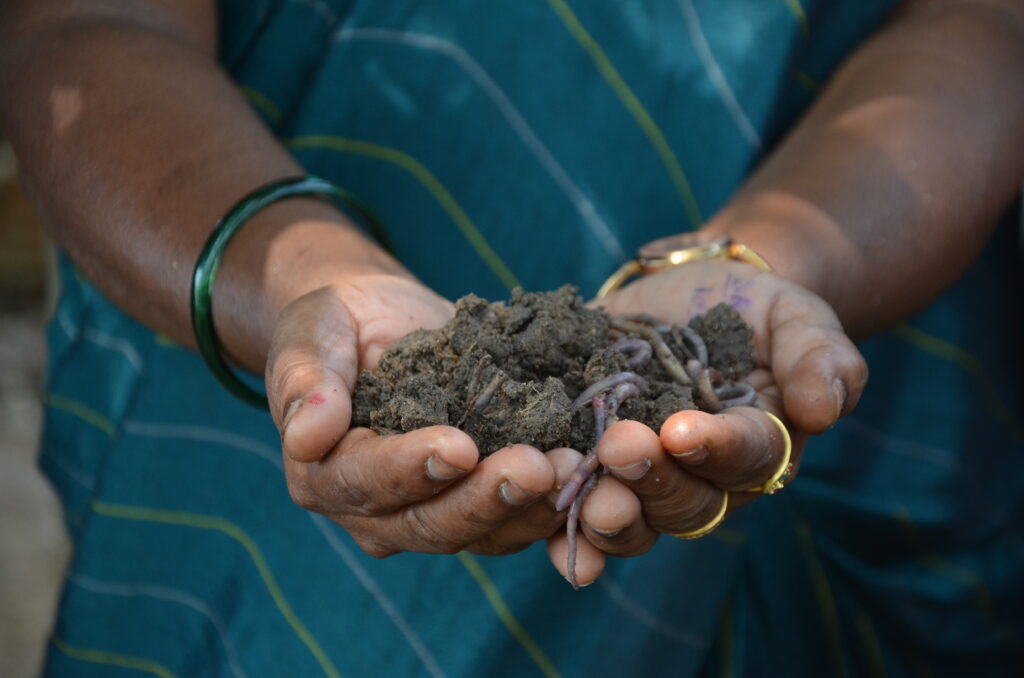
The results of natural farming systems appear profoundly in soil and plant health. Farmers describe the transformation physically: compacted ground becomes crumbly, organic matter builds up, and fields retain moisture longer. Healthier soils support more insects and microorganisms, which help regulate pests naturally. Water use can drop by as much as half thanks to improved soil moisture retention. Earthworm populations, farmers say, return in abundance—some studies have recorded increases of up to sevenfold. Partial benefits start to appear from the first year of switching to natural farming systems, and full benefits in four to six years, rippling through the wider ecosystem.
As plant health improves, crops become more resilient to drought, heavy rain, and disease. The proof is tangible: when Cyclone Montha struck Andhra Pradesh in October 2025, hundreds of thousands of hectares of cropland farmed using conventional chemical methods lay devastated. In contrast, neighboring plots, with the same seed varieties and soil type, but employing natural farming methods, stood undamaged, thanks to their more developed root systems and improved ability to absorb water. Farmer Scientist Dusari recounts how he and his wife went to sleep confidently on the eve of the storm. “As I have been practicing natural farming for three years, I believed the field would be fine” he says. The couple awoke to find their crops intact.
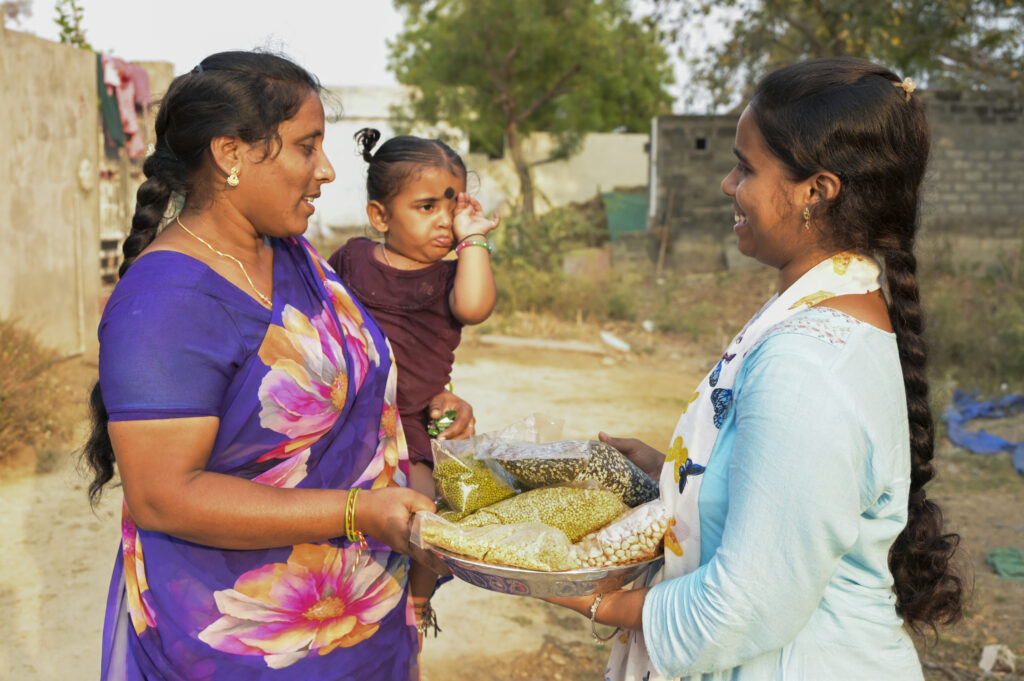
Increasing access to natural farming produce has several health benefits that stand to counter malnutrition and non-communicable diseases in the region. As such, APCNF is actively building demand for natural farming produce by linking farmer markets with programs focused on nutrition education. As Monica Sivangula a district health and nutrition anchor explains, village food committees map the needs of households and run campaigns that emphasize the nutrition benefits of natural farming produce. As awareness grows, so does the willingness to change diets away from ultra processed and chemically farmed foods, helping reinforce a direct local production to local consumption loop. Based on a study conducted by APCNF across 247 villages, 87% of households now consume five to seven food groups daily, a significant improvement from the earlier three to four food groups per day.
Back in the courtyard, everyone has drained their glasses of Ugadi Pachadi. Farmers start to walk on to their fields, barefoot, as a sign of respect to the earth. They continue discussing seeds, weather, and the coming season. Ugadi Pachadi’s symbolism, with its balance of sweetness and bitterness, feels fitting here, in a landscape where the future of agriculture is unfolding slowly, field by field, conversation by conversation, experiment by experiment.
“These women,” says Vijay Kumar, “are going to save humanity.”
Words by the Food Planet Prize team.
Photos by Isabel Baudish and APCNF
Andhra Pradesh Community Managed Natural Farming
- Launch year: 2016
- Founder: Rythu Sadhikara Samstha, under the Government of Andhra Pradesh. Led from inception by Vijay Kumar Thallam as the Executive Vice Chairman.
- Based in: Andhra Pradesh, India
- Website: https://apcnf.in/