Buckets of foul smelling, curdled milk could be the inspiration for a brand new, fully compostable type of packaging.
The global amount of industrial agricultural waste is staggering. We trash roughly 1.4 billion tons of food each year, approximately one-third of all food produced. That amounts to around 1 trillion USD in revenue losses. And that’s without the carbon cost of making and transporting the food that ends up in landfill.
But Robert Luo, CEO and founder of the material science company MiTerro, has come up with a solution made from milk protein inspired by visits to his uncle’s dairy farm in North-western China.
Luo, now a Forbes Under 30 scholar and Global Shakers Sustainable Fashion Innovator of 2019, was puzzled by the amount of spoiled milk left to waste in this otherwise efficient and well-organized farm, and rose to the challenge set by his uncle to find a solution. Then a student at the University of California, he started researching the make-up of milk waste, and found a way to repurpose it. On a molecular level, the protein structures of wool and milk are not dissimilar, and Luo and his childhood friend, Zhuang, figured out a way to mimic the wool protein structure to form a bio-based, water-degradable, home compostable packaging material that is cheaper than the conventional plastic. According to MiTerro, this material produces 80% less CO2 emissions.
Using the endless supply of agricultural waste and byproducts from the plant and dairy industries, MiTerro is now on a mission to replace all the world’s petroleum-based, single-use plastic and paper-based materials with its alternative packaging.
Bio-based detergent pods – photo by MiTerro
Luo believes that he can address two of the biggest problems in the world by turning dairy, stem grain, or soybean waste into plastic alternative packaging material.
Designers have already tried working with milk fibers blended with petroleum-based acrylic. But MiTerro has removed the fossil fuels and claims to have created a totally sustainable product from milk waste. Spinning it into fabric first, the company worked with farmers and food companies in the US and China to fashion milk shirts, underwear, and facemasks. The media went crazy.
Now they’ve expanded the theory to include natural polymers from other agricultural waste such as beer, potatoes, and paper pulp, creating a unique prototype compostable material that is 20-40% cheaper than other bio-based products. And as it’s water-based, it leaves no microplastics in the oceans.
The material’s strong water and oxygen barrier and heat-sealable capacity mean that it can package fresh produce, dry food, fashion, cleaning products, and technological devices. Global corporations from Georgia Pacific and SPB to Budweiser and Unilever and Lipton, are lining up to test out its potential.
Give a man a fish, the old saying goes, and you feed him for a day. Teach a man to fish, and he will have food for the rest of his life. Of course, such a statement ignores the multitude of things that impact food access, and most glaringly of all, ignores the fact that the man himself knows what is best for him. So how can we sustainably — and holistically — help communities feed themselves in the long term? World Neighbors has been grappling with this question of food insecurity for decades since it first originated in 1951. Their answer is to work hand-in-hand with rural communities as they raise their own funds, improve their own economic options, ensure community and reproductive health, support sustainable agriculture and sustainable resource use, and increase gender equity.
Currently, World Neighbors works with rural marginalized communities in 14 countries in ecologically fragile areas across Africa, Asia, Latin America, and the Caribbean, consistently respecting the needs, assets, and wisdom of community members, and facilitating their leadership in making sustainable advances. There’s no quick fix here. Instead, World Neighbors works with the poorest, most marginalized communities for an average of 8-10 years to address the issues specifically plaguing each community.
Olga Chivalan Mendoza, from the community Santo Tomás in San Lucas Tolimán (Atitlan, Guatemala) is standing with her daughter in front of their improved kitchen garden which now grows a variety of vegetables, providing both food and additional income earned through selling vegetables in the market.
World Neighbors attempts to meet individual communities’ specific needs by providing local trainers, consultants and volunteers who demonstrate sustainable food production. Farmers attend Farmer Field Schools to learn from experienced neighboring farms. Though specifics vary between communities, World Neighbors has a few constants that have been designed to help farmers, including improving the quality of the soil by utilizing organic fertilizers; utilizing organic pest control without harsh, expensive, and environmentally damaging products; establishing irrigation systems to conserve water in the rainy seasons; reducing the amount of soil disturbance by limiting deep plowing of the fields; planting seeds that are more drought and disease-resistant, which will grow better as the climate continues to change; and establishing tree farms within the communities to stabilize possible erosion and improve soil quality.
World Neighbors’ goal is for farmers and home gardeners to produce enough food for their families and communities so they don’t have to spend their limited resources on buying food cultivated elsewhere. Additionally, they help people grow additional produce that can be sold as a source of income. While much emphasis in the past decades has been on helping poor people secure microloans from banks, World Neighbors rejects this conventional thinking. Instead, they help communities form savings and credit groups of up to 35 people who save small amounts. When they amass enough capital, they loan to each other at very low interest rates, thereby ensuring the money stays in the community.
Holistic, people-centered, collaborative, and long-term: these are the factors that set World Neighbors apart.
Monarch Tractor has recently launched its first line of electric tractors with its groundbreaking MK-V model—the world’s first full-electric, driver-optional, data-collecting smart tractor. Its CEO hopes the company is going to revolutionize the future of farming.
LIVERMORE, California
All is quiet on the farm—well, nearly. There’s none of that deafening roar usually heard from a tractor’s traditional diesel machine, brusquely plowing through fields. Instead, the MK-V model emits a lighter, clunking sound. It’s also tiny (a slender 48.4 inches, compared to 72 inches on similar machines), slipping between rows of grapes with an almost graceful dexterity. It has taken Praveen Penmetsa and his team at Monarch Tractors six years of developing, testing, breaking, and fixing to create such an elegant machine.
Penmetsa comes from a long line of southern Indian rice farmers. Little surprise then that the 45-year-old ended up working in agriculture—sort of. As CEO of Monarch Tractors, a Silicon Valley meets Napa Valley “clean farming” tech company, Penmetsa is building a brighter future for farming through electric tractors. He and his team are determined to try to make farming profitable again. And they’re doing that by offering a machine that has three advantages: Driverless, electric, and it collects data. This is a trifecta of features that, Penmetsa points out, no other company currently offers. Originally from Hyderabad, capital of southern India’s Telangana state, Penmetsa was visiting his hometown in 2012, following a long stint working for electric battery companies like Toshiba and Panasonic, specializing in electric vehicles. On that trip home, electricity kept cutting in and out, resulting in frustrating work delays and steamily hot afternoons.
Drawings and sketches for the winning design concept for the Monarch MK-V tractor – the first of its kind in the world – on display at Monarch Tractor in Livermore.
Penmetsa’s mind began to wander—electric batteries store energy generated by the car. Was it such a stretch to imagine an electric car battery could power a home? “I would be thinking, oh, I wish I had that Prius we worked on, I would have power here,” he says with a smile. “But that’s a ridiculous notion.”
Still, the wheels began turning—literally. If tractors were electric and could store power in their batteries, they could be relied on when a power cut hit. Nearly 60% of India’s population works in the agricultural sector; an electrical tractor could kill two birds with one stone. “So you could use it out on the farm but also power the house in the village,” Penmetsa elaborates. It didn’t take long before he built a prototype with Zachary Omohundro, a robotics and remote systems expert, supported by grant funding from the U.S. Agency for International Development (USAID). “We took it to Maharajpet, a village just outside of Hyderabad, did the training, and told the farmers, ‘Nowyou can drive it!’” he recalls. “But the farmers laughed at us and we found out that there were only two people in the entire village who knew how to drive a tractor.”
That’s when the idea to develop an autonomous tractor was born. “Farmers told us there’sno future in farming. And I thought, oh, it’sIndia; life is hard.” But Penmetsa soon realized that the same sentiment was echoed all over the world, from Hyderabad to Sacramento. “Nobody felt like there was a future in farming,” he says. “And that was the genesis for us to continue to work on this project.” In 2015, Penmetsa returned to Silicon Valley, partnering with Mark Schwager, who had worked at Tesla, and Carlo Mondavi, scion of the famous Italian-American winemaking family.
The front end of a Monarch MK-V, an autonomous EV tractor, glides through a row of grapes in Livermore, California.Zach Moore, Testing Lead at Monarch Tractor, drives the MK-V tractor at Wente Vineyards in Livermore on a clear spring day.
A solution to farming in crisis
The fact that life is getting increasingly difficult for farmers globally is an undeniable reality. In the United States, tighter immigration laws and the pandemic have caused the agricultural labor force to dwindle, driving up the cost of finding tractor operators—it costs roughly $30 an hour for a driver. While costs vary depending on region and crop, in the San Joaquin Valley, the rate for a driver on an almond farm in 2019 was just over $20 an hour.
“COVID demonstrated that we don’t have sufficient labor during peak periods,” explains Scott Shearer, Professor and Chair of Ohio State University’s Food, Agricultural and Biological Engineering Department. “In rural America, it’stough to find qualified labor for those seasonal periods.” That’s where Monarch’s most significant success lies. According to their internal research, a wine grower using ten Monarch tractors for mowing, tilling and disking can save up to $79,000 a year in fuel, up to $200,000 a year in labor, and up to 500 tons of CO2 emissions annually. For farmers, that represents enormous savings.
Electrification
In industrial agriculture, tractors are typically huge machines capable of farming corn, wheat and soybeans, which make up roughly half of US farm revenue. On large feed farms, farmers use combine harvester tractors, which can weigh up to 25 tons and have up to 650 horsepower. Monarch’s MK-V model is 75% lighter, weighing only 5,750 pounds.
“The shot over the bow is what we are seeing in California when it comes to lower horsepower tractors,” explains Shearer. “Some processes on farms are very well suited to electric tractors; other things are more energy intensive and it’sgoing to take more time.”
An employee works on assembling wiring harnesses at Monarch Tractor’s facility in Livermore.
Monarch is also looking at providing farmers with their own source of electricity that can be used to either power their farm or sell back to the grid. While the tractors don’t produce energy themselves, they are able to store it, which can be used as needed. “We’re aiming for a closed-loop system,” explains Penmetsa. “We’re trying to increase rural grid resiliency.” Ten Monarch tractors can store about 1 megawatt of energy. “And a lot of our farmers have 100, 200 tractors,” says Penmetsa. “That’s a lot of extra energy.”
Thanks to the MK-V model’s battery storage capabilities, the tractor doubles as a portable power source. The battery sits up on the tractor’s hood, and although Monarch remains tight-lipped about storage size, Penmetsa discloses it was “more than a 100kWh.” (By contrast, Tesla batteries store around 3MWh.) The Monarch battery can power around ten hours of “average” farmwork, such as spraying, or five hours of “heavier” tasks, like plowing. Inbuilt power sockets on the machine can power anything from a phone to an electric car. And since most farmers have several tractors working, ten tractors would equal 1Mwh of energy storage.
After requests from farmers, Monarch engineered a battery-swapping process that one trained person can handle in under 10 minutes. With enough extra batteries, the MK-V tractor can run non-stop. As some crops have a very narrow period of time when they can be harvested, this could be a game-changer.
Praveen Penmetsa, co-founder & CEO, and Mark Schwager, co-founder & President, pose for a portrait next to the Monarch MK-V autonomous EV tractor.
Driverless and Data-Driven
Monarch’s driverless option is perhaps its most impactful aspect. Tractor accidents are the leading cause of injury and death among farm workers in the United States. Tractor rollovers (when a tractor overturns on its driver) cause an average of 130 deaths every year. Experience doesn’t matter—80% of the deaths involve seasoned operators. Remote operation removes most of the danger from the equation, says Penmetsa, and farmers can manage multiple tractors at once from the Monarch app on their phones.
“Digitization of agriculture is everything,” Shearer emphasizes. “If you can’tmeasure it you can’tmanage it.” Monarch’s 360-degree cameras, mounted on the tractors and accessible to farmers at any time, feed a continuous stream of images to a central database. If something is amiss, the farmer is immediately alerted. “[Farmers] can have full traceability of what’shappening on the farm,” Penmetsa explains. “‘Whatdid we do six months ago? Is there a pest infestation on a particular row? Did we spray this row?’ Those are questions we can answer.”
Such data collection and storage capabilities are paramount for a future where an increase in unpredictable extreme weather events is resulting in catastrophic loss of crops; incredibly tight margins mean predicting crop yield is vital to making ends meet. It also means that farmers can spend less money on personnel. Yet the main difficulty for Monarch has been convincing farmers to use their tractors.
Penmetsa refutes any suggestion that the agricultural industry is slow to change. “Historically, agriculture has always been at the forefront of technology. It’sonly in the last twenty or thirty years, because of the profit margin reduction, that farmers have become extremely careful in technology investments.”Instead, with profit margins so slim, farmers cannot afford to take risks. The best way to convince them, Penmetsa says, is simply to show them.
An American flag hangs on the wall of the manu- facturing and assembly facility at Monarch Tractor. With staff in Singapore, Hyderabad, and California, Monarch’s aspirations are global in scale.
Coming full circle
Since its launch in 2012, Monarch has raised $81 million in funding over three rounds, through venture capital and other strategic partners, including agriculture equipment giant Case New Holland. Headquarters are at Livermore, just east of San Francisco, where two large buildings house around 220 research and development employees.
In Hyderabad, there’s a team of 30, with another 15 in Singapore (with some government funding) working across data science. The geographical spread is an indication of Monarch’s global aspirations. In November 2022, Monarch received a $3 million grant from the California Energy Commission (CEC) to accelerate development and rollout. The company is now in talks with large- scale agriculture machinery companies to license their technology.
Amidst all the wins Penmetsa has had in California, though, his heart is still at his family’s farm in India. “One day I want to bring it to India,” he says with a smile. “And see it on the rice farms.”
Mazher Udaipurwala, Industrial Designer at Monarch Tractor, uses an Oculus VR headset in his design process at Monarch Tractor’s facilities in Livermore.
Food providers—large-scale companies that mass-produce meals for hospitals and schools,as well as hotel groups, cities and restaurant chains—serve billions of meals annually. Despite their size, there hasn’t been nearly enough focus on how to cut their greenhouse emissions. Enter Coolfood, a one-stop solution to facilitate plant-forward, climate-friendly eating.
CLEMSON, South Carolina
Spring is in full bloom at Clemson University. Trees are budding, daffodils are pushing through fresh mulch, and a warm breeze rustles the grass. Inside the Schilletter Dining Hall, nestled under towering oaks of this Southern university, things are also turning green.
“When I was a kid, our local favorite was the ‘bird dog,’” Natalie Pritchard, Executive Chef of Student Dining, says with a laugh. A mess of bacon bits, chopped chicken, and ranch dressing sandwiched in a hot dog bun, it looks nothing like the veggie-forward sweet potato and corn pizza she’s currently rustling up.
The finishing touch is fresh thyme and sage, sourced from less than a mile away at Clemson’s new hydroponic micro-farm. Pritchard slides the flat-crust pizza into the brick oven, and the cheese starts to bubble. The staff will serve it alongside a special placard emblazoned with a small green degree. That label indicates it’s a Coolfood recipe, a sign to students that their meal is a more climate-friendly option.
At a nearby table, four freshmen tuck into their lunch. None of the young men identifies as vegetarians—they all know, and love, the bird dog.
But meat isn’t their main focus, either. One is eating a vegetarian pizza. “If it tastes good, we’ll eat it,” says student Tom Kiernan.
Coolfood program is run by the World Resources Institute, a non-profit research organization. The program has its own branding that is used to nudge consumers towards low-emission food optionsHearts on the wall of a Schilletter Dining Hall at Clemson University reflect students’ self-identified preferences for healthy living and eating. The Coolfood program at Clemson offers hundreds of “plant forward” recipes.
Aramark, Pritchard’s employer, has served meals to Clemson University students for over 50 years. Last year, the company teamed up with Coolfood, an initiative run by the non-profit organization World Resources Institute, to serve meals that have, on average, 38% fewer emissions than the average American meal. Aramark also took the Coolfood Pledge, a commitment to reduce their food related GHG emissions by 25% to 2030.
Aramark is one of the world’s largest food service providers, serving more than three million higher education students on nearly 300 campuses annually. For years, Aramark has been increasing their meat-free meal options to serve its younger customers better. But their current goals are now more climate oriented: cutting 25% of its food-related greenhouse gas emissions by 2030.
50% of Aramark’s total greenhouse gas emissions came from sourcing food. “We knew we could bring that down dramatically,” says Alan Horowitz, the vice president of sustainability at Aramark. “Coolfood offered us a ‘one-stop solution’ to do just that.”
‘How do we feed 10 billion people by 2050?’
The idea for Coolfood started with a research question: how will we feed 10 billion people sustainably by 2050?
Back in 2015, a few sustainability experts at World Resources Institute, including Richard Waite, started investigating. The organization was interested in climate change, specifically in setting “science-based” targets to slow climate change by cutting greenhouse gas emissions. Two things were clear from the outset. One-quarter of the world’s carbon emissions come from food production, and two-thirds of those emissions come from food sourced from animals. A lot of conversations around food focus on individual choices around plant-based eating. But researchers knew that realistically addressing climate change wouldn’t simply boil down to people choosing to eat more plants. It would also require food providers to nudge people towards those choices by making smarter food-sourcing decisions themselves.
Members of the Coolfood team sit at the World Resources Institute head- quarters in Washington, DC. From left to right, Gerard Pozzi and Richard Waite stand in the back. Clara Cho, Denise Phelps, and Sarah Sarkar sit in the front.
Bringing large food providers on board wasn’t as challenging as one might expect. Most large corporations already have sustainability commitments of some kind in place. And WRI has a reputation, forty years strong, for developing green solutions that appeal to large-scale businesses. When WRI announced Coolfood, they found—almost immediately—ten food providers hungry to reduce their food-related carbon footprint, unsure how to do it, and eager to collaborate.
“There’sthis credibility… and integrity about WRI that is obviously very important” to large companies,” says Anne Bordier, who leads the Coolfood team of twelve data and sustainability experts.
Over 60 major food providers, like MAX Burgers and IKEA, have joined the Coolfood pledge: to reach a 25% absolute reduction in food-related GHGemissions by 2030. Using their food purchase data, Coolfood tracks the 3 billion meals a year currently served by its Pledge members, each one a contributor to reducing carbon emissions. In total, Coolfood’s tools and expertise are used by organizations serving 8 billion meals a year. The group has an ambition to increase that to 12 billion meals a year by 2025.
Digging into the numbers
One of Coolfood’s main tools is its research-based greenhouse gas calculator. It helps companies understand their food-related carbon footprint. The calculator is based on the latest guidance from the Science Based Targets initiative, a corporate campaign helping businesses align with practices from the United Nations’ Paris Agreement (WRI is also a key member of this initiative).
The program considers how much emissions are produced from indicators like animal feed, food transport, processing, packaging, and even food “loss” that occurs before a company like Aramark purchases it.
The need for greenhouse gas emission reduction is critical. In order to achieve the Paris Agreement goal to limit planetary warming to 1.5 degree Celsius, Coolfood says that emissions from food will need to drop by 25% to 2030.
Clemson University feeds over 8,000 students every day. An increasing number self-identify as “flexitarians”, raising demand for vege- tarian and climate-friendly food options..
Plus, as Waite points out, “There are going to be more people on the planet… and global food demand is projected to grow by 21% between 2015 and 2030. We really have to take that into account.”
It comes down to basic, albeit rather chilling, math: If the world needs to reduce absolute food-related emissions by 25%, while accommodating a 21% growth in food demand, our per plate emissions goal for 2030 should actually be a 38% reduction.
With this in mind, Coolfood identified 23 best-bet behavioral “nudges” that food providers can implement to encourage consumers to choose more plant-friendly options. Those nudges range from free samples of plant-rich dishes to briefing front-of- house food staff on engaging talking points to entice diners.
Clemson University is one of the first college campuses to pilot the climate-friendly Coolfood program.
Scalability and climate education
When Coolfood launched in 2019, it had 10 members; that number has now increased to almost 70 in four years. More importantly, the companies themselves are bigger players. Corporate behemoths aren’t best known for quickly pivoting, but their industrial impact is exactly why Coolfood is targeting them.
“We want scale here,” says Bordier. “We’re trying to… reach those big organizations that serve millions of meals a day.”
That first cohort, which included companies like IKEA, collectively reduced its emissions by 21% per plate. The changes were small and manageable: increasing the share of plant based foods on the average plate by 3%, and reducing the share of beef and lamb by 1%. This early cohort is on track to meet its pledged goals. Other adopters that joined Coolfood since 2021, which include Aramark, are still rolling out the program. “It’s just too early to accurately track the reduction in carbon footprint in the rollout of Coolfood meals,” says Aramark’s Horowitz. Last year, Clemson was part of a pilot program in which Aramark tested its implementation at just one of the ten North American universities it serves. A rollout for all 1’500 of Aramark’s US-based sites started in early 2023.
Working with so many colleges, hospitals, and corporate centers across a wide range of cultural and political environments hasn’t always been easy. But Aramark doesn’t necessarily see that as a barrier.
“We are not the climate police,” says Horowitz. “We have our own commitments, and we embrace those commitments. But take the University of Kentucky, that school has a program to promote local cattle farmers. That’s fine. We are happy to accommodate. This is not a monolith implementation.”
The Coolfood program is designed to be inclusive of food service providers from around the world. Aramark is a $16 billion company that serves meals in 20 countries. But educational settings closer to home, explains Horowitz, open the door for Coolfood to make an impact beyond the environment.
“In my mind, that is the next frontier,” says Horowitz, who anticipates that Aramark will soon integrate the Coolfood program into their operations serving K-12 school districts. “The real opportunity here is serving these meals as a form of education, even to 4th to 5th graders.”
After all, isn’t the conversation on climate change ultimately about the world we are leaving behind for our children? What better way, then, to lighten our impact on the world, one meal at a time.
Mangrove ecosystems provide community livelihoods, function as biodiversity hotspots, and help mitigate the effects of climate change, but efforts to protect them have been patchy and localized. A few organizations have banded together to change that.
MARISMAS NACIONALES
Oscar González Díaz takes a closer look at the mangroves surrounding a small patch of earth and vegetation, one of few remaining in this part of the lagoon. The leaves are sparse, but they will regenerate once the rains pick up and increase the ratio of freshwater to saltwater in the Chumbeño lagoon, connected to the ocean on Mexico’s Pacific coast.
A fisherman from Francisco Villa, one of the villages along the lagoon, González Díaz is also a community monitor in this area of the Marismas Nacionales Nayarit biosphere reserve. The protected area is home to 15-20 percent of Mexico’s mangroves, and local monitors have been working in tandem with governmental authorities and with support from conservation groups to monitor, protect, and restore them.
Oscar Gonzales, a park ranger of the Marisma Nacionales Reserve, installs a motion sensor camera while on patrol. The reserve sustains many 250 species of fish, and mammals, such as deer and wild cats.
“This is natural restoration. More than 40 of us participated,” says González Díaz, standing barefoot in the muddy patch of greenery surrounded by dead mangrove trunks protruding from the lagoon surface. “It was a much taller forest than what is left.”
The Marismas Nacionales Nayarit Biosphere Reserve in the state of Nayarit is a vast area of interconnected mangrove forests, lagoons, wetlands, and intertidal zones. Covering more than 1,300 square kilometers (800 square miles), it is larger than more than a third of national parks in the United States and United Kingdom. The biosphere reserve provides habitat for wildlife, including jaguars and more than 250 bird species, and the mangroves are vital for the fishing that drives community economies.
The mangroves sustain two of the most productive coastal activities in Mexico: tourism and fishing
“It is a reservoir of life,” says González Díaz. “A key role of the mangroves is as an incubator for shrimp. Everything is protected in the roots,” he says back on the shore, where some fishermen are taking advantage of downtime during the seasonal shrimp fishing ban to repair their nets.
Due to its geographical location and socioeconomic conditions, Mexico is highly vulnerable to climate change. Coastal areas are exposed to sea level rise, erosion, and tropical storms.
In tropical and subtropical countries around the world, mangrove ecosystems provide community livelihoods, function as biodiversity hotspots, and help mitigate the effects of climate change. An understanding of their importance has been growing over the decades, but research and conservation efforts were often disconnected or localized. Five years ago, a few organizations banded together to try to change that.
The Global Mangrove Alliance was launched in 2018 by coordinating members Conservation International, The Nature Conservancy, Wetlands International, the International Union for the Conservation of Nature, and the World Wildlife Fund with the goal of reversing mangrove loss and increasing mangrove habitat. An estimated 50 percent of the world’s mangroves have been lost in as many years, with devastating impacts on food sovereignty and climate change resilience, but the rate of loss has been slowing down substantially.
Membership in the alliance quickly began to grow, and it comprises more than 25 national and international non-governmental organizations, foundations, and scientific research institutions on five continents.
“We were just seeing a lot of mangrove efforts fail,” says Emily Landis, Climate and Ocean lead at The Nature Conservancy. “It seemed that no one was learning from each other. We were duplicating efforts. We weren’t achieving scale. It was just a general sense of, we can do better, and we should be doing better, in talking to each other and working on this together.”
The organizations started out taking stock of the situation, with dialogue to sort out who was doing what where, what was working, and what was not. Member groups were already working on initiatives in tandem with their own constellations of partners, from rural fishing cooperatives to NASA. The alliance began setting up working groups at the global level and now also national chapters on the ground to address different facets of their overarching goals of halting mangrove loss and implementing science-based restoration with community engagement.
“We’ve continued to grow as the challenges, and the solutions have been identified,” says Landis. “The main priorities that we have are a policy, a science, and a communication focus.”
Karen Douthwaite (WWF), Ali Raza (IUCN), Chris Zganjar (The Nature Conservancy), and Emma Barnes (WWF) are representatives of organizations that make up the Mangrove Alliance. Photos by Clay Williams
There are roughly 70 species of mangrove trees and shrubs across tropical and subtropical regions of the world, growing in intertidal zones where saltwater and freshwater mix. Their raised root systems provide food and shelter for juvenile shrimp, shellfish, fish, and many other animals, acting as nurseries for species that contribute both to local livelihoods and to the global seafood supply. More than four million people from Indigenous and other local communities rely directly on mangroves for small-scale fishing activities.
Mangrove forests form natural buffers where the land meets the sea, mitigating storm surges, and winds, which reduces risks of flooding and other damages. They also have a tremendous capacity to convert carbon dioxide into organic carbon, stored both in the trees and shrubs and especially in the sediment-rich soil in which they grow. Scientific studies over the past five years have found that mangrove forests sequester up to five times as much carbon as inland tropical forests.
“Of all the world’s ecosystems, mangroves are the most effective per unit area at trapping and storing carbon,” the Global Mangrove Alliance noted in its first State of the World’s Mangroves report, launched last year. “In the face of accelerating climate change, mangroves are particularly important contributors to ecosystem-based adaptation,” the report highlighted.
The conservation of mangroves contributes to the mitigation of climate change because they capture and store a large amount of carbon dioxide
The converse is also true, though: per area, the destruction of mangroves can be a particularly important contributor to greenhouse gas emissions. The majority of that destruction is due to human activity, and research shows that aquaculture and agriculture—notably the pond-based shrimp farming and oil palm industries—are the top cause, according to studies. Deforestation and urbanization are also contributors. So is climate change. While mangroves naturally alleviate some climate change impacts, human activity can act as stressors, weakening the capacity of mangrove forests to handle tropical storms and rising sea levels.
There is growing recognition in the international community of the importance of mangroves and other coastal ecosystems, and how they are interconnected with communities, climate change, and food systems. In 2015, the United Nations Educational, Scientific and Cultural Organization, UNESCO, established July 26 as the International Day for the Conservation of the Mangrove Ecosystem. In 2019, the UN General Assembly proclaimed 2021-2030 the UN Decade on Ecological Restoration and marine and coastal ecosystems are part and parcel of the call to action.
Coastal ecosystem restoration, traditional livelihoods, and climate change were also part of the discussions at the first annual and in-person Ocean and Climate Dialogue, held this past June in Germany to discuss how to strengthen ocean-based action in the context of climate change and UN programs and mandates. The initiative grew out of the UN Climate Change Conference in 2019, and a UN secretariat will present a summary of the dialogue at the next conference, COP27, in November. The Global Mangrove Alliance team has been working closely with other coalitions on advocacy related to climate change negotiations.
Gabriel Ortiz retrieves a string of oysters farmed on rafts in the Reserve. Ortiz is a member of the Ostricamichin cooperative, a local partner for WWF and The Nature Conservancy.
“We’re working on stronger language for oceans, which obviously then benefits mangroves and having mangroves be part of the climate solution both for mitigation and for adaptation. And this will of course, then also trickle down to the country level because all of these are country-level commitments, but as a whole, it’s a global solution,” says Landis.
“From the policy side, there’s a lot that can still be done,” she says. “There’s also a lot of interest right now in innovative financing around mangrove systems.”
The Global Mangrove Alliance is examining the issue of financing in partnership with a World Economic Forum mangrove working group. Carbon offsets have been around for decades but have largely focused on inland forest protection and replanting. Corporations, institutions, and even individuals can fund certified initiatives that reduce or prevent carbon dioxide emissions to offset their own carbon footprints. There is now growing interest in what has been dubbed Blue Carbon, with credits for the protection and restoration of seagrasses, tidal marshes, and mangroves.
The livelihood of communities in the Marismas Nacionales Reserve, such as Bocas de Camichin, depend greatly on shrimp fishing and oyster farming.
For Kevin Loza Pérez, the connection between mangroves and climate change is much more tangible. He is the treasurer of Ostricamichin, a community cooperative farming oysters in mangrove-lined waterways near the southern edge of the Marismas Nacionales Nayarit biosphere reserve in Mexico. The mangroves are key to livelihoods in the Boca de Camichin village, where practically everyone lives from fishing and oyster farming, and they also protect those livelihoods from hurricanes, which have been increasing in frequency and intensity with climate change.
Ostricamichin members use the hanging raft method, with empty half shells strung on ropes hanging from cross-beams on floating rafts. They anchor their rafts in one area while oyster larvae attach to the old shells and then move their rafts to another area while the new oysters grow. But when hurricanes and storms are approaching, as well as in the off-season after harvest, they anchor and affix their rafts in channels within the mangrove forest for shelter.
“Mangroves serve as protection,” says Loza Pérez, doing three things at once in a little Ostricamichin office along the coconut palm-lined shore, where the cooperative will sort and weigh the daily harvest around dusk. For now, oyster farmers are still heading out to tend to their raft systems throughout the day, slowing their boats to a crawl when they approach farming areas.
“We have done clean-up work in the mangroves and estuaries,” says Loza Pérez, adding that cooperative members have successfully established regulations and conservation policies in their general assemblies, with fines and other consequences to deter deforestation and littering.
Oyster farmers unload their boats and clean the oysters after retrieving them from rafts in the waters of the reserve
Now 23, Loza Pérez has taken part in oyster farming for a decade, starting out by helping his father. Ever since he was a young child, his grandfather would talk about his dream for the oyster farming community: industrial smoker ovens. As one of the cooperative board members, Loza Pérez has been able to help fulfill that dream. Ostricamichin recently bought two smoker ovens, which will greatly increase the value of part of the local annual harvest, which hit 1,400 metric tons last year. Loza Pérez now has a new dream the cooperative has been working at: certification for export.
Value-added production and sustainable fishing practices have been a priority for some Global Mangrove Alliance members working with local communities on the ground, while others have focused on scientific research, conservation, restoration, or policy. The alliance works closely with Global Mangrove Watch, an open-access online platform with remote-sensing data mapping that can help local governments and groups monitor mangrove habitat and loss. The idea has always been to also coordinate on the ground between members at the local level.
“When we started the alliance we had to come up with a global goal in terms of the restoration and keeping existing mangroves standing, but it took time with all of these partnerships,” says Karen Douthwaite, Lead Ocean Specialist at the World Wildlife Fund.
The Global Mangrove Alliance has been supporting regional program development with community groups, NGOs, governments, and businesses in tropical and subtropical regions around the world. Some alliance members have also been engaged in other regional efforts, such as the Save Our Mangroves Now project in the Western Indian Ocean region.
“That has really been aimed at international policy engagement but also bringing together four of the countries of the Western Indian Ocean—Kenya, Tanzania, Mozambique, and Madagascar—around a shared vision for mangrove conservation and looking at the importance of mangroves to people,” she says.
Sacks of oysters in the Bocas de Camichin community wait to be sold, and transported across Mexico’s territory.
Now, Global Mangrove Alliance coordinating members are moving forward with the development of national chapters on the ground in countries with local interest in forming them. It is a third step in the alliance’s phased approach. Colombia was the first to get started around two years ago, and others have since followed suit. In the past year, there have been efforts to start national chapters in several countries, including Kenya, Indonesia, México, and Ecuador.
“We were able to build momentum and build out our membership and then secure additional resources. We finally had an opportunity where we felt like we could start to expand work on the ground,” says Douthwaite.
World Wildlife Fund and The Nature Conservancy staff in Mexico began discussions about the potential national chapter at the end of last year. Along with other groups, both organizations have been working for years in the area of the Marismas Nacionales Nayarit biosphere reserve. Their incipient chapter efforts are focused on that area.
Pilar Jacobo (left) of the World Wildlife Fund and Yves Paiz of The Nature Conservancy are the local staff designing and implementing projects to improve the management of the mangrove ecosystem.
The biosphere reserve was established in 2010. It overlaps pre-existing ejido community rights and fishing cooperative permits, and its creation required approval from local ejido community residents all around the area. Several years of local engagement and negotiations with government authorities preceded the decree declaring the area a protected area, eventually fomenting community support for the reserve.
“They got involved in this model from its creation to its management, but not in the beginning,” says Víctor Hugo Vázquez Morán, director of the Marismas Nacionales Nayarit biosphere reserve, which is managed by the National Commission of Protected Natural Areas. “Generally in Mexico people think a protected natural area is not to be touched. If they see the US models they say no, as soon as an area is created here we won’t even be able to enter.”
Mexico has moved away from an expropriatory model, and the biosphere reserve designation provides even more leeway for community and economic activities. Community land and resource rights are respected, and their livelihoods are also protected from competition, as fishing and business rights in the area are restricted to locals.
Victor Hugo Vazquez Morán is the director of the Marismas Nacionales Reserve.
The Marismas biosphere reserve, however, demonstrates how protecting mangrove forests themselves is not enough for conservation. Human activities and natural phenomena at sea and far inland can have drastic impacts on the balance of sediment and salinity levels required for mangrove habitat. Projects and infrastructure established prior to the creation of the Marismas biosphere reserve are still affecting the mangroves today.
Fifty years ago, the government excavated a channel between the Pacific ocean and Marismas waterways with the aim of boosting shrimp in the lagoons. Over the decades, the man-made Cuautla channel that was initially only the width of a road has eroded to more than 1.5 kilometers (about one mile) across and has generated coastal erosion displacing a nearby community. The additional influx of saltwater disrupted the balance of salinity, particularly in the Chumbeño lagoon, the furthest inland. That is what caused the mass die-off of mangroves in the lagoon, where community monitor González Díaz and other residents have engaged in some restoration efforts.
Highways and roads through wetlands areas disrupted freshwater flow and natural capacity to control flooding. Dams on most of the 12 rivers feeding into the Marismas, as well as increased water use by agriculture and populations, have restricted the incoming flow of freshwater and the dams have also decreased the levels of needed sediments, mangroves, and estuaries in some areas of the Marismas. In other areas, more intense inland storms in the watershed of a major undammed river are resulting in too much sediment.
Mangroves are important breeding and feeding habitats for birds, as well as terrestrial and marine fauna.
Long-term comprehensive land and water management plans inland are needed, but overall the biosphere reserve is a conservation success story. In its first five years of existence mangrove coverage actually increased by three square kilometers (1.8 square miles) and since then only 0.32 square kilometers has been lost—to illegal pond-based shrimp farms, according to Vázquez Morán, who has been working in the area with the National Commission of Protected Natural Areas since before the Marismas reserve’s creation. The National Commission of Protected Natural Areas has a network of community monitor teams working in the biosphere reserve and inland areas of influence. and It also provides some small grants to support community projects.
“We increased the mangrove surface coverage, something no other part of the country or protected natural area has been able to show,” he says. “What better indicator than that could there be to demonstrate that the joint work with communities, ejidos, and other agencies from all three levels of government, with a lot of participation, is achieving the objective of the creation of the protected area: the conservation of these mangrove forests while they continue to sustain work and the economy.”
To support its work and economy, a philanthropic gift from corporate donors went to a cold storage room for the Ignlogar fishing cooperative in the Antonio R Laureles community, near the northern edge of the Marismas biosphere reserve. Without it, when locals brought in their shrimp or fish hauls, they had no choice but to sell to the intermediaries waiting on the shore at whatever price the buyers were offering.
In coordination with The Nature Conservancy, SmartFish, a Mexican NGO, undertook a Fishery Improvement Project for whiteleg shrimp with the Ignlogar cooperative. Fishery Improvement Projects are usually environmentally-focused collaborative processes between various stakeholders to improve sustainability in fishing and business practices. The fisheries can work toward applying for international Marine Stewardship Council certification.
Oscar González Díaz is measuring ocelots’ footprints in the reserve.
SmartFish supports small-scale fishers that adopt sustainable practices to access better-paying markets by improving quality, implementing traceability, and addressing logistics and infrastructure barriers. With Ignlogar, SmartFish worked a fair bit on the management, administrative, and business side of things, but has also gotten the cold storage facility up and running, training local women in cold chain management, equipment maintenance, processing, and packaging traceable, value-added products. SmartFish has a marketing-focused offshoot branch that helps find markets for sustainable, small-scale fishing products.
“We work with cooperatives to give them tools that give them access to a preferential market, as long as they meet a series of criteria. They need to be organized cooperatives, possess use permits, and have a commitment to the environment,” says Alejandro Rodríguez Sánchez, one of the founding members of SmartFish, following a visit to the Ignlogar cooperative.
“We have an office that takes care of promoting demand for these sustainable products, because once that’s there, people on the supply side can close the cycle with purchasers,” he says. “We are trying to get the big chains to create responsible purchasing policies.”
Other cooperatives in the Marismas area have heard of Ignlogar’s experience with SmartFish and the Fishery Improvement Project and have expressed interest in projects of their own. The Nature Conservancy and World Wildlife Fund staff in Mexico have been analyzing where that might be possible. That has been the initial focus of the nascent Global Mangrove Alliance chapter in Mexico: pooling knowledge, experience and resources to figure out how best to collaborate to fill gaps and address local needs.
Two fishermen from Ostras de Camichin load off their daily catch.
Back in the cold storage room outside the Ignlogar cooperative office, Dainen Jaramillo Barrera and Viridiana López Rodríguez are explaining what the procedures will be once the seasonal shrimp fishing ban lifts. They and 12 other women will be back to work in full swing, getting literal tons of shrimp on ice while they sort it by size and weigh it. They also work with line-caught white snook, preparing, packaging, and freezing high quality fillets that can fetch much higher prices than selling it fresh in the village.
Twenty years old, Jaramillo Barrera used to go out fishing with her husband before she got the job, and she loves seeing the stars while out on the water at night. She never affiliated as a cooperative member herself, as is the case for most women and youth who participate in fishing activities in the region. Ignlogar currently has 220 members, and only three are women. But that is starting to change, and the cooperative board members seem proud that it is. Of some 80 pending membership applications, most are young, and roughly half are women, according to the cooperative president.
It is only for part of the year, but working in the cold storage facility is López Rodríguez’ first formal job. A 28-year-old single mother of three, she never had the opportunity before, getting by with income from a little snack shop she set up out of her home. “We have learned so many things,” says López Rodríguez. She, Jaramillo Barrera, and many of the other women were very nervous when they first started, but now they could run the place—and they essentially do, with support from SmartFish when needed.
“Once we had started this work, we sent out [our product] and people said it turned out really well,” says Jaramillo Barrera. “People liked it, and that gave us motivation and joy to keep working.”
So much of American life can be improved by reducing food waste. ReFED can help.
TRUCKEE, CALIFORNIA, USA
Dana Gunders is groan-laughing, despite herself. For the last hour, the conversation in a Truckee, California, grocery store café lounge has focused on the impact of food waste on human beings and our environment, “food waste” appearing at first blush to be a mild, if approachable term for a few ingredients not making it into a dinner recipe at their peak. In fact, food waste refers to a massive systemic issue across every aspect of how we make, transport, buy, prepare, and dispose of food and its byproducts. Gunders, as executive director of ReFED, the leading nonprofit in this arena, is constantly thinking about the food we don’t eat: the produce that rots in fields unharvested or in transport to point of sale, the bulk purchases that expire in hotel and restaurant walk-ins, the ugly fruit at the farmer’s market that never gets chosen, the government-mandated portions in school lunches that may not be a fit for your 8-year-old’s appetite.
How to talk about food waste, it turns out, is a major part of resolving a crisis that denies access that millions of people could have to affordable healthy food, contributes to high quantities of greenhouse emissions, and increases the cost of food overall. And so, if there is anything funny to be said about food waste, it’s that the term doesn’t convey the scope of the challenge. “It’s a terrible term,” Gunders says, her laugh extending into a sigh as she slides the base of her palm across her eyelids. “People understand it very quickly, though not always correctly.”
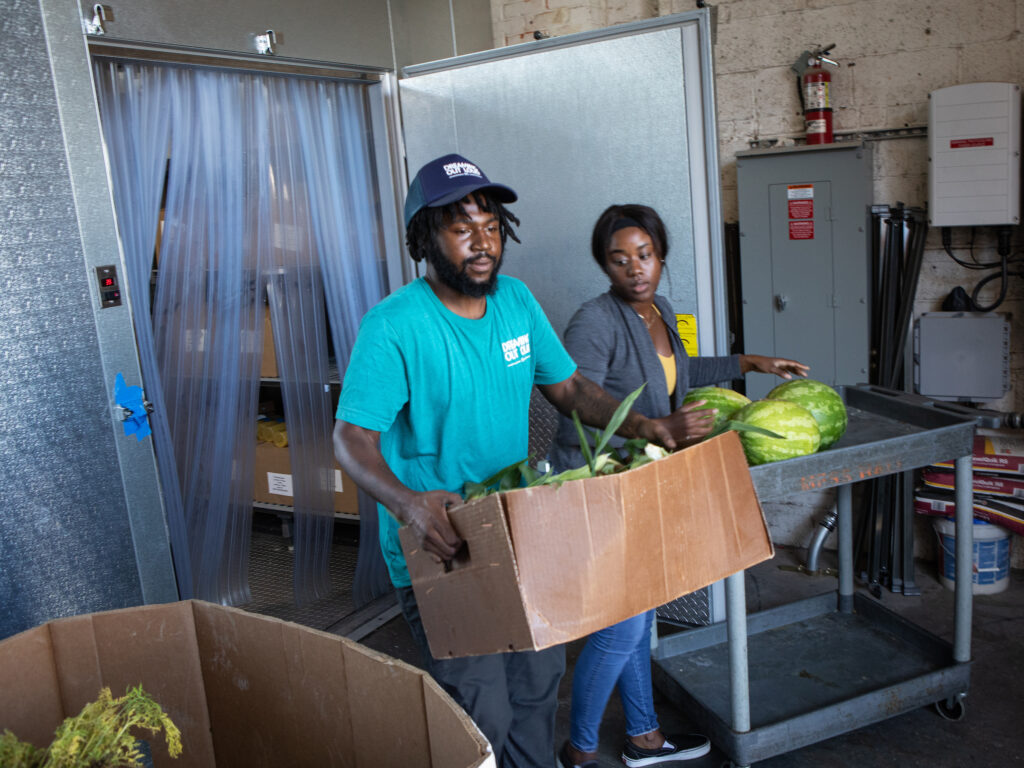
Stocking produce at ReFED grantee Dreaming Out Loud
It could be said that the United States has consistently struggled to manage its food system effectively and consistently. In 2021, as one marker, more than ten percent of Americans (13.5 million households) weren’t sure whether they’d have food on a given day. And yet, the U.S. tosses out about 35% of its food supply, or about 80 million tons, a number that Gunders describes as “ridiculous.” She considers other terms: “We talk about ‘surplus food’ a lot because it’s not waste until you waste it, right? What we really want is for there to be less surplus in the first place, and then for it not to go to waste.”
The good news about food waste is that, at least by Gunders’ standards, nobody wakes up committed to throwing food away. In a society where the bottom lines are treated as gospel, no business wants to buy food unnecessarily and have it not be consumed. Since its beginnings seven years ago, ReFED has been the sole national nonprofit dedicated to significantly reducing food waste, with aims to cut that 80 million ton in half by 2030. This won’t just save food, it could limit global warming and remake the food system into something far more inclusive and not inherently mired in systemic injustices.
To study food waste is to realize how it touches, and is touched by, every part of our lives.
From data to action
ReFED first formed in 2015, but its history really started with a foundational report that came a year later: the 2016 Roadmap to Reduce U.S. Food Waste by 20 Percent. It was part analysis, part action plan, and part acknowledgment of the severity of the issue. “It’s really about examining the food system to understand where waste is designed into it,” Gunders said. “And how do we find ways to design it out?”
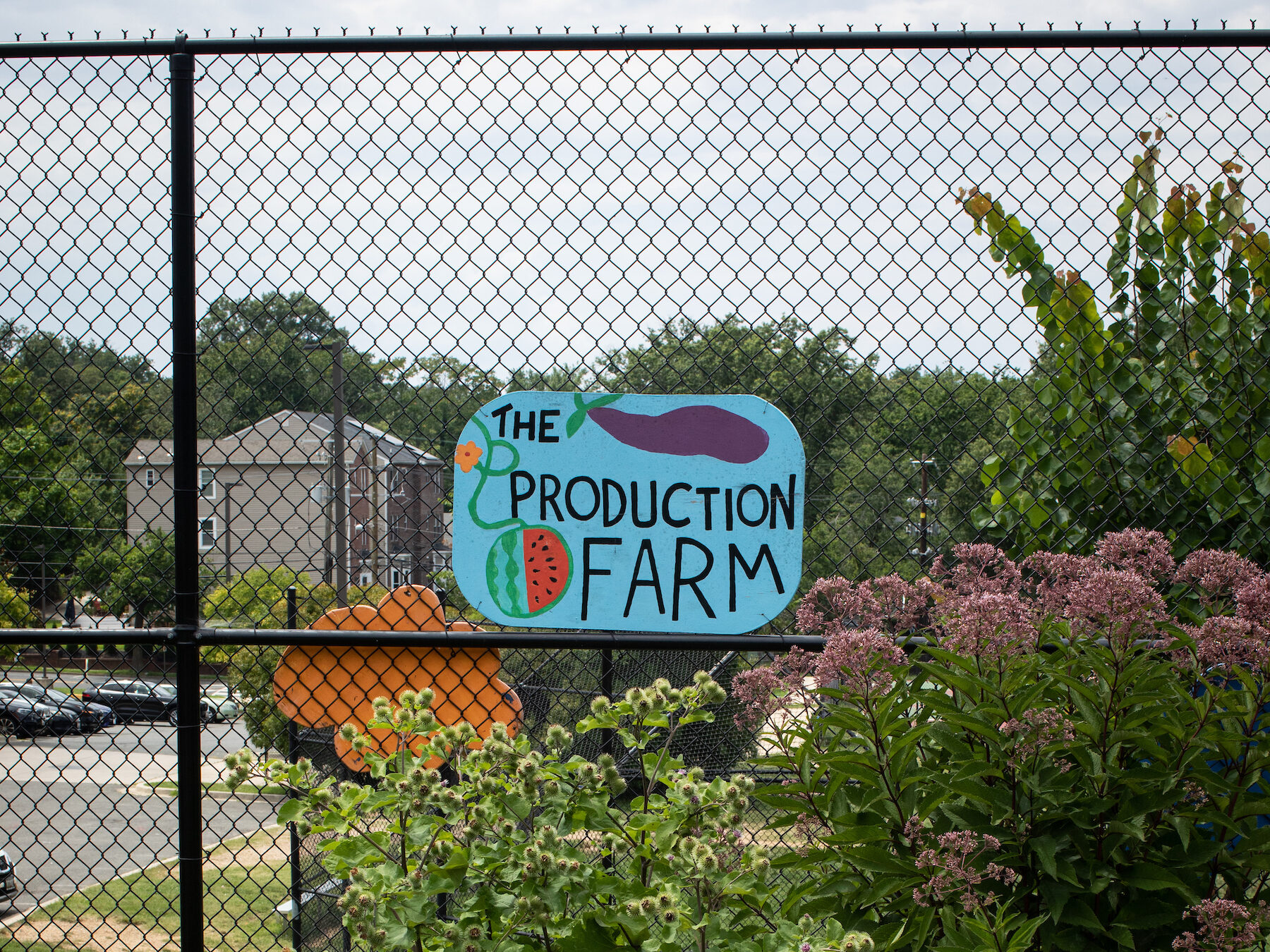
Dreaming Out Loud farm in Washington, D.C.
It also introduced one of the core creative tensions facing the organization: how to produce data, great data even, but always with an eye on making sure that data translates into action. “Lord knows we don’t want to sit around and create reports that sit on shelves and nobody uses,” says Gunders. “Our ultimate goal is to have people do stuff with that information.”
First things first. “You can’t manage what you can’t measure”, as Gunders puts it, so the organization compiled data sets and built an open-source data and insights engine. A robust toolkit that’s been used by government agencies, retailers, farmers, and many other stakeholders, the engine allows users to discover what actual documented issues currently exist, to research existing solutions and providers working on those issues now, and to calculate what impact those efforts may have.
One key action it’s meant to spur is donation. Impact investors, notably Jesse Fink, the founder of Priceline, were at the heart of the organization’s founding. Current funders include huge corporations and foundations like General Mills, Hellmann’s, Deloitte, and the Walmart Foundation. That insights engine? Sponsored by the Kroger Co. Zero Hunger | Zero Waste Foundation. This June’s announcement that ReFED would help launch the $100M Circular Food Solutions Funding Platform was the culmination of years of efforts to build structures around how they channel money.
“Anyone who’s interested in this topic, anyone who’s a funder, can participate in education and deal flow,” says Gunders. “And anytime an organization is looking for money, we put that on a list and send it out to all of these groups and it helps kind of grease the wheels of the whole system.”
Emily Broad Leib, Founding Director of the Harvard Law School Food Law and Policy Clinic, says ReFED is a critical platform for everyone interested in attacking this problem. “ReFED is really at the center of building that ecosystem, of maintaining that network, and keeping all the other stakeholders engaged,” she says. “They’re the group that’s field-building, the hub for all the spokes in this issue.”
Leib helps maintain the policy finder for ReFED, in part because the ReFED site is the most visible space in the food waste community, a digital watering hole for powerful groups who want to help and groups on the ground who are already helping.
So despite their relatively small size—just 20 employees—ReFED seems well positioned to effect change throughout the entire food system. Which would be nice, since, well, the system is so convoluted, so far from ideal. Take, for example, food waste and hunger. Right now, food banks, soup kitchens and churches rely heavily on food donations to feed those who are food insecure, a group that disproportionately comprises communities of color. So food waste… fights hunger?
“If I were going to design the food system from scratch,” says Gunders. “I would not design it so that the way we feed people who can’t feed themselves is to just over-buy and over-consume and then [donate the food] later in its life… what we really want is a food system that’s so efficient that we don’t have that surplus. And acknowledge that it is our social responsibility to have everyone in our country fed.”
She describes meeting a leader in food surplus issues in the Netherlands who was perplexed even at the idea of donating large amounts of uneaten food. There simply aren’t enough hungry mouths to feed in a country that prioritizes feeding the poor. So instead, they can focus sharply on reducing surplus without worrying about downstream impacts on hunger.
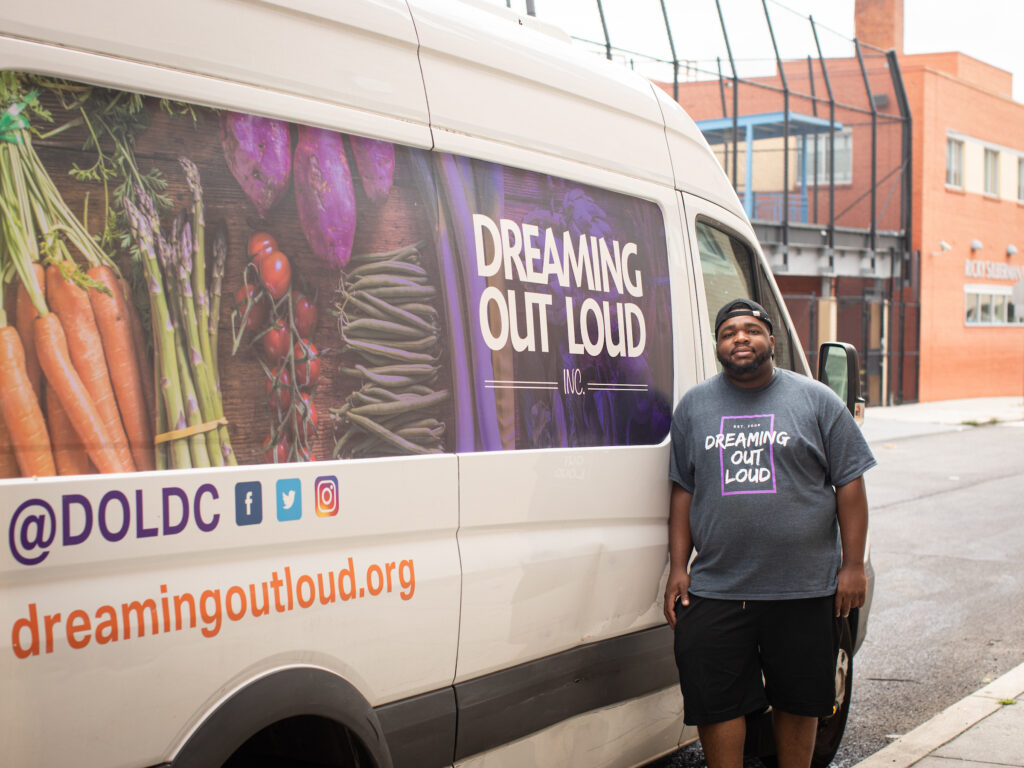
Dreaming Out Loud combats food apartheid through education, dignity and support to both farmers and consumers
But that is the Netherlands. In the United States, tackling food waste can involve a very delicate political and economic dance. Gunders recently testified in front of Congress and says that Michelle Obama’s 2012 school lunch guidelines came up, once again. The familiar talking point was that anyone who put more fresh vegetables in school lunches must not be against food waste, since children just throw the vegetables out. “It’s not okay to use waste as this argument against feeding people well,” says Gunders. “How about this: make the food taste better.”
For all the institutional and financial muscle of ReFED, though, one of their greatest assets is the understanding that big fixes in food waste sometimes start small. Yes, there are large-scale packaging solutions, and more private sector technology deployed against food waste than ever (food waste tech companies raised $1.9B in 2021, shattering old records). But according to Harvard’s Leib, small-scale, sometimes even personal, solutions are key.
“The actual process of addressing food waste happens at a local scale,” Leib says. “If we want to meet the 2030 goal of reducing food waste by 50%, we’re not going to get there unless we leverage what other people are doing on the ground. Some solutions are low-tech, and for those it’s about getting the message out. Otherwise, you’re just reinventing the wheel throughout the country.”
As Gunders puts it, ReFED is by design very “manual” on the solutions side. “We’re just reaching out as we hear about cool things that people are doing or cool companies or cool nonprofits that are doing something in this space,” she says. “Then we extrapolate from there: if scaled up, this could actually save, for example, 40 tons of food across the country and here’s how much it would cost to do it, and here’s how many greenhouse gases would be saved… it’s all a model we’re estimating, but we’re trying to paint some kind of picture to help people prioritize what they can do.”
Individual choice is also a confounding factor. Gunders says her favorite stat comes from a survey that found that 75% of Americans waste less food than the average American. That is, people always underestimate how much food they themselves waste. What they don’t realize is that small choices, such as putting out an overabundance of food at a house party, may make them feel good, may even be key to their self-identity as good hosts, but should be viewed also in light of food waste. Your individual desire to not leave any guest potentially hungry is closely related to desire that shoppers have to see supermarket shelves always full, even if that means guaranteed food waste or the resulting higher prices. Expectations and behavior alike need to readjusting, starting with each consumer.
Leib says that’s why the scaling up of all these smaller solutions is so key. “We’ve already seen a lot of preliminary successes coming from ReFED’s work,” she says. “But into the future, the change needs to be exponential.” In a world where food waste is responsible for 8-10% of global greenhouse gas emissions, she says, solutions both big and small need to be expanded as rapidly as possible.
A dream in DC
When the pandemic took root in the U.S. in early 2020, it exposed the vulnerabilities of the American food system—from indefinitely delayed supply chains to forced closures of business that serve or store food, which led to massive losses. ReFED saw an opportunity to create a rapid response fund to get money flowing to organizations already engaged with those communities most affected, ultimately delivering more than $3.5 million to 37 for-profit and nonprofit organizations. The effort helped to collectively keep more than 50 million pounds from being wasted during a critical period of the pandemic. In Washington, D.C, one such organization is Dreaming Out Loud (DOL), which was able to make 70,000 meals and deliver groceries to 1,300 recipients each week through November 2020 thanks to fund resources provided by ReFED.
Dreaming Out Loud’s Farm Manager Taylor Lewis
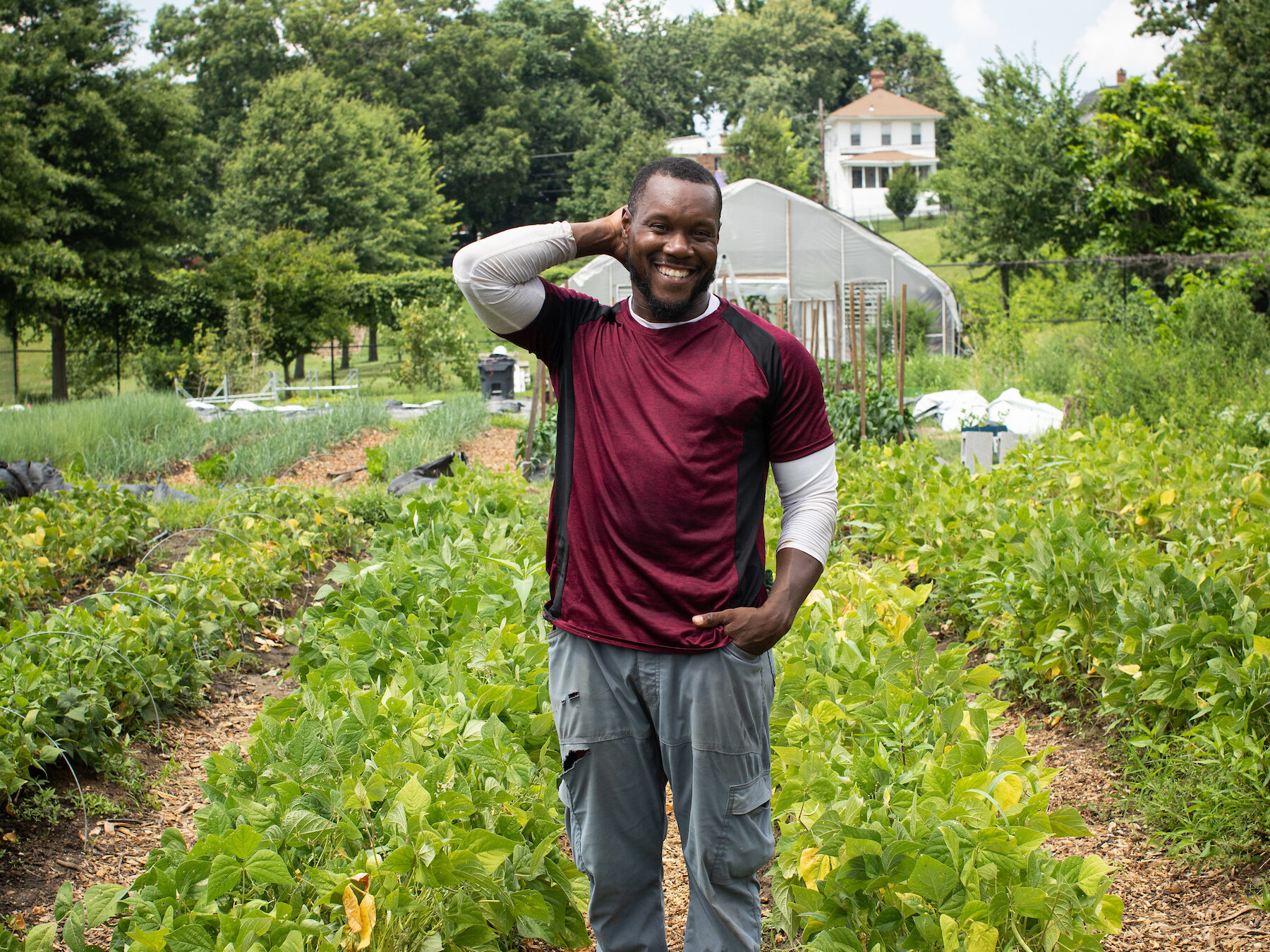
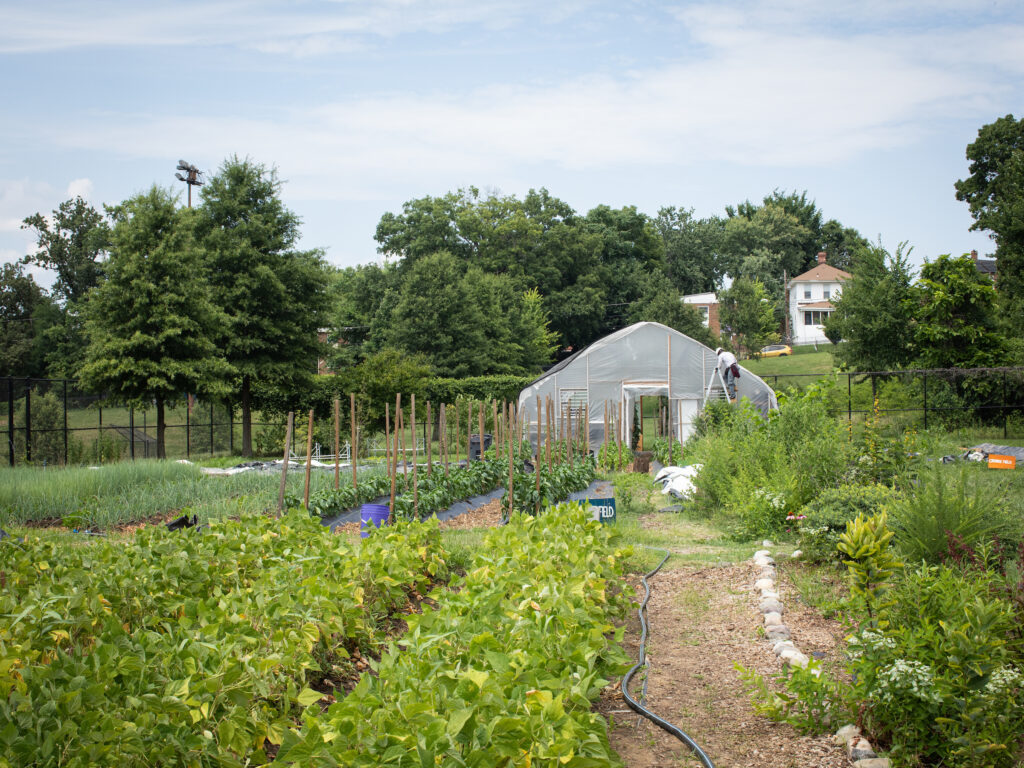
When Taylor Lewis began at DOL in February of this year, he was tasked with managing the Farm at Kelly Miller, a two-acre urban space atop a grassy hill, tucked behind a middle school in Washington D.C.’s Ward 7. His first mandate: to assess the site’s operations and workflows as the farm had become a beacon of community engagement since his employer launched it in 2018. Amid cordoned off row crops, in-progress digging, irrigation installation, a slew of raised beds, and a compost area, the farm produces fruits, veggies, and herbs to stock DOL’s aggregated farm-share, wholesale markets, and “U-Picks,” where community members of all ages harvest their own goods.
The Kelly Miller property would be Lewis’s first urban farming experience after five years tilling soil, two of them in a rural village in Ghana living with expat friends following a turn in the U.S. Navy. Suddenly Lewis found himself forced to live off the land in ways he hadn’t previously thought about. “For the first time I experienced what it meant to truly reap what you sow,” he said, seated underneath a shady tent one July morning. “You put a single seed in the ground, and it produces pounds of food. I felt fulfilled. I got into a more organic or natural rhythm of doing things and I realized this was something I might be doing for the rest of my life.”
DOL builds community-driven food systems through not only cooperatively supplying healthy foods targeted toward those who are most likely to be exposed to systemic harm, but by creating economically viable opportunities within the food system for those same residents. When Christopher Bradshaw founded the organization in 2008, it was with a clear eye on how food has been politicized in the D.C. Metro area, which is to say, the United States.
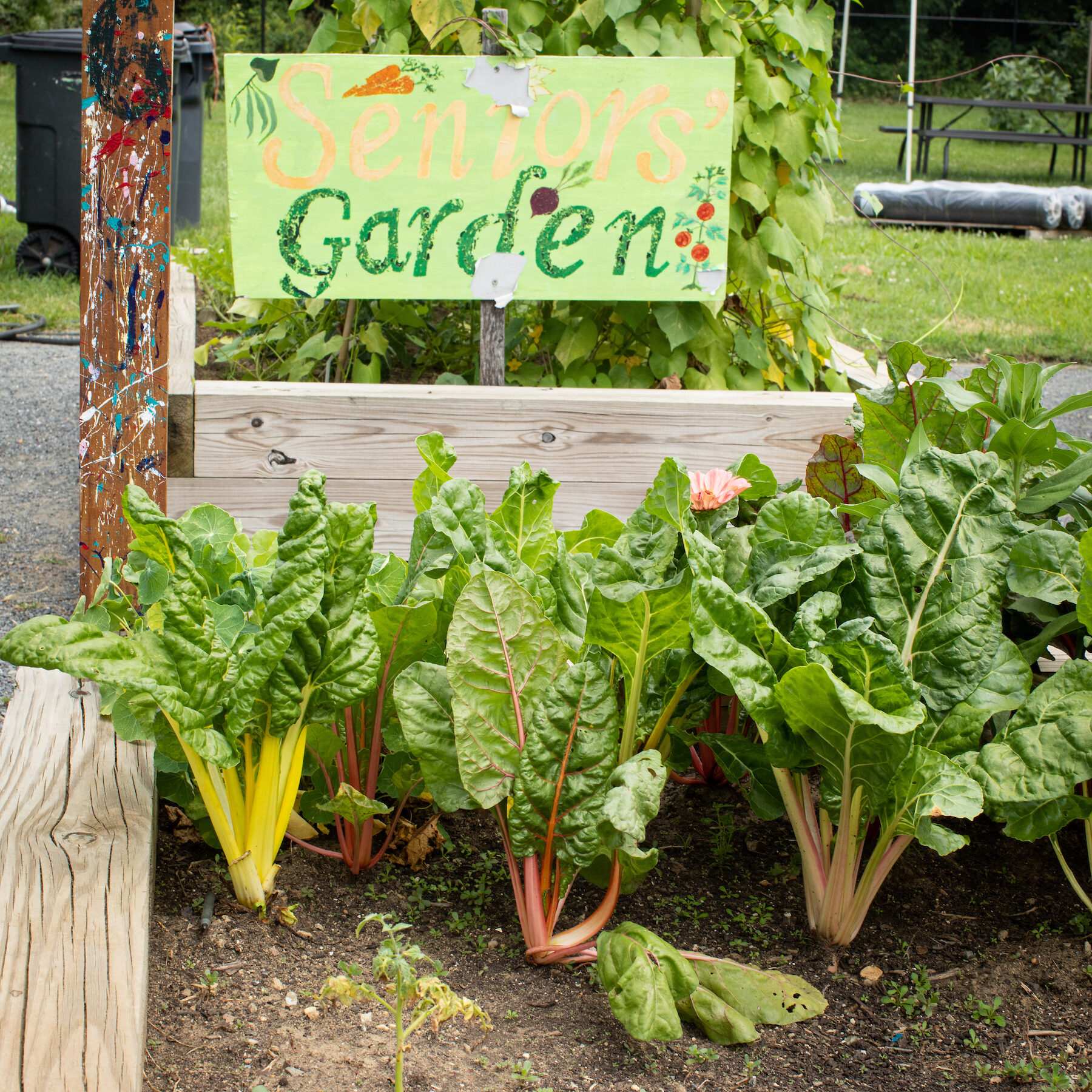
The Farm at Kelly Miller is a Dreaming Out Loud farm in Washington, D.C.’s Ward 7
To understand the mechanisms of how food as a business operates in the U.S. is to understand that this country has never embraced the responsibility of feeding its people—all of its people. From forcibly removing indigenous peoples off of ancestral land in their care, and owing to an agricultural legacy born out of slavery, food was not intended to ensure a country’s inhabitants receive nourishment or delight in pleasure. Rather, food became incentive to expand territories and acted as fuel to extract maximum results from a disposable labor pool robbed of their identities. The social caste hierarchy rooted in the eras of western expansion and enslavement is apparent in the weaponizing of food that brings us through the 21st century: the eradication of indigenous methods of tending to the land as the government pushed Native people to reservations; sharecropping where Black Americans were trapped in cycles of debt and access to food was restricted often to counter efforts to vote; the abuse of migrant farm laborers, many hailing from Central and South America, and the growing doom of food apartheid, the accurate term for what is often misnamed “food deserts,” where folks who are systemically blocked from living in certain areas find themselves miles away from grocers with healthy, appealing options.
DOL assessed the results of this brutal history and envisioned a path toward food security, including teaching urban agriculture skills to residents made vulnerable by these systemic issues. For that to happen, they would need to shepherd farmers, makers, and sellers into an integrated and transparent process that maximizes their effort and limits unnecessary losses. One way to do this is to aggregate produce from smaller farmers in the region to sell wholesale, distribute through the CSA, and retail at their markets. Or pre-purchasing from such farmers, which provides sustainability, lowers the farmer’s operating costs, and prevents them having to add labor to the retail side of their business. Without DOL, most of those farmers would not be able to produce enough food to make the investment worthwhile, or they would get stymied by frustrations like not having the cash to purchase cold storage to reserve and transport harvest waiting to be sold. Such was the case with a farmer in North Carolina whose story a DOL staffer related, who was harvesting his crops all day, leaving them to sit outside overnight, then driving 90 miles to market. Inevitably his routine was unsustainable, both due to the physical strain but also the loss of quality in his hard-earned harvest.
The Farm at Kelly Miller is a Dreaming Out Loud farm in Washington, D.C.’s Ward 7
DOL’s approach is to operate as a food hub that actually has skin in the game and knows the community they’re supporting. For example, they know that many of the heads of household who shop at the market at Kelly Miller are seniors, so they established a convenient drive-thru option. And recognizing that folks who pay with government assistance still want the sovereignty of picking and choosing which carrots or bell peppers go in their box ensures that all DOL staffers and volunteers are trained to know their produce and treat all customers with dignity and respect. It’s these types of efforts, from the herculean physical feats of moving thousands of pounds of food, to the mundane of setting up processes that flow smoothly, that reduce the risk of food waste across every farmer, company, organization, and household that touches DOL’s system. This is the kind of impact ReFED aims to have anywhere people have access to their solutions.
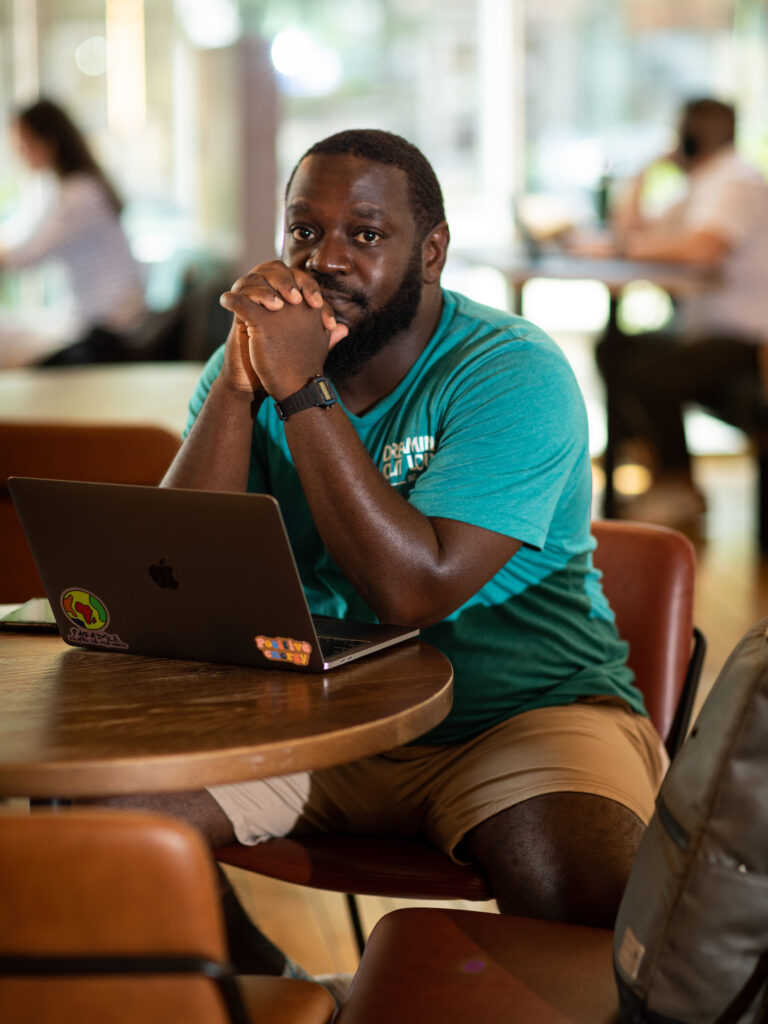
Christopher Bradshaw, Founder of ReFED Grantee Dreaming Out Loud
Food sovereignty, food security, environmental protection, racial justice, better health outcomes: so many things could be improved by what ReFED is trying to achieve.
Harvard’s Leib offers a blunter rationale for supporting ReFED’s mission against food waste. “It’s just a stupid problem,” she says. “Nobody is benefitting from this.”
Country: USA
Thousands of tons of avocados (and other fruits) rot before they have a chance to reach our plates. By creating an edible, protective second ‘peel,’ Apeel Sciences wants to get more and better produce to our tables.
PAUMA VALLEY, CALIFORNIA, USA
Balancing precariously on the 41st rung of a ladder propped on the bough of an avocado tree, an avocado picker extends a 12-foot (3.6 meter) pole and deftly strips the branches of their fruit. His right leg wrapped around two rungs, torso twisted 180 degrees, he works from branch to branch, filling the navy canvas pouch slung across his chest.
He nimbly descends the ladder, which wobbles in the breeze providing fresh relief on the scorching mountainside, tugs on the cord to collapse the ladder, and maneuvers it to the next branch. He repeats the process again, and again, day after day, zigzagging across San Diego’s North County until Cal Pacific Growers’ entire avocado crop is stripped.
This is the very beginning of the food production chain that provides 6.25 billion avocados to millions of Americans every year. After they’re picked, the avocados are sent to a packing warehouse, distributed to grocery stores, taken home in brown paper shopping bags, and, if they’re lucky, smashed onto toast.
But thousands of tons of avocados are left in the fruit bowl just one day too long, and never reach the plate. Apeel Sciences, a Goleta, California-based biotechnology company, has devised a way to extend avocados’ fleeting window of ripeness (and freshness) by creating an invisible coating—a kind of second peel that mimics the way plants naturally protect themselves—applied post-harvest to avocados and other produce. This step could make a dent in one of the most pressing problems of agriculture: food waste. For this initiative, they are shortlisted for the 2022 Food Planet Prize.
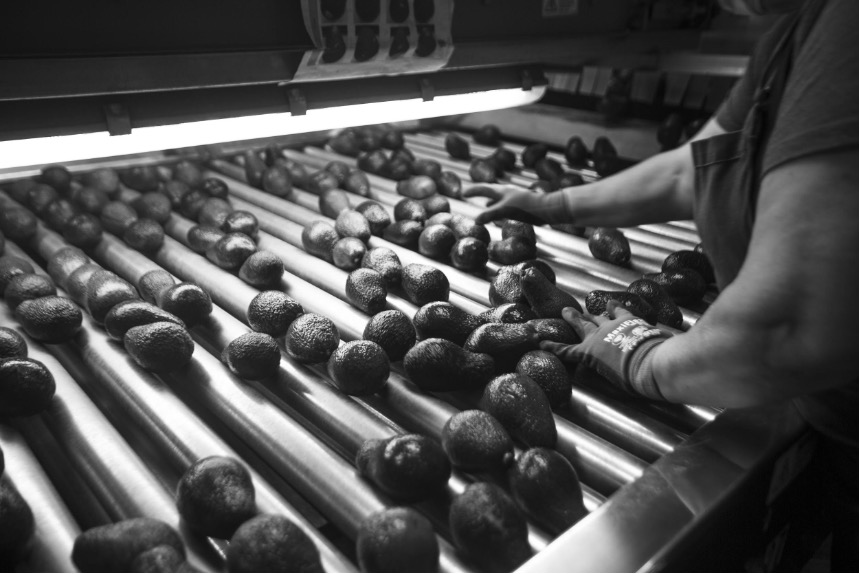
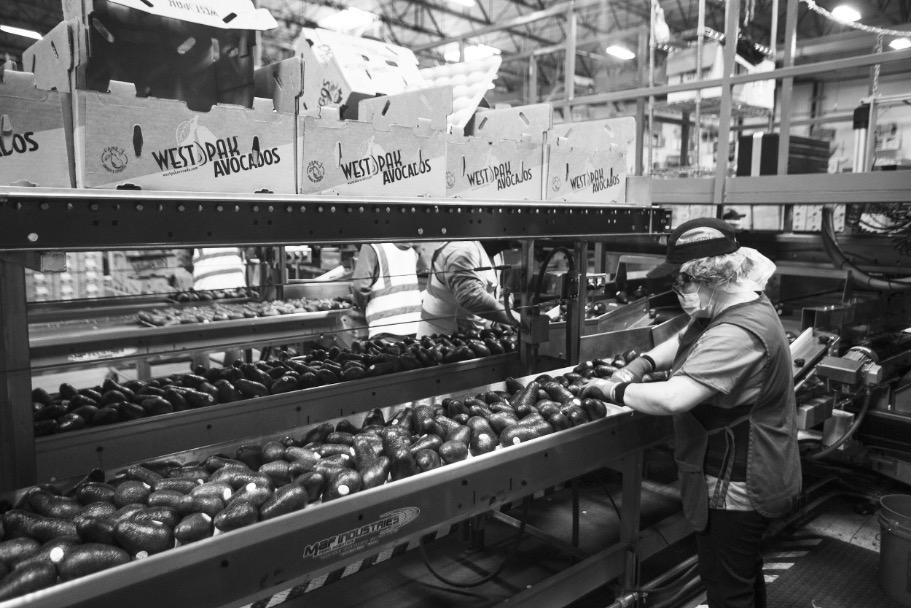
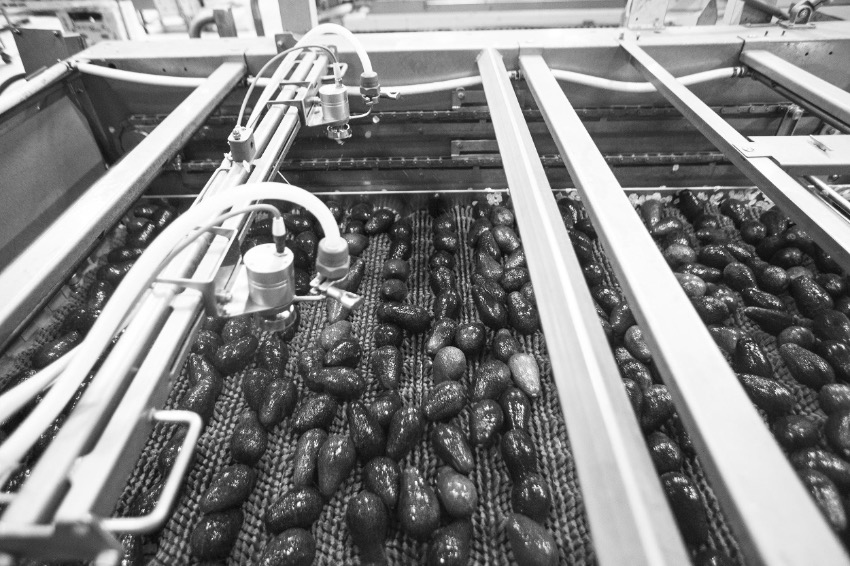
Avocados ready to be packed at West Pak Avocado, Inc, in Murrieta, California. West Pak is a family-owned avocado grower, packer, shipper, and distributor that works with over 1,000 avocado growers across California, Mexico, Chile, and Peru.
Each year, around 40% of all food in the US goes uneaten, equating to around $165 billion of food that could have been used to make more than 58 billion meals. According to ReFED—a US non-profit working to reduce food waste, and a fellow finalist for the 2022 Food Planet Prize—if just half of that food was recovered, every hungry person in the US could be fed three meals a day, every day.
Although some of this “surplus food” is recycled in various ways, the majority goes straight to landfill or incineration. ReFED estimates that 24% of all food—54 million tons—goes to these waste destinations. Food waste has a huge impact on the environment: producing food is an energy-intensive process, and food that ends up in landfills produces large amounts of methane, and households are the largest generator of food waste. For every 100 lbs of food waste in landfills, 8.3 pounds of methane is emitted into the atmosphere.
Food waste is one of the most preventable challenges of our time. The climate-focused nonprofit Project Drawdown recently affirmed that food waste reduction is a top solution for mitigating climate change. As a result, nonprofits, city councils, and tech start-ups across the US have been pioneering ways to save as much food from landfills as possible.
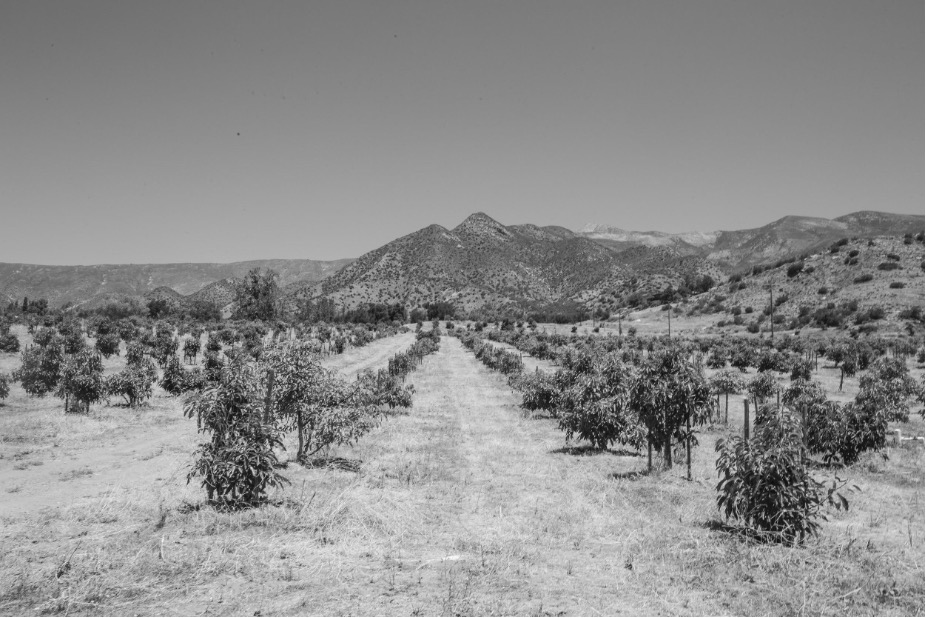
The Topa Topa avocado ranch in Ojai, California
Just over a decade ago, James Rogers, a graduate student at the University of California, Santa Barbara, was driving home through the region’s patchworked farmlands, listening to a podcast about global hunger. As his car curved through the winding roads that cut through lush green fields, he wondered in a world where food was so simple to grow, how could 820 million people be going hungry? And if so, many people were going hungry, where was all this food going?
Over the next few weeks, the question stuck with Rogers. Although his Ph.D. focused on solar power, he began to ponder whether food waste was a more pressing issue.
He began tinkering with fresh foods, studying crops that had a long shelf life, such as citrus fruits, and comparing them against those that didn’t, such as strawberries and cucumbers. “It simply doesn’t make sense that so many people are struggling with the compounded effects of climate and hunger when there is such an abundance of food available. This is a solvable problem,” he says.
Rogers’ background was in metallurgy—the study of the properties of metals. He took inspiration from metallurgists who discovered the chemical reaction to stop steel from rusting and wondered whether he could use a thin barrier to protect produce–in the same way a chemical barrier is used to protect the iron and carbon compounds that make up steel.
Rogers enlisted the help of college friends Lou Pérez and Jenny Du, two fellow UC Santa Barbara graduates, and the three of them got to work in his father’s garage, trying to create an edible coating that would keep water in and oxygen out of fruit and vegetables.
Rogers was convinced there was a way to use the peel of a lemon to sustain strawberries for longer, but he just wasn’t sure how. “I knew I didn’t want to synthesize something in a lab,” Rogers says. “I wanted to develop something that would work with nature, rather than against it.”
After much trial and error, which involved the team experimenting with various compositions made up of the lipids and glycerolipids from different fruit and vegetables, they finally found a formula that appeared to extend a strawberry’s shelf life for days. Their success prompted them to think of the bigger picture: “How would it ripple through the system? Instead of food going bad in days, it could now last weeks without refrigeration. That was big.”
The three friends applied for a $100,000 grant from the Bill & Melinda Gates Foundation, with “a philosophy, rather than a product,” to develop a food-based coating that could be sprayed onto fresh produce. Using the hypothesis that food could be used to preserve food they won the grant. In 2012, Apeel—now valued at more than $2 billion and with investors like Katy Perry and Oprah Winfrey on board—was launched. Rogers was 27.
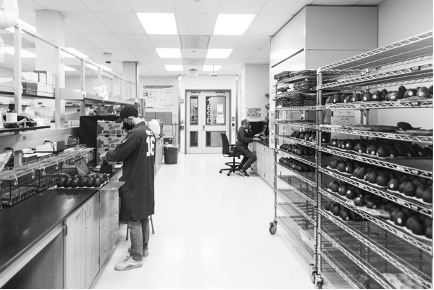
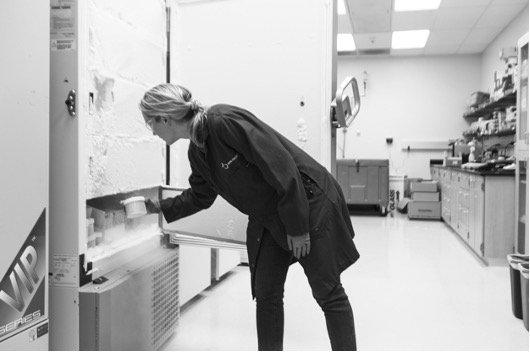
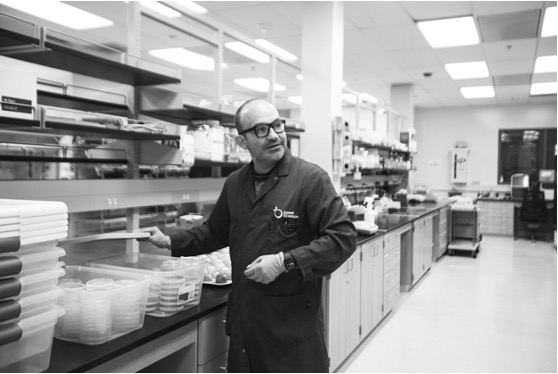
The Apeel Sciences laboratory in Goleta, California, where Apeel coatings are tested on a variety of fruits and vegetables. The coating is derived from discarded peels, pulps, seeds, and stems, which the company sources from numerous suppliers
Today, Apeel is based in a 110,000-square-foot laboratory in Goleta, just a stone’s throw from the garage where it all began. Since launching its first product commercially in the US market in 2019, Apeel now offers FDA-approved coatings for four fruits and vegetables in North America—avocados, organic apples, limes, and cucumbers—and five in Europe—avocados, lemons, grapefruit, mandarins, oranges, and mangoes. The Apeel product is carried by around 40 retail partners, including Kroger, the UK’s Tesco and Asda stores, and Europe’s Edeka, Rohlik, and Eroski stores.
Apeel’s coating is a powder which is then dissolved with water. It is derived from discarded peels, pulps, seeds, and stems, which the company sources from numerous suppliers, including winemakers for leftover grape skins and seeds or sauce-makers for tomato remnants–known as feed. This feed would not have been used for human consumption, and so is spared from the landfill.
The coating is edible, completely natural, and works by slowing the water loss and oxidation that contributes to produce deterioration—it is made up of the materials that plants naturally produce to protect themselves. Apeel pulls the desirable properties from plant material and creates a barrier specific to each piece of fruit or vegetable. “We are at this unique time in human history where we don’t need to make something new, but we can instead identify the building blocks that nature has been using and reusing,” Rogers says.
In addition to working with stores to introduce Apeel-protected produce, the company partners with suppliers across the US, South America, and Europe, where its trademarked coating can be sprayed onto produce at the beginning of the supply chain. With thousands of tons of avocados being grown and consumed in the US—among the most thrown-away produce in the US—seemed like a good place to start.
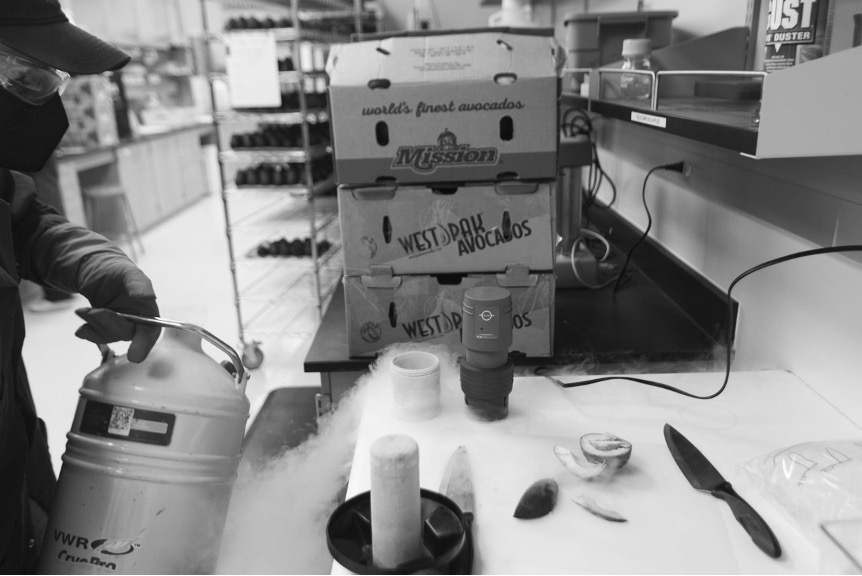
Spraying nitrogen on avocados at the Apeel Sciences lab. Avocados oxidize quickly, so freezing them this way preserves their properties, giving the scientists an opportunity to study their potentially valuable characteristics and compounds.
Savannah Braden stoops over a wrinkled, darkened avocado, caressing its callused skin. “What have you lived?” she asks the fruit, pondering its previous lifetime before its imminent end on a lab table. Braden, the associate director of technology at Apeel, is nicknamed the “avocado whisperer,” for her fascination with the fruit.
“If you really spend time with an avocado, you can learn about weather patterns, extreme events. It’s really kind of amazing.”
The brightly lit corridor of Apeel’s Goleta headquarters runs through the building like an artery, laboratories branching off left and right. Each room is a hive of activity, scientists milling around clutching clipboards and trays of strawberries, peering over slides of smashed avocado, and squinting at computer screens displaying intricate webs of compounds. They’re working on their latest project: whether they can devise a coating that would keep certain nutrients from leaching out of fresh produce.
Apeel develops specific coatings for each piece of produce. The company’s work has been so pioneering that they have had to develop many of their own measuring technologies, and in 2021 purchased a company that focuses on hyperspectral imaging, so they can see inside a piece of fruit to determine how fresh it is.
Savannah Braden, Apeel’s associate director of technology, at Apeel’s headquarters in Goleta, California.
Fruit and vegetables behave differently depending on where they are grown and when they are grown; there’s no one-size-fits-all. Each coating can take anywhere from six months to a year to develop for produce that behaves in a straightforward manner, or between three and five years for more complicated produce, for example, anything that’s fragile, like berries.
“We’re constantly seeking to figure out what else we are throwing away that we could potentially use,” explains Matt Kahlscheuer, a bioscientist who has worked for Apeel for the past seven years, heading up the research and development program. “For example, this fruit has great antifungal properties, how can we take that to protect a strawberry that goes moldy very quickly?”
Another branch off the arterial hallway leads to the impossibly bright photography room, where fruit is primped and prepped for photoshoots.
Each piece of fruit is lined on a white sheet of paper under tiny cameras which take hundreds of pictures as the fruit changes. “We can measure the shrink in produce over time, discoloration, and how the produce deteriorates. At the beginning of our work we knew Apeel was working but we couldn’t really measure how well it worked. If you just leave produce out on the counter and go back a few days later, you can tell it’s changed but you miss everything in between.”
This way, the team can watch in slow motion how produce degrades, day by day. “We wanted to know when rot onset, when colors started to change,” Braden adds. “And so by using this timelapse system we’ve been able to gather a lot of data and fill in the gaps.”
Matt Kahlscheuer, head of Apeel’s research and development program, is a bioscientist who has worked for Apeel for seven years.
The R&D team consists of 10 engineers and scientists, with a further 30 in the company’s development team. In one lab, a begoggled scientist deftly chops up avocados, then pours liquid nitrogen over the fruit, the cloud of water vapor billowing across the sterile countertop.
Avocados oxidize very quickly, and freezing them this way preserves their properties, meaning they behave like a pre-cut avocado, giving the scientists an opportunity to study their potentially valuable characteristics and compounds. In one corner lies a respiration chamber, monitoring the amount of carbon dioxide produced as fruit ripens.
“Because it’s not attached to a tree, it only has a certain amount of breaths left before it uses all of its carbon and it begins to decay,” says Braden. “Apeel dampens out that rate and basically extends how many breaths left it has before decaying. That’s a really important metric for us.”
Avocados are an especially interesting fruit for the team because of the way it ripens, and its protective skin.
“They’re the hardest to work with due to their biology,” says Kahlscheuer. “But there is so much to be learned from them that we don’t know yet. If we learn a lot about how avocados behave we can apply those learnings to other produce. From a technical perspective, avocados are the most interesting. But yeah, they’re difficult to work with.”
“Ripeness prediction is really difficult for avocados,” adds team member Juliet Nwagwu Ume-Ezeoe, explaining the team’s choice of focus. “Because they are so valuable, it is really a critical point for retailers.”
By the time an avocado is picked, shipped, and displayed at a store, it may only have a few days left until it spoils. Avocados treated with Apeel coating tend to achieve peak ripeness for four to six days, compared to the usual fleeting window of two to three days.
Workers at the West Pak Avocado, Inc facility in Murrieta, California sort and label avocados before packing them.
The only possible time to apply the coating is at the packing house, where produce is shipped once it is picked to be analyzed for quality control, then sorted, labeled, and packaged. Apeel had to convince packing houses that their product was instrumental in the supply chain—a difficult task, considering the agriculture industry that is notoriously slow to change.
“The food industry is so fragmented it is incredibly difficult to modernize,” Rogers adds. “When everyone is optimizing for themselves and not the efficiency of the system as a whole, we end up with massive amounts of waste and very little incentive for anyone to change.”
Last year, Apeel began working with West Pak, an avocado packer that works with over 1,000 growers across California, Mexico, Chile, and Peru. Its packing facility is in North County in San Diego, where Apeel is sprayed onto avocados as they journey through the packing process, arriving straight off the trees in large crates, rolling down conveyor belts to be measured, weighed, coated with Apeel—about as thick as 110th of a piece of paper—and stamped with the Apeel label.
In West Pak’s end-of-year sustainability impact metrics for 2021, the company estimated 1.8 million avocados had been saved from landfill in retail stores, conserving 130 million liters of water, and avoiding 660 megatons of carbon emissions, the equivalent of planting 110,000 trees.
Avocados being washed and packed at the West Pak warehouse in North County, San Diego.
Once Apeel had its product ready for market, they faced a new challenge: how to get it onto shelves? Rogers quickly found there wasn’t a market for longer-lasting produce, with most businesses informing him that fresh food going bad quickly meant their customers came back for more sooner.
As a result, the company has had to prove that longevity actually boosts sales. A pilot scheme launched in 3,000 German stores owned by the Edeka Group found that selling Apeel avocados in store resulted in a 50% waste reduction, as well as a 20% rise in sales, according to statistics from Apeel and Edeka. Shortly after the scheme, Edeka signed on to carry Apeel avocados, oranges, and clementines across all of its stores. According to Apeel’s latest research, its produce is already having a significant impact on the climate, with a 10-25% lower environmental impact than non-Apeel produce. Its EU avocados, for example, withdraw 15.3% less water and use 12.4% less fossil resources than an ordinary avocado.
In 2020, Apeel announced Walmart would begin selling its Apeel-coated English cucumbers—a huge win for the company.
In spite of their business success, Apeel still had one last hurdle: convincing customers to buy a piece of fruit sprayed with a new, unfamiliar substance.
Education remains key to reaching shoppers, and is one of the focal points for Apeel moving forward. The company is investing in social media outreach, targeted marketing campaigns and in-store educational displays. Only time will tell if this will be enough to shift consumer awareness.
It’s nearly impossible to collect data on what food households throw away, but supermarkets do keep count, and Apeel has partnered with numerous stores across the US and Europe to collect data on food waste. They then use the data to determine which product to work on next—the team is currently developing coatings for berries, asparagus, and cherries.
“Our coating doesn’t yet address mold, and so we are developing methods of protecting produce from fungi,” says Kahlscheuer. He adds that the company is also trying to understand how Apeel’s coating impacts the nutrition of produce, and how it could be developed to preserve nutrition after a fruit or vegetable has been harvested. Research has found vegetables can lose up to 77% of their vitamin C within a week of harvest, while spinach can lose up to 90% within just 24 hours. The warmer the temperature, the faster the degradation. Scientists also believe that B vitamins similarly degrade.
Avocados on their way to be packed at the West Pak facility in Murrietta, California.
There has been little development in the space Apeel is working in, although numerous tech start-ups have launched to measure and prevent food waste. Leanpath works in commercial kitchens by scanning food that’s thrown into the trash. Spoiler Alert works at the buyer and supplier level, using software to help manage and move inventory to save food from spoiling, which is particularly useful when unexpected surpluses happen.
The challenges of persuading key stakeholders to come on board with Apeel may already be taking its toll. An undisclosed number of employees were laid off in July and the company announced it would be scaling back operations after years of continued growth.
If there really is to be a significant difference made, Gunders adds, manufacturers will need to implement these technologies upstream before reaching stores in order to slow down the spoilage process sooner.
“[There’s] no incentive to worry about what happens after you’ve passed food on to the next link in the chain,” Rogers says of the flaws in the current food chain. “The food system is like a game of hot potato, but unfortunately the music always stops after the potato is thrown to the consumer. Some producers and retailers even think this is good for business.”
And, if Apeel’s scientists can figure out how to preserve nutritional value of fruit and vegetables, their product may be able to tackle far more than just food waste, such as retaining nutrition in fruit and vegetables, which could prove life-saving in countries affected by famine. The longer an avocado develops on a tree, for example, the higher its oil content. This could make a huge difference in regions where malnourishment is endemic, and to the 14 million children under five who suffer from acute malnutrition.
The technology could drastically change the way people consume fresh food. “And that’s the key point,” Kahlscheuer adds. “Changing an industry that has been set in stone for so long.”
“We could unlock so much potential. In today’s world, food that goes to waste is just as valuable as food that is sold—and that’s a behavior we need to change.”
Country: USA
Challenge: Eating in harmony with the world underwater
Against the backdrop of climate change and overall environmental degradation, oceans are often categorized as victims of warming, acidification, pollution, and vanishing species. They also instill fear as rising sea levels threaten food security and livelihoods. Economic inequalities facing coastal communities are another cause for concern. Regenerative ocean polyculture offers a powerful solution to these issues.
Until recently, researchers and investors alike paid little attention to the ocean’s own formidable potential to address these challenges. But as aquaculture becomes the fastest-growing food sector, the industry is under increasing scrutiny. And rightly so! Today’s conventional ocean fish cultivation, much like land-based agriculture, has many ecological drawbacks. One of them is the accumulation of excess nitrogen and phosphorus from feeds and fertilizers, causing dead zones in the oceans.
“Regenerative ocean farming is one of the most nutritionally, socially and environmentally sustainable food productions on the planet.”
Coincidentally, seaweed and shellfish have the distinguishing feature to feed on some of the excess nutrients to fuel their growth. They also capture part of the 25% atmospheric carbon oceans absorb every year. On top of buffering ocean eutrophication and acidification, growing sea greens and bivalves together in a polyculture system contributes to healthier marine environments. It provides diverse species with forage, refuge, and spawning habitats. This safe haven results in a 40% to 360% greater abundance of fish and invertebrates and up to 30% more biodiversity.
This regenerative mariculture can also bring about systemic social change. According to a World Bank study, farming seaweed in just 0.1% of the world’s oceans – about 40 million hectares – could create 50 million jobs. That coastal and indigenous communities have long cultivated mollusks and harvested wild seaweed is a tremendous opportunity to create an equitable blue economy driven by those most affected by changing climate and declining capture fisheries.
Nutrition-wise, despite low-calorie counts, seaweed and bivalves are incredible sources of the much sought-after protein and omega-3 fatty acids. The foodstuffs are also rich in potassium, iron, zinc, iodine, and multiple vitamins. All in all, regenerative ocean farming is one of the most nutritionally, socially, and environmentally sustainable food production on the planet.
Country: USA
Challenge: Providing fast-growing, sustainable proteins to an ever-growing world population
Throughout our existence, humanity has depended exclusively on the biological process of photosynthesis to take carbon dioxide (CO2) out of the atmosphere and convert it into nutrients that feed us either directly in the form of grains, fruit, or vegetables, or indirectly, as meat or dairy. But our complete reliance on photosynthesis to transform CO2 into food has left us vulnerable to biophysical and geographical limitations.
Crops require soil, water, and a specific set of favorable climatic conditions to grow. And Livestock uses even more resources than crops. Altogether, agriculture occupies 30% of the land on Earth.
Country: USA
Challenge: Reversing desertification and conserving arable land
Grasslands encompass roughly one-third of Earth’s land surface and 70% of global agricultural areas. They provide food for humans, habitat for countless species, and livelihoods for more than 1 billion pastoralists. However, overgrazing, deforestation, and global warming are turning grasslands into deserts at an alarming rate.
Nominate yourself or someone else, it takes three minutes and could change the world!