Traditional pesticides and insecticides are crucial for global agri culture but have huge drawbacks. Can insect sex pheromones be part of the solution?
COPENHAGEN, Denmark
On an ordinary workday in 2013, Irina Borodina, a professor of biotechnology specialized in yeast cells, was sitting in her office at dtu Biosustain, a research center focused on sustainability and biotechnology, in the northern suburbs of Copenhagen. When her colleague Scott Harrison, the head of the center’s analytical department, barged through the door and started drawing something on the whiteboard, there was no indication this day would result in the launch of BioPhero, a company pioneering the production of pheromones for pest management. Harrison had drawn a molecule, though it looked more like the number eight.
“Irina, can we make this?” he asked her.
“Sure, we can do anything with our technology. It’sonly a question of time and money,” Borodina said. “But what is it?”
“It’san insect sex pheromone.”
Harrison wasn’t the type to barge into offices, draw on his colleagues’ whiteboards, or talk to them about insect sex. But this was a big deal: this pheromone could potentially revolutionize global agriculture. If the molecule could be reproduced with fermented yeast cells—Borodina’s specialty—it could be a breakthrough for environmentally friendly insect control. Borodina was in. A week later, they flew to Athens to discuss the idea with a Greek colleague, Dimitris Raptopoulos, who’d been researching these sex pheromones for years.
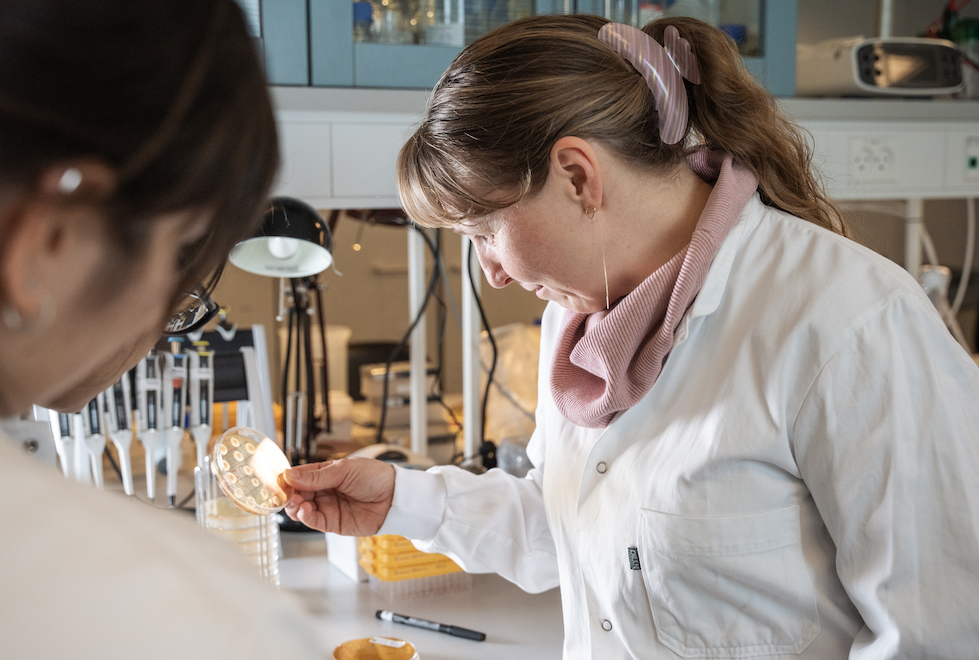
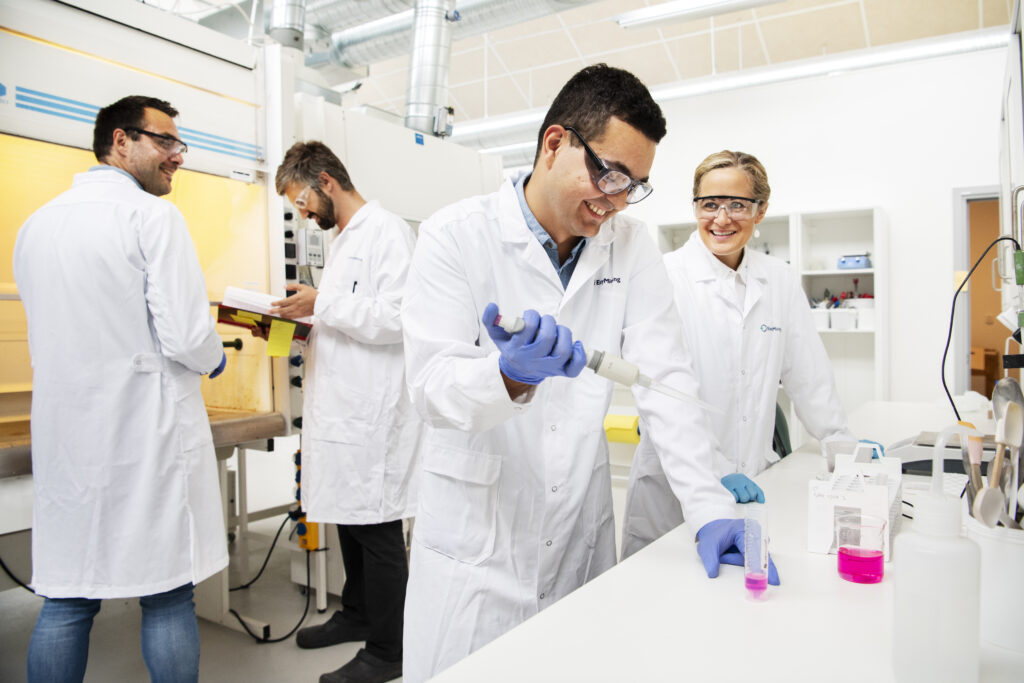
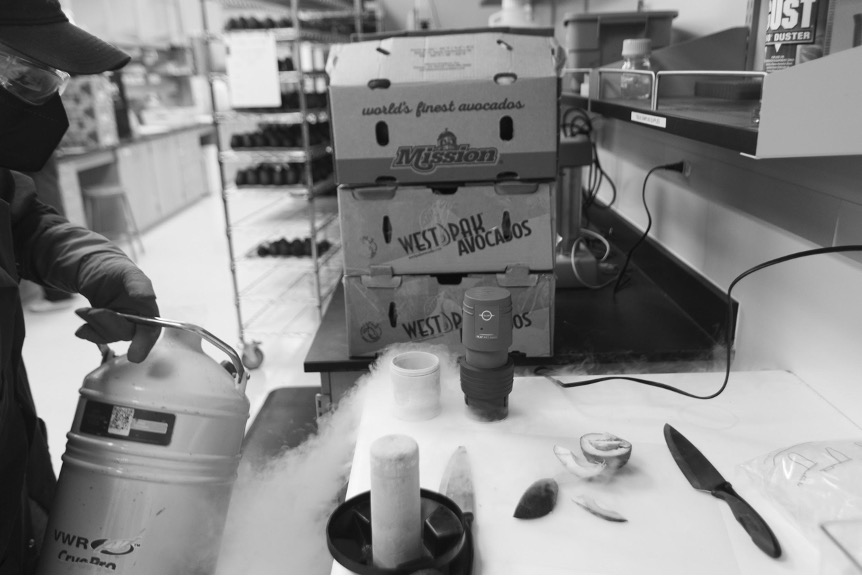
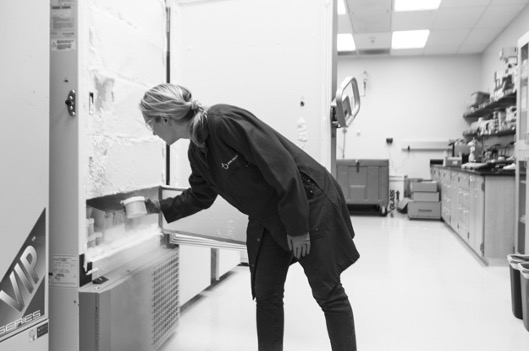
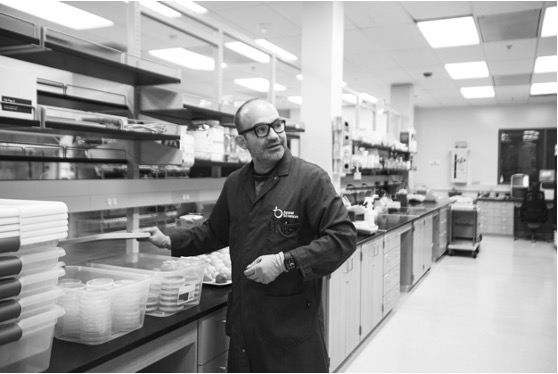
Professor Irina Borodina looks at yeast trial results in the strain development lab.
From greenhouses to open crops
The idea that would lead to the founding of BioPhero was simple, and it wasn’t new. When female insects are ready to mate, they naturally secret pheromones, chemicals that insects and other animals use to communicate with each other, to attract the male insects. If farmers could somehow secrete the same mating fragrances in their crops, they’d be able to confuse the male insects so much that they wouldn’t find the females. The reproduction wouldn’t happen and the insects would have been biologically controlled, rather than with the usual chemical pesticides.
Some organic fruit farmers already employed the mating disruption technique. They used small amounts of chemically produced pheromones in orchards and greenhouses, either by using dispensers or puffers, or by using water traps. By releasing exactly the same pheromones in the air, the farmers would be able to disrupt the communication between the calling females and the males.
Mating disruption worked well, but the high cost of chemically synthesized pheromones prohibits the applications on large areas of row crops. Therefore it had mainly been used to control pests in fruits and nuts and to control the gypsy moth in forestry. Because of the prohibitive price of chemically produced pheromones, it wasn’t financially sensible to saturate the air on open crops or greenhouses, even for farmers that charged a premium for their products.
“If we could produce pheromones by fermentation instead of chemical synthesis, we’dbe able to lower the cost so much that pheromones could be used on a much larger scale, also in row crops. The potential was huge,” Borodina says.
At her laboratory in Copenhagen, Borodina got to work with her team. Her initial job was to reproduce the active ingredients, the pheromones, which would then need to be formulated for use in the fields. With the help of several grants, colleagues, and collaborations with other experts, the company BioPhero started operations in 2018, five years after she had first heard about the sex lives of insects.
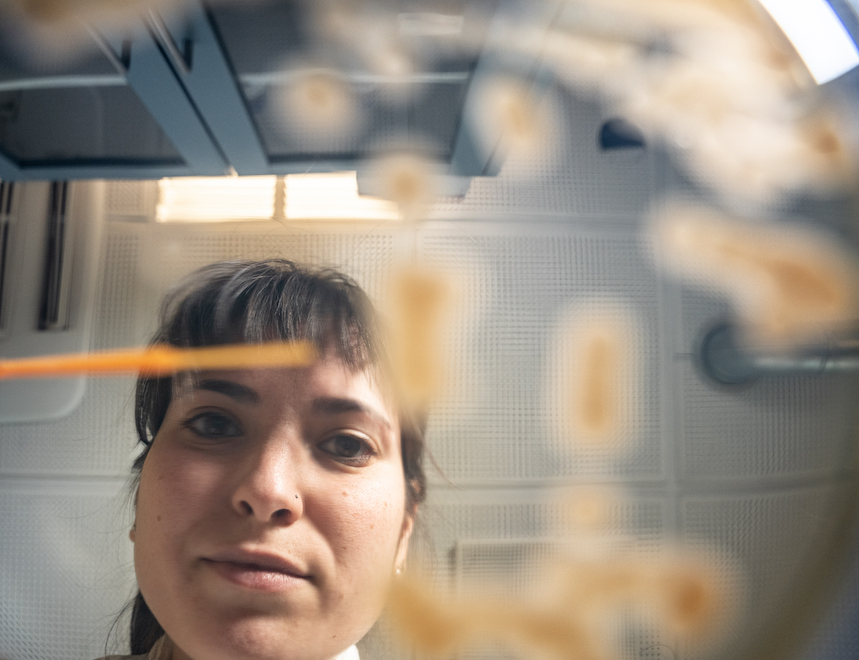
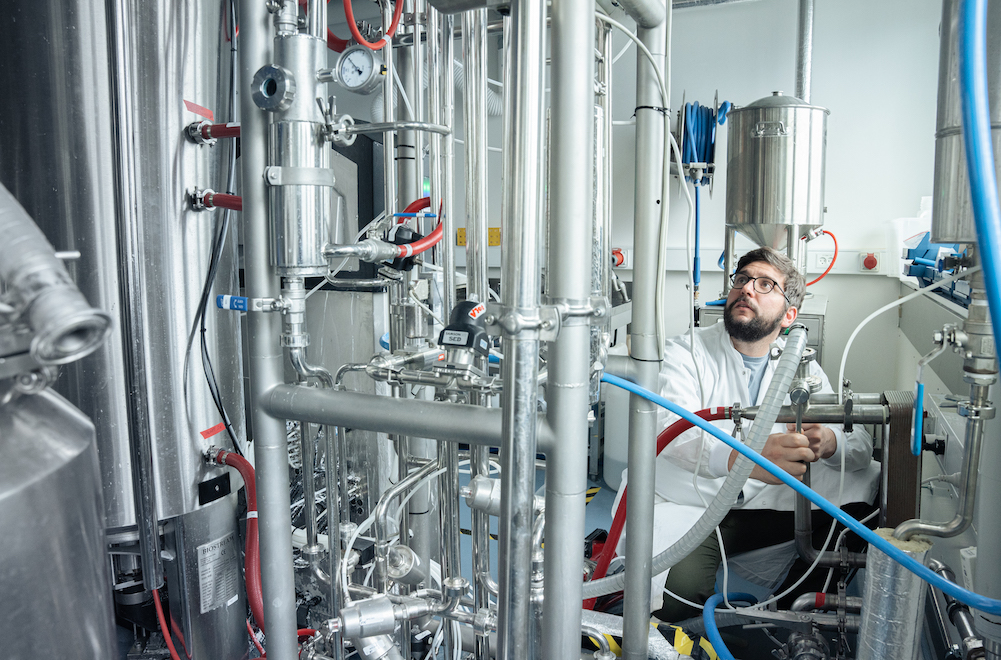
Strain Engineer Arian Belmonte Del Ama checking the result of a yeast strain experiment in the strain development lab.Fermentation Assistant Ede Balázs Mán adjusts the large bioreactor used to scale up the fermentation process ahead of commercial production of pheromones.
A global human rights concern
It’s hard to estimate how dependent global agriculture is on pesticides and insecticides, and whether or not the world needs pesticides to feed its quickly growing population is a hotly debated topic. While agriculture groups argue that more than half the world’s crops would be lost due to insects, diseases and weeds would be lost without crop protection, sustainability experts and NGO’s argue that the chemical crop control could easily be swapped for greener ways of farming. All sides agree on the need for some form of pest management.
“According to some studies, there’dbe up to a 40% production loss if farmers weren’table to protect their crops against plant diseases and insect plants,” says Joachim Offenburg, a senior researcher on biological pest control at the University of Southern Denmark.
But the widespread use of chemicals in agriculture is highly problematic. According to estimates, 4 million tons of agricultural pesticides are spread each year, a number that has grown by 80% between 1990 and 2017.
United Nations experts have called the excessive use of pesticides “a global human rights concern.” In a 2017 report presented to the Human Rights Council, two United Nations experts provided research that showed that an estimated 200.000 deaths each year—99% of them occurring in developing countries—are linked to acute poisoning caused by pesticides. They also pointed to research documenting how chronic exposure to pesticides can be linked to cancer and other diseases, hormone disruption and developmental disorders. Furthermore the UN experts warned that the excessive use of pesticides has contaminated soil and water sources, which threatens animals, biodiversity and the overall ecosystem.
Similar concerns have caused many countries to regulate the use of pesticides. The outdoor use of many chemical pesticides, especially insecticides such as neonicotinoids which pose a high risk to bees, were banned in the EU in 2018, a ban that was expanded in 2023. But EU countries are still issuing emergency authorisation for their use in exceptional cases, and the insecticides are still being used in many developing countries that have weaker regulations.
The regulatory issues are just one challenge that farmers dependent on pesticides are facing. Insects are increasingly developing pesticide resistance, and there’s a growing awareness of pesticide residue in food, which has caused resistance to the use of pesticides among many consumers.
“The certifications are being phased out more quickly than new pesticides are being approved, there are fewer and fewer pesticides available on the market for farmers, and the insects are developing resistance to the insecticides,” explains Offenburg. “That’s created a growing demand for alternatives, and especially for biological solutions.”
In addition to facing the same challenges as traditional insecticides, such as insect resistance, biological insecticides must grapple with their own issues. One of the biggest issues is that they often need to be deployed in tandem with other chemical or biological solutions, as they aren’t always as efficacious as conventional chemical pesticides.
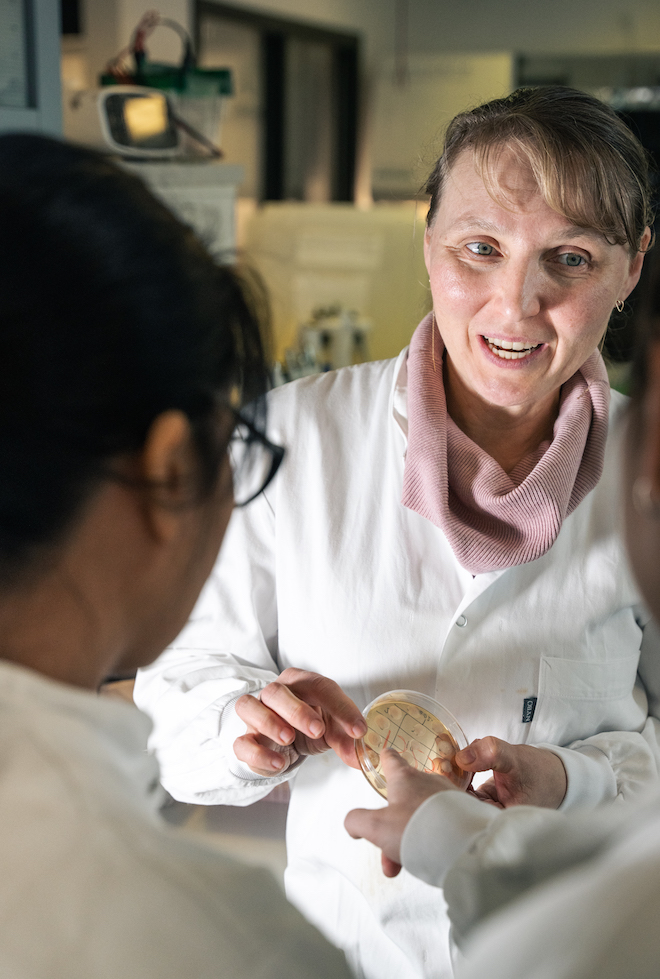
Irina Borodina speaks with colleagues at the lab..
The demand for eco-friendly pest contol
In 2022 BioPhero was acquired by the agricultural chemistry company FMC Corporation for around $200 million. That one of the world’s largest pesticide manufacturers has invested in a company focused on biological solutions shows a wide belief in the importance of sustainability. It’s not just new policy, it’s also changing customer demand.
At the time of the acquisition, BioPhero was working towards launching four products, aimed at cotton bollworms, diamondback moths, rice stem borers and fall armyworms, which are used in row crops like corn, soybean, cotton and rice. Borodina chose to focus on these products because they address important pests in large crops, where there’s a big need for sustainable control methods. The scientists are now working on producing other pheromones, targeting key European row crop pests, among others.
The products are currently being tested for field use on all continents and in the different target crops. The main markets will be the row crop markets worldwide, with an initial main focus in Asia and Brazil. BioPhero’s products are already being used by farmers, either through trial permits for testing products, or through emergency permits issued when pests suddenly became resistant to chemical solutions.
So far, the results have been positive. One trial study in rice fields in Bangladesh, conducted by the company Russel IPM which had formulated pheromones produced by BioPhero, found that the insecticides could be completely replaced with pheromones and microbials. Furthermore, the insecticide-free protection gave a 40% higher rice yield than traditional insecticides. Borodina was almost as stunned at the results as the farmers, whose livelihoods and environment can be deeply impacted by the outcome. “That is a huge difference for these farmers, especially because their profit margin is often less than 20%. If they then get 40% extra, that is basically just pure profit. It is great for them,” says Borodina. “I hope we will see the products being used in their final, approved form this year. We want to see impact, and we want to see change.”
A team of chefs and scientists in southern Spain are trying to cultivate an edible sea grain for the first time. Can Aponiente’s “sea pantry” fight global food insecurity and be used for conservation purposes?
EL PUERTO DE SANTA MARIA, Spain
Tucked away in Spain’s southwest corner, the seaside town of El Puerto de Santa Maria is best known for its past. Once considered “the city of a hundred palaces,” what remains are crumbling facades and the dubious distinction of having one of the country’s highest unemployment rates. It’s an unlikely place to find a three-Michelin-starred restaurant at the forefront of marine grain cultivation, but Chef Ángel León has never been one to conform.
It’s early March, and León is preparing to reopen Aponiente (“facing West”) for the season with characteristic energy. With its focus on experimental fine dining, Aponiente has been a beacon for fine dining fanatics since it first opened in 2007. This season, as in all others, the diners will come from around the globe, eager to try avant-garde dishes made from discarded fish parts, macroalgae, plankton or marine vegetables. In preparation, forty-two cooks are chopping and sauteing while a team of cleaners carefully wipe the glass doors and windows that look out on the marsh.
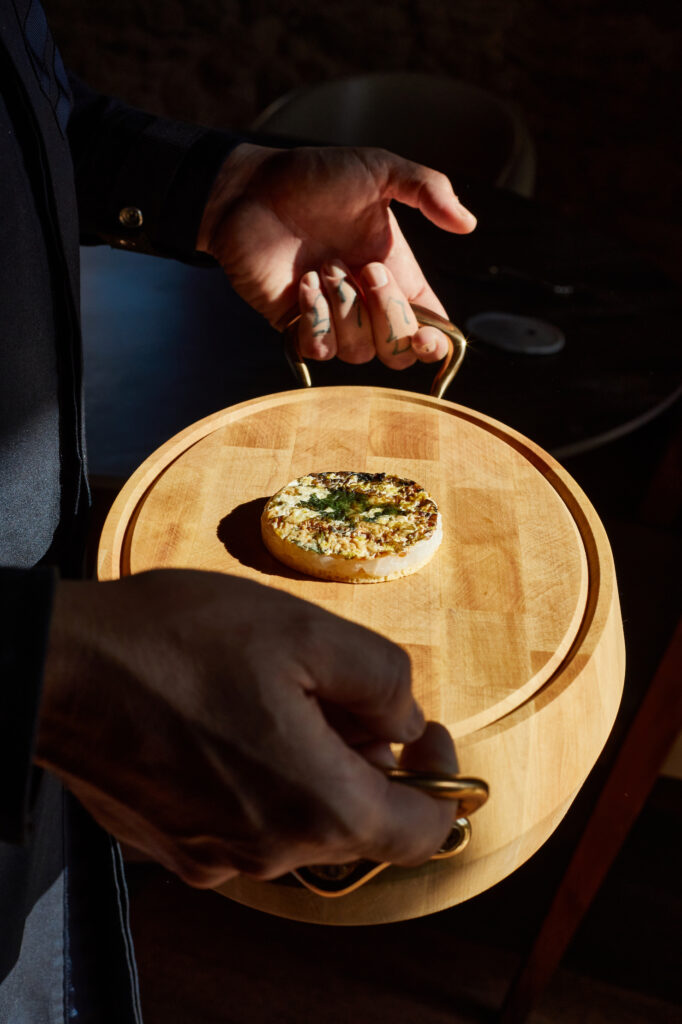
Staff add the finishing touches to squid and razor clams dishes from Aponiente’s menu: muergos a la marinera and queso de calamar.
Among the crew at Aponiente, two stick out: Juan Martín and Sofía Rivaes. They aren’t chefs or sommeliers; Martín is an environmental scientist and Rivaes is a biologist. They are part of a small team helmed by León that has embarked on an ambitious project to domesticate an aquatic plant called Zostera marina. They are animated by the belief that if properly cultivated in estuaries, Zostera could help alleviate the global food crisis, improving the outlook for a world in which an estimated 345.2 million people currently suffer from food insecurity. Zostera would be a new grain that can be cooked similarly to rice, but with higher protein and fiber levels, and grown with a much lower climate footprint with no need for irrigation. To León—and others who support his project—it is a source of hope.
“There is a whole marine pantry to be explored,” says León. While there’s been much focus on turning to insects to feed a growing population on a planet with dwindling resources, few have looked to our waters for solutions. Seafood represents 17% of the current production of edible meat, according to the Food and Agricultural Organization (FAO). But with land under rising pressure from desertification and the need to restore ecosystems to fight climate change, there isn’t much more sustainable space left for additional food production. The aquaculture sector, which the FAO says overtook industrial fishing as the world’s primary source of water-based food about a decade ago, is an intriguing solution.
An ancient solution for the future
Growing up by the sea, León always thought he would become a fisherman. Instead, he studied culinary arts in Seville and had a remarkable career in gastronomy, becoming one of the most acclaimed chefs in Spain. He had always been drawn to maritime ingredients, but it wasn’t until 2018 that he first heard about Zostera’s edible grain and ancient past. In pre-colonial times, the Seri indigenous people in Mexico collected Zostera— also known as sea wheat—in the Sonoran desert. They never farmed it; they harvested it from naturally-growing ecosystems.
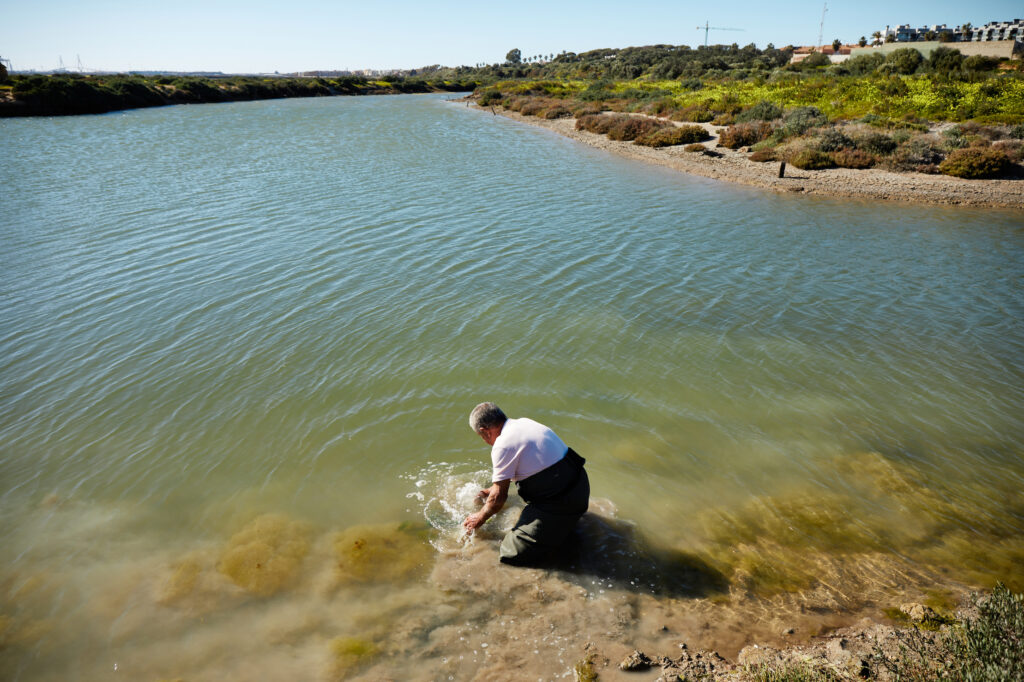
A fisherman gathers oysters for a dish at Aponiente.
León could immediately foresee the culinary advantages this neutral-flavored sea cereal could offer. Then there was its nutritional value: A low-fat, protein-rich source of calories, Zostera’s grain contains 17 times more fiber than rice and twice as much fiber as lentils, wheat and millet.
Unlike rice, which humans have cultivated for millennia, Aponiente’s initiative “is the first time someone is trying to grow Zostera in captivity to obtain its grain,” says marine ecologist Carlos Duarte, a distinguished professor at King Abdullah University of Science and Technology, and an expert on the species.
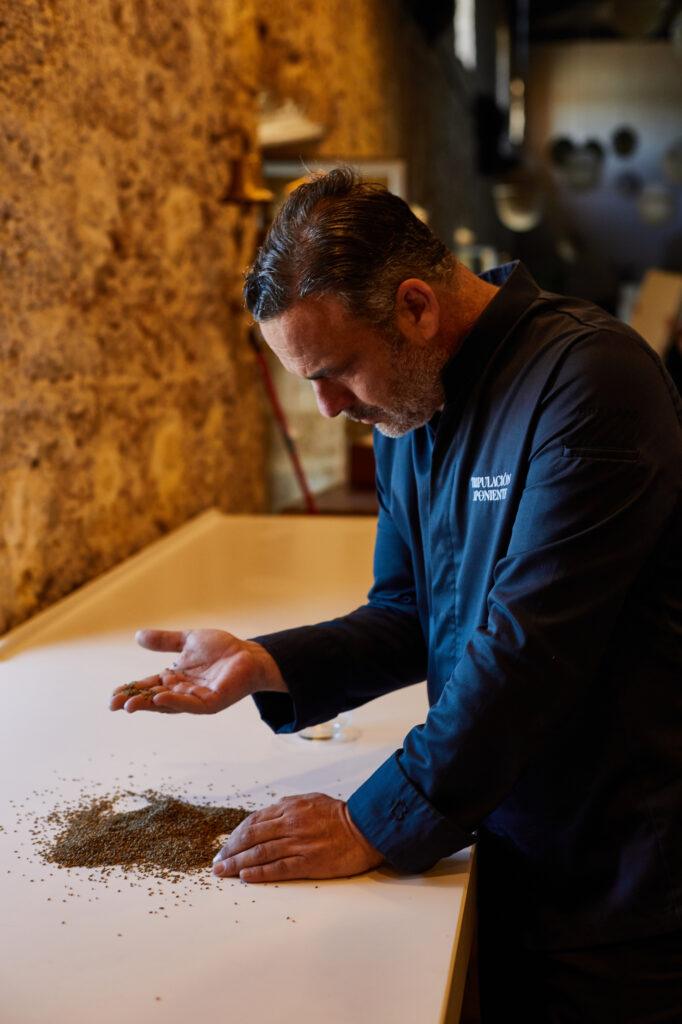
Chef Angel León examines the Zostera grain.
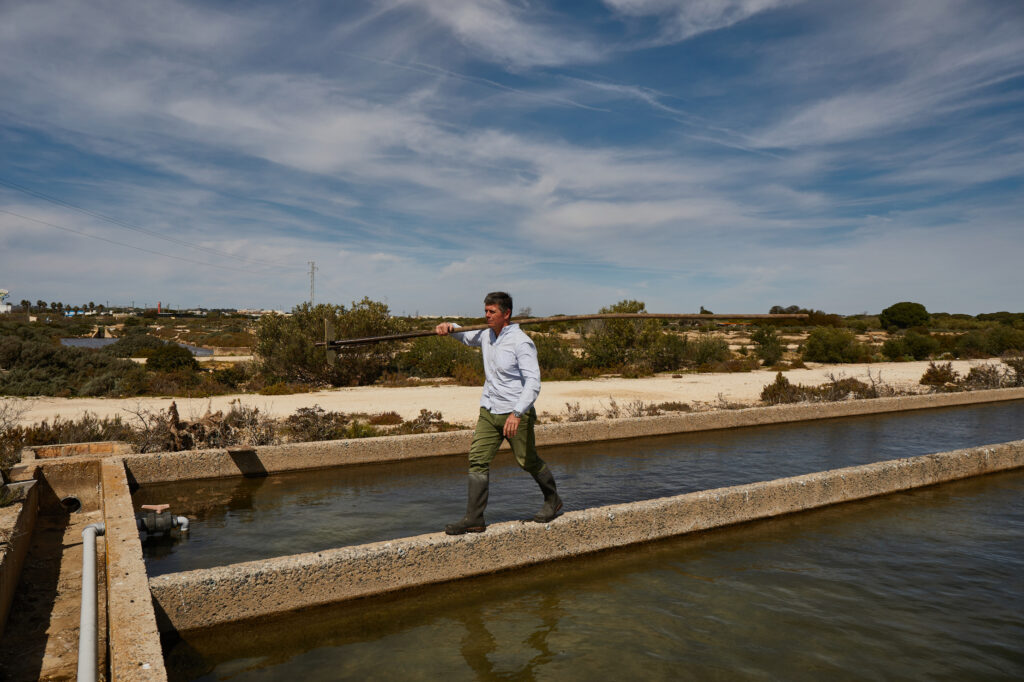
In 2018, León and Martín began looking for estuaries and abandoned saltpans, areas where seawater gathers and evaporates. They hired a team of scientists from University of Cádiz to facilitate learning how to grow Zostera in the Bay of Cádiz’s tidal marshes, and enlisted a professional shellfish harvester, Ricardo Ariza, to take care of the plantation. So far, León has invested over €350,000 ($380,000 USD) in testing Zostera cultivation in various estuaries along the bay, and his team is also studying how to grow Zostera in tidal marshes. They refuse to use fertilizers and pesticides. The goal is to revive these man-made ecosystems following Cádiz’s traditional salt farming techniques: Managing the hydrodynamics using walls and gates to control the tide.
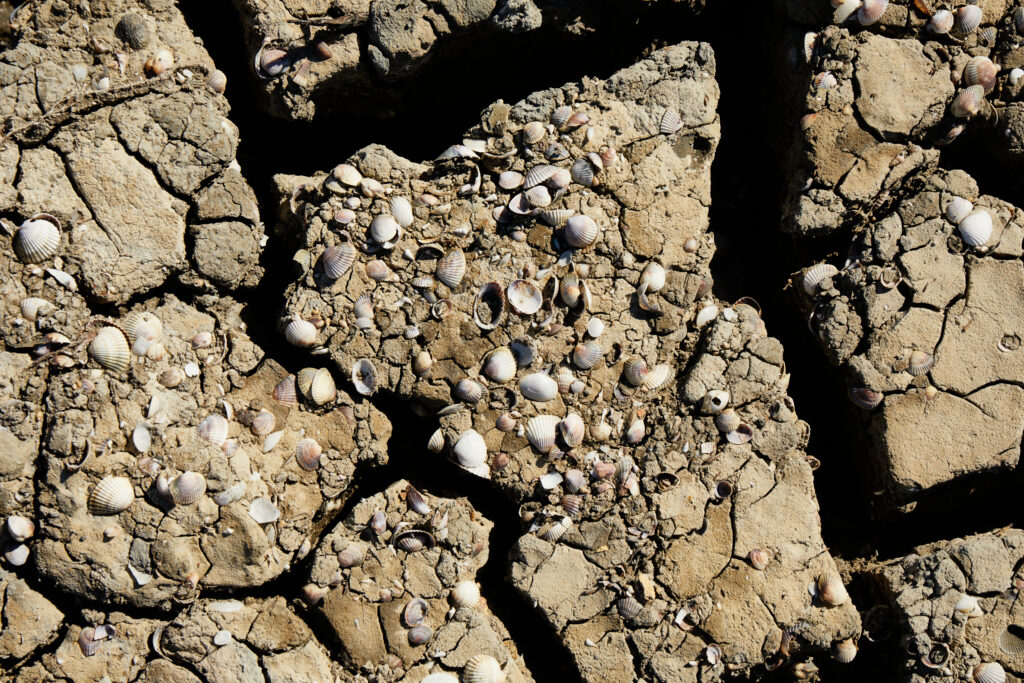
Duarte notes that these ecosystems naturally exist in the Spanish Atlantic as well, in the Bay of Cádiz and in the south of Portugal. The problem in Spain, he says, is that centuries of human-driven coastal modifications have shrunk Zostera’s natural habitat. Fernando Brun, a researcher at University of Cádiz who is also growing the plant in captivity, has seen Zostera almost completely disappear from Andalusia (the southern Spanish region that is home to Cádiz and Aponiente). “A few known populations remain in the inner sac of the Bay of Cádiz, but very few square meters,” Brun says.
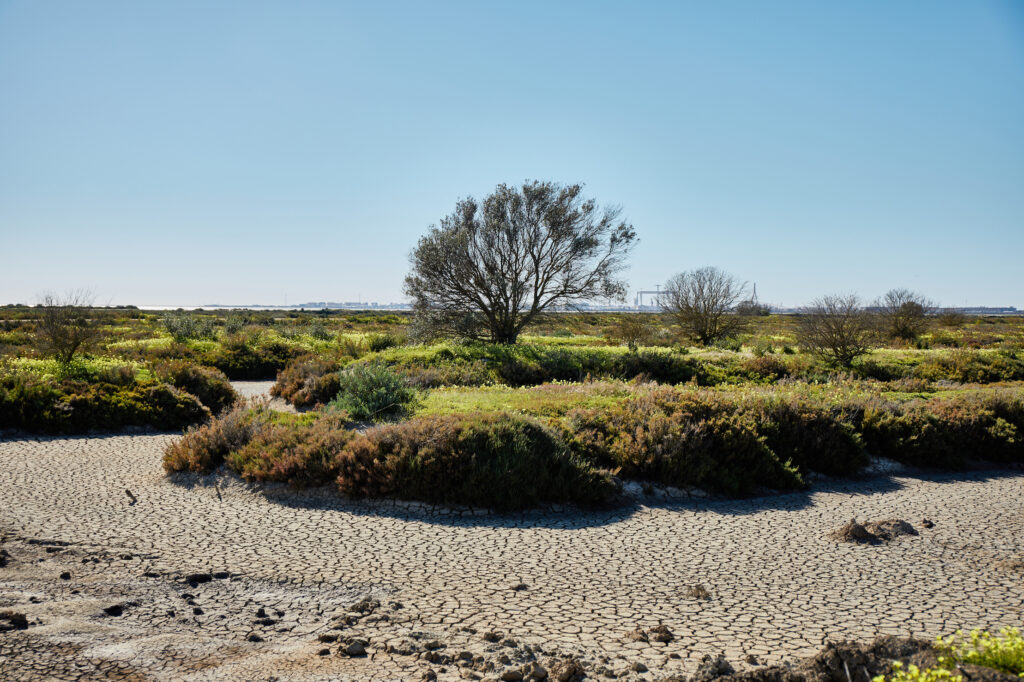
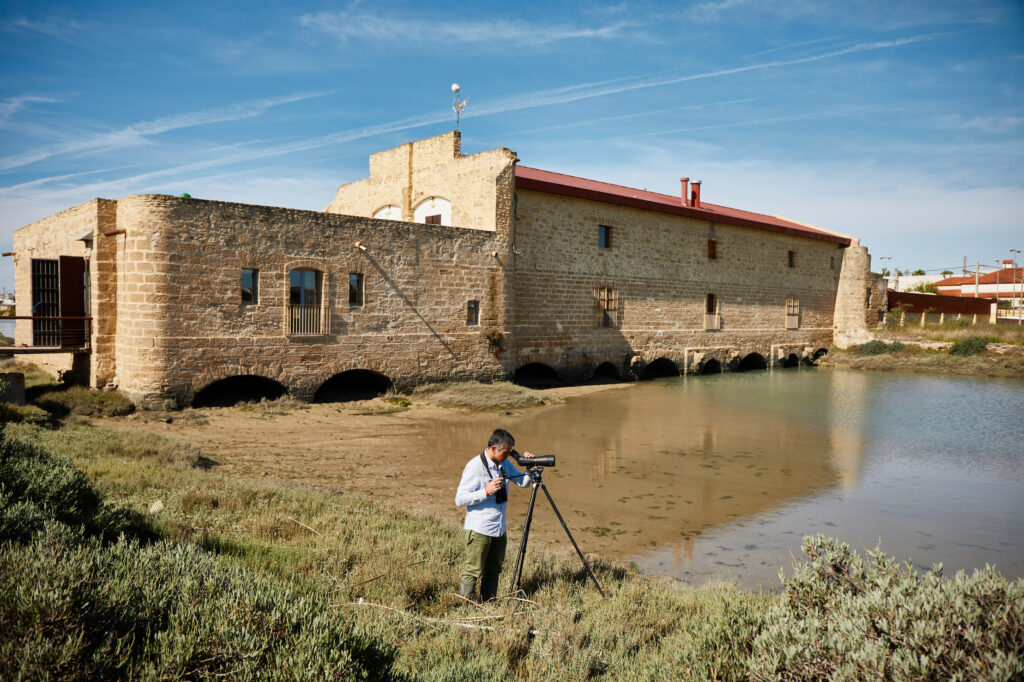
Juan Martin Bermúdez explores the marshes near Aponiente, where Zostera is being harvested. Much of Cádiz’s coastline and its famous wetlands, estuaries and saltpans have been impacted by development and tourism, leaving a sometimes barren landscape.
The environmental impact
The collaboration between the restaurant and the University of Cádiz ended in 2020, though each has continued their research independently. León’s project focuses mainly on “raising awareness with a fork” and communicating the sea’s capacity to fight food insecurity. The University of Cádiz researchers seek to cultivate Zostera mainly for conservation purposes, to repopulate the Bay of Cádiz’s seafloor. The ideal scenario for Zostera’s recovery, says Brun, would involve protecting the existing populations, promoting its ex situ conservation by creating nurseries, and developing restoration and reforestation programs in areas where it was once present.
Martín and Rivaes are equally interested in the ecosystem benefits of the Zostera plantation. As opposed to rice farming, which accounts for 12% of global methane emissions, Zostera is a potential ally in the climate crisis. It has the capacity to sequester carbon: Seagrass meadows account for less than 0.2% of the seafloor, but are responsible for sequestering 10% of the annual carbon stored in the oceans. Seagrass meadows sequester carbon at more than20 times the long term rate of terrestrial forests.
Zostera can also fix the ground’s substrate and prevent coastal erosion, as well as provide shelter for fish spawning in tidal marshes. These biodiverse salt-water lagoons also offer climatic and tidal stability in an area safe from predators. When wetlands aren’t managed properly, especially in a warming world, theyare an outsized source of methane and other climate-harming gasses. That can’t happen from growing Zostera in tidal marshes, Duarte notes, as these ecosystems are saltwater wetlands.
What León calls Aponiente’s “sea pantry” is operational in six estuaries, two using Zostera. The goal is to scale their formula for large-scale use, at which point they’ll go public with their research. This open-source mentality hasn’t necessarily helped find private investors, who are more interested in patents. “But we don’twant to withhold that information, we want to share it so that everyone can grow this grain,” Martín explains.
Rising to the challenge
León’s initiative to bring back almost obsolete traditional aquaculture practices—playing with hydrodynamics to develop chemical-free seafood farming—is also a direct response to the urbanization of Spain’s coastline. Thanks to mass tourism development, over 15% of Cádiz’s coastline has been degraded since the 1960s. Agriculture and industrial activities have resulted in 42% of the Bay of Cádiz tidal marshes draining. Researchers estimate that almost all of the 129 existing saltpans located in the bay are now completely abandoned.
“These ecosystems are very dependent on human activity and, if they are abandoned, they lose their environmental value,” says ecologist Ignacio Hernández, who directs the University of Cádiz’s biology department.
Hernández believes in the importance of building a Zostera nursery to repopulate the area, and to eventually consume its grain. But, he warns, it’s not as easy as planting and harvesting. Zostera has a wide distribution range, but one that is limited to just the Northern Hemisphere. “That means that the plant is always going to be a bit stressed in water temperatures that are in the borderline,” Hernández says. He also points to the plant’s low reproductive capacity. Only 1–10% of Zostera seeds germinate successfully and give rise to viable seedlings.
Its potential, however, is clear. “Unlike rice, it doesn’thave to be sown every year. Once the seagrass meadow is established it can flower and produce grain without seeding,” Rivaes explains. Seagrass meadows are among the most profitable ecosystems, with an estimated value of between €30,000–35,000 per hectare per year, “much higher than the €2,000–2,500 per hectare per year of tropical forests,” he notes.
Dry tidal marshes in the Bay of Cádiz. Researchers are hopeful that harvesting Zostera could revive the ecosystem.
Duare envisions Zostera’s potential domestication in the long run, but, for now, he says all we can expect from Aponiente’s initiative are controlled plantations for food production—pioneering but largely inaccessible. To be scalable, all of Zostera’s benefits—including carbon sequestration, coastline protection, and habitat architecture—will have to be considered, rather than just its capacity to feed people. “Alone, food production is unlikely to be profitable,” he adds.
Despite its strong potential to mitigate food insecurity and the twin crises of climate and biodiversity, Aponiente Sea Pantry has yet to receive any public funding. But León is determined to carry out his initiative with or without aid.
“We are stubborn. We will discover how to tame the plant, and we will share that knowledge so that everyone can grow it,” León says. “We will leave that window open in an uncertain future where humanity will have no choice but to open their eyes, look at the sea and understand that there may be grains in it.”
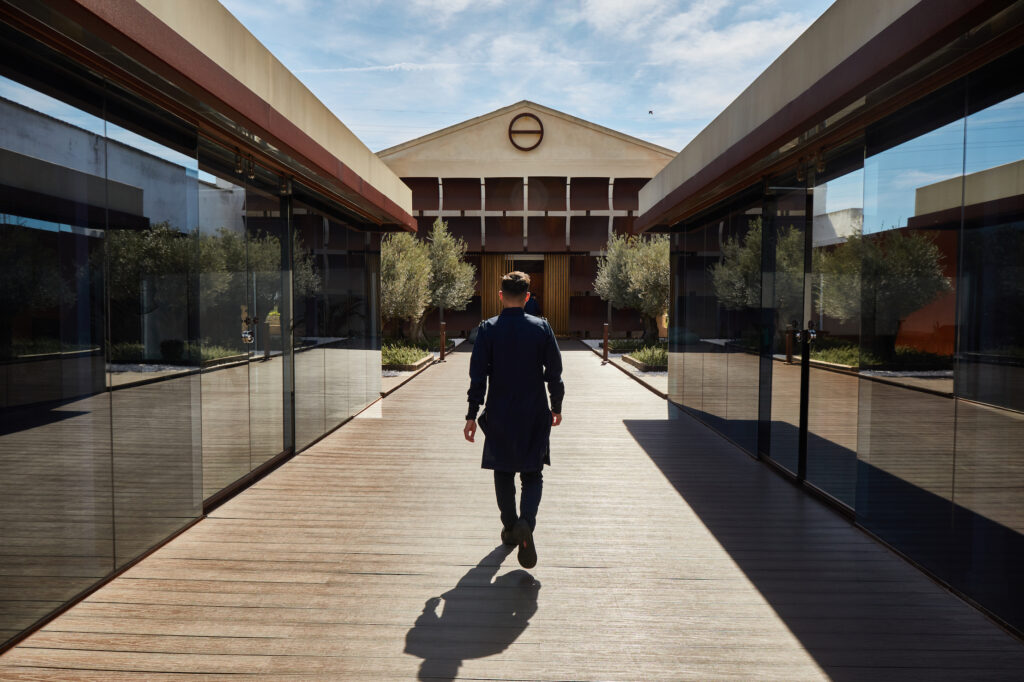
Juan Martin Bermúdez examines the marshes near Aponiente.A staff member walks back into Aponiente restaurant..
In rural British Columbia, Catalyst Agri-Innovations Society is harnessing the power of poop.
ABBOTSFORD, BRITISH COLUMBIA—
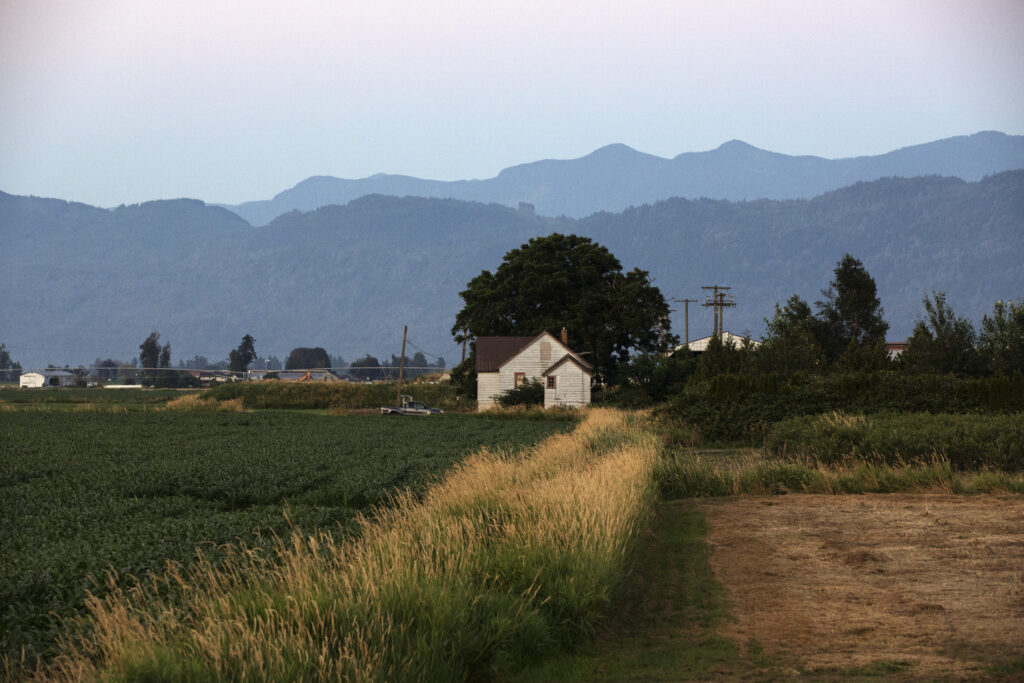
It takes no more than an Uber ride with the window down across Abbotsford, B.C. to notice that you are in Canada’s agricultural capital. The scent of Cedar and Spruce that envelops most of the Fraser Valley, the Southwestern region of British Columbia that neighbors Washington State, is overpowered by the farm smells of wheat, fresh grass and, especially, cow feed—in all parts of its cycle.
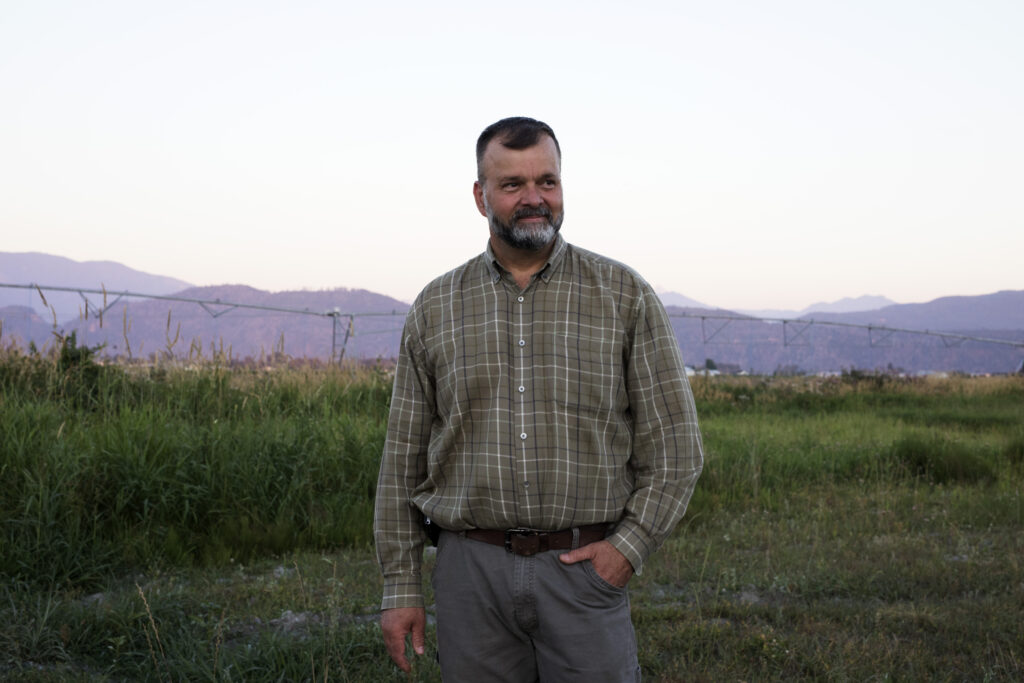
The odor of cow manure grows faint to new visitors after a few days, and some locals don’t detect it at all, but, despite living in the area for years, Chris Bush couldn’t leave it alone. That odor was a sign of a problem with local agriculture; one he wondered if he could fix.
Back then, he was an account manager losing interest in his job selling two-way radios at a regional telecom company. One night, trying to disconnect from work, he read a sidebar story in Popular Science Magazine about a farm in Vermont that made electricity from cow manure—the same dung he’d get a faint whiff of every morning on his drive to work. A lightbulb turned on in his mind.
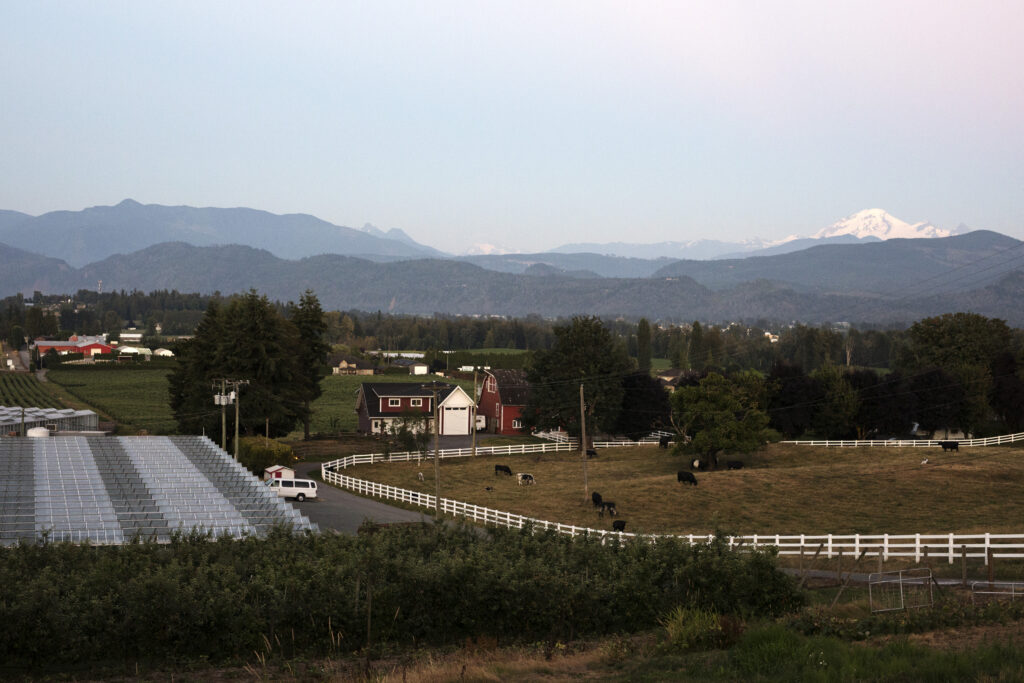
The city of Abbotsford, British Columbia, is surrounded by rolling mountains and sprawling fields.
“We have massive amounts of manure lying around, and our environment is suffering from it,” he says. “It seemed to me like there was a gigantic gap between what is being done and what’s possible here in Abbotsford.”
Bush was right. The chickens and cows of the province of British Columbia produce nearly three billion kilograms of manure every year: about enough to fill a full-sized American football stadium to its top. And Abbotsford, with its 25,000 cows and nine million chickens, produced far more waste than the city of 160,000 people could handle. Much of it would get shipped to the prairies as fertilizer or, worse, dumped in abundance on local crops and nearby rivers, filling the soil, air, and water with methane: a compound that, liter for liter, traps 80 times more heat in our atmosphere than the carbon dioxide puffing from our car exhausts. Cow waste would even trickle down the Abbotsford aquifer and flow downstream towards Washington State at a rate that made American farmers complain about their up-north neighbors. Abbotsford had a manure problem, and Bush wanted to deal with it.
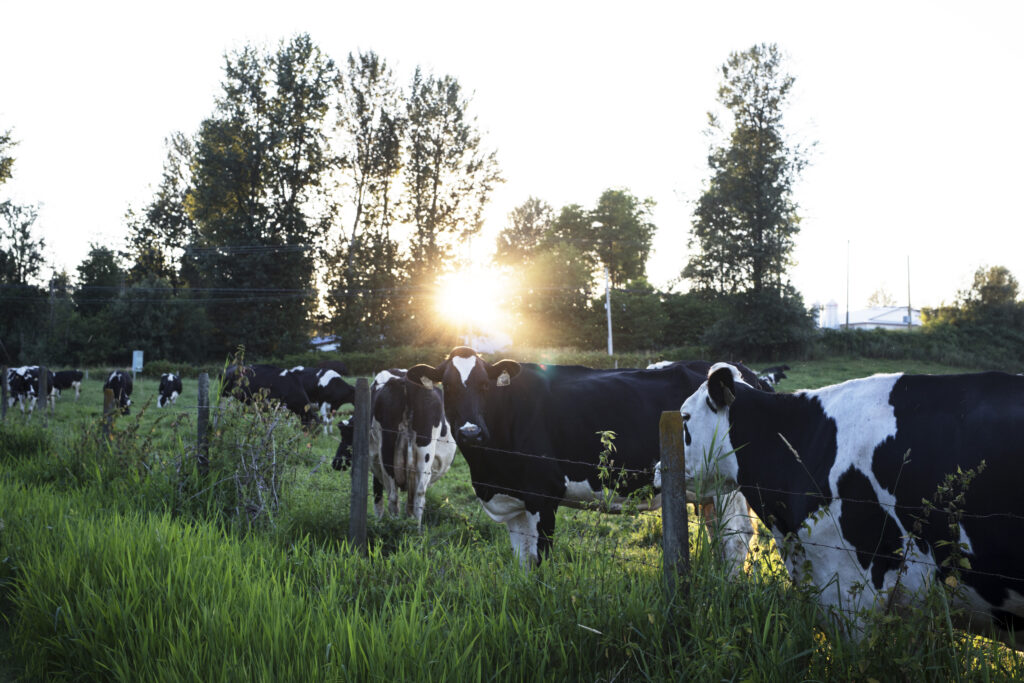
Cows graze a pasture at sunset in Abbotsford, British Columbia.
He wondered if there was a way to make good use of all that manure. It was a prescient thought: recycling on-site farm waste would only become a more relevant global challenge in the 15 years to come. The nitrogen fertilizer used by many farmers then and now—the kind that tripled global grain production over the last 50 years—continues to dwindle in its supply, even before supplies from Russia became squeezed by the war. Couple a worldwide fertilizer shortage with a supply chain still wobbly from the pandemic, and you get expensive and scarce food for plants and, in consequence, smaller crop sizes.
Bush was fascinated by how some small farms fermented their manure and transformed it into fertilizer, all while capturing the methane in the waste and using it to power their homes. But many of these farms did so in isolation. He wondered if he could find a way to scale the transformation of manure into gas and fertilizer, to serve many farms at once.
The key to his dream was something called a biogas plant, which is a network of oxygen-free tanks called anaerobic digesters that take in manure and ferment it at nearly 40 degrees Celsius for three to four weeks. The process replicates what happens in a cow’s third stomach: the manure separates into solid and gas. When that happens in the stomach of a cow, it farts. A biogas plant, in contrast, turns that gas into usable fuel and funnels it into the power grid. And as a bonus: the solid that remains is odorless and can be used as fertilizer for crops.
Some farms in British Columbia were using small biogas plants, and the technology was particularly strong in Europe. But to do this on a grander scale, he would need to build an industrial-sized biogas plant. The price tag: around $6 million. He needed to win over his neighbors, some of whom were worried about the smell or traffic. More than anything, though, he needed investors, but the idea was so new in the mid-aughts that there wasn’t even terminology for the kind of zero-carbon farming he was contemplating.
“Back then, nobody had the sexy language,” says Bush. “I’d tell people I want to power the city with cow poop, and they’d look at me like I was a nutjob.”
Christopher Bush, Catalyst Agri-Innovations Society co-founder, poses for a portrait at EcoDairy, in Abbotsford, British Columbia.
Still, Bush could not shake the idea. So, in the wake of the 2008 recession, he sold the family home and moved with his wife, eight-year-old twin boys, and six-year-old daughter to East Abbotsford. With the remaining equity from his house, his entire savings of $500,000, and $4 million in research grants and investor money that he finally tracked down, he built a farm and a biogas plant, with the goal of powering community homes with Abbotsford’s abundance of manure.
“We had planned another baby, but went for the anaerobic digester instead… we even had a picture of it next to those of the kids on our fridge,” he says. “We put everything into this.”
Bush’s initial results, especially for an ex-telecom specialist, were auspicious. It took him barely two years to build a working biogas plant, capture energy from cow droppings and convert it to electricity. In 2010, his plant became the first in North America to extract gas from cow manure and sell it to utility from a farm—the 126th plant on earth to do so, he says with a grin.
What would eventually make his plant special, he thought, was scale. Many biogas systems across the world already produced enough energy to sustain themselves. Bush had a grander idea: what if he eventually developed a biogas plant that could power an entire community? Arguably, no country needed this technology more than Canada, one of the top manure-producing countries in the world, without a blueprint to dispose of it in an environmentally friendly way.
The investment was huge, but the finances appeared simple: he had to produce $2,500 of gas per day for six months to break even. Any profits would go toward funding his brainchild, the Catalyst Agri-Innovations Society: a consortium of people dedicated to advancing the environmental and economic sustainability of agriculture, hopefully, one day based in a research and innovation center.
Farms are scattered across the city of Abbotsford, which is often referred to as the agricultural capital of Canada.
But his operation soon struggled: in the first 18 months, it averaged only $1,000 in profits per day. People were not buying the gas; machines would often break and need repair; and Bush, experimenting with cow, hog, and chicken manure, was still far away from nailing the recipe for maximum gas production.
“Every month, I’d sell off a little more to my investor group to keep the plant going, and then when I ran out of shares to sell, I had to sell the plant. Financially, it was catastrophic for me… I was broken when it died.”
A former business partner bought the biogas plant from Bush in 2012, giving the then demoralized 40-year-old the chance to cleanly exit the farming world and start fresh. But Bush found himself unable to walk away from his goal: he figured his idea was the right one, but that it just needed better execution.
“I recognized I am an addict to this vision. I mean, I had already sold the house,” he says.
“It had become more important for me that the project worked than that economically I survived. We need this. The world needs this.”
Catalyst Agri-Innovations Society’s pilot plant at EcoDairy.
Now, 15 years after reading the Popular Science Magazine sidebar, and ten years after losing much of his life’s savings, Bush remains at work, and the Catalyst Agri-Innovations Society is alive as a four-person operation.
On most days, Bush drives ten minutes westbound from the home he now rents with his wife to the Bakerview Farm Eco-dairy, a small dairy farm with a biogas plant that he and his team now use as a research headquarters. The parking lot there is full of families, gathered around the front-facing on-site ice cream shop.
“The front end is what pulls the people in. Us,” he says with a slight smile, “we work at the back end.”
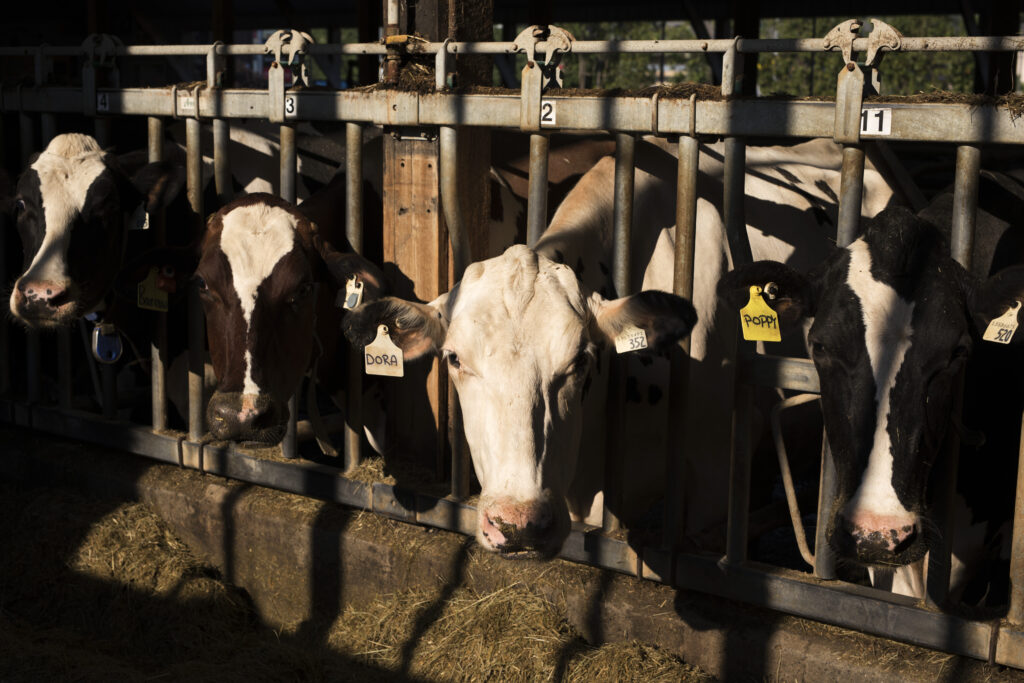
Behind the ice cream shop is a modest-looking collection of barns engulfed in a scent of manure that penetrates even the hardened nostrils of any local Abbotsfordian. A blue-grey barn on the right houses 50 cows, each with a yellow name tag on their right ear. Colleen, Alexis, Daffodil, and their contemporaries all face away from a dung-caked pit lined with a steel trough, which carries the fresh cow waste outside towards a network of bungalow-sized barns and trailers.
“You have to follow the poop to see the magic,” says Bush.
Cows feed inside the EcoDairy. Manure produced by the cows at EcoDairy is moved into a holding tank, which Catalyst Agri-Innovations Society filters and feeds to the digesters.
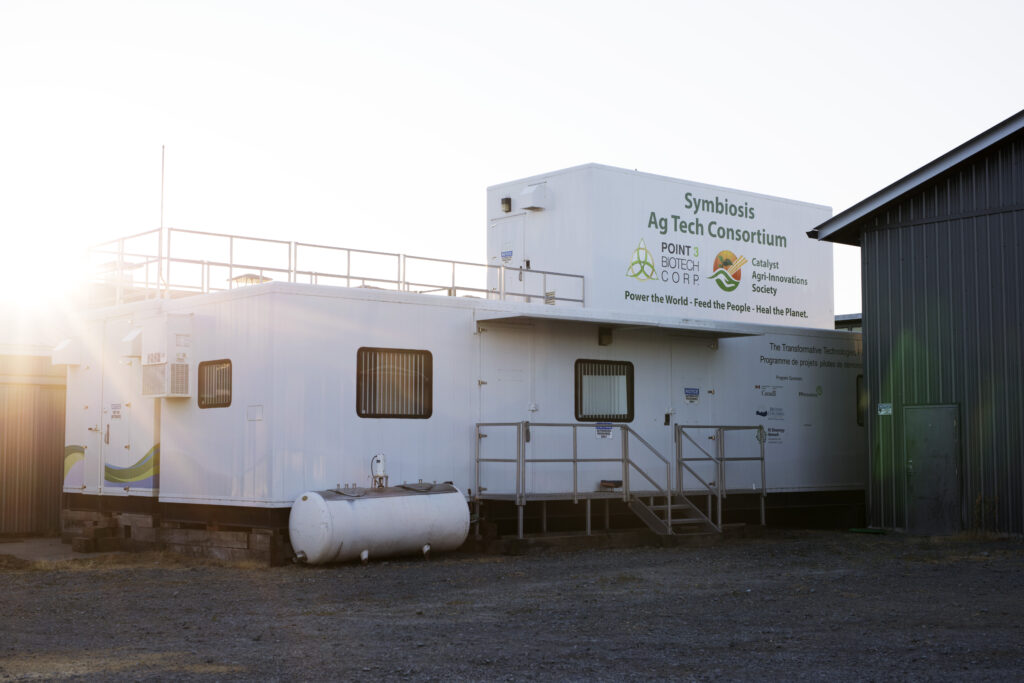
The eco-dairy is more eco than dairy: the buildings behind the cow barn hide the biggest active anaerobic digestion facility in all of Canada. Trailers propped up on two-foot stilts and packed with scientific equipment.
Those trailers contain $5M CAD ($3.8M USD) worth of equipment: 15 half-liter bottles connected to a chromatograph and monitor, eight 20-liter vats kept inside cupboards, two cylindrical 400-liter anaerobic digesters lining the walls, and six 1500-liter digesters kept inside a 38-degree fermentation room in the back. In its own barn is one big horizontal 85,000-liter digester that Bush calls Bertha.
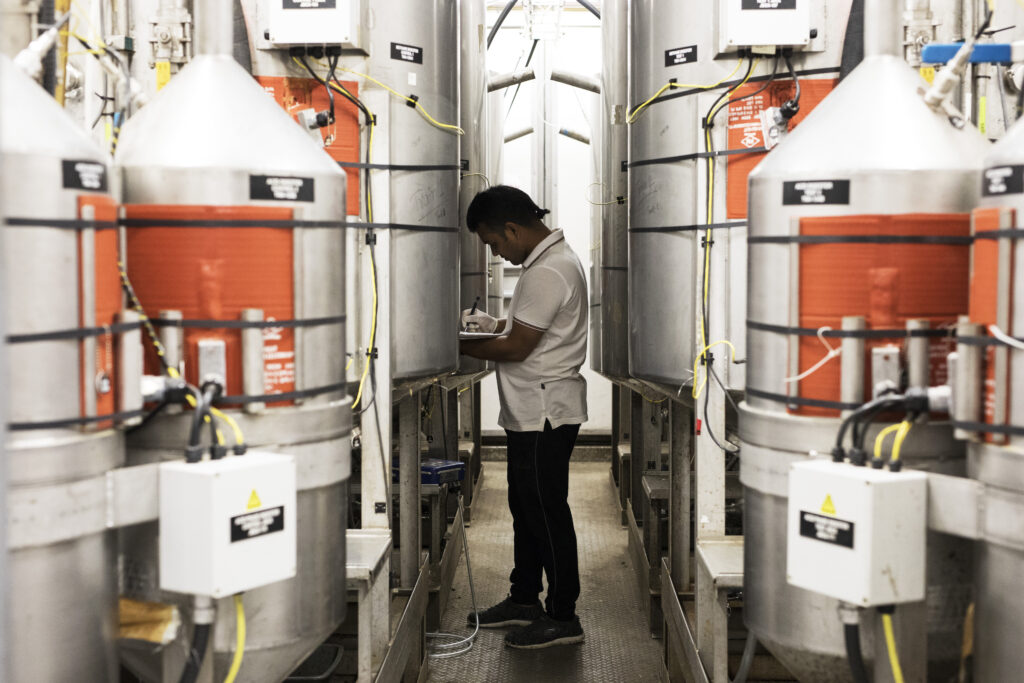
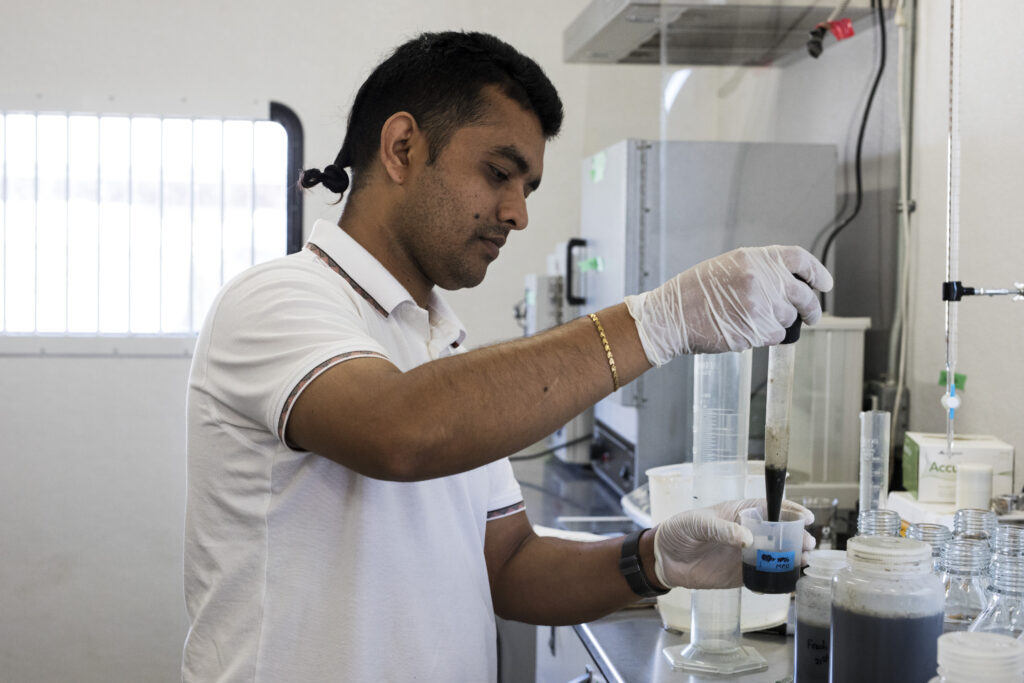
Suman Adhikary, a bioreactor engineer for Catalyst Agri-Innovations Society, measures how much gas, as well as the quality of the gas each tank is producing within the anaerobic digestion pilot plant at EcoDairy.
Each container is filled with a fermenting, charcoal-colored manure mixture—roughly three parts cow, chicken, and hog excrement, and one-part industrial food processing waste—Bush calls it poop soup.
The machines take 25 days to digest the mix and funnel its gas into the utility grid. Ultimately the gas powers 1000 homes and businesses across the province. The manure, meanwhile, after it gets stripped of its methane, becomes environmentally-friendly fertilizer for nearby crops.
Bush is no longer solo on his mission to make waste less wasteful: he has teamed up with James Irwin, a serial entrepreneur, bio-chemist, and CEO of the agricultural research corporation Point 3 Biotech Corp. Before joining forces with Bush, Irwin used anaerobic digestion on microalgae to extract astaxanthin, an antioxidant with a red pigment that he yielded so purely it would sometimes come out as purple.
James Irwin, Catalyst Agri-Innovations Society co-founder, poses for a portrait at EcoDairy.
“A few people said, hey, you’re like the Walter White of Precision Agriculture,” says Irwin, “because of the blue meth, or whatever. I don’t know—I’ve never watched the show.”
Irwin had also used anaerobic digestion on microalgae to make biodiesel, and later to convert fats from agricultural waste into renewable natural gas. Bush wondered if the scientist’s expertise in collecting usable gas from organic materials would complement his own goals. So, they became business partners.
“Chris is the visionary at Catalyst, and I bring the research,” says Irwin. “He is building the car, and I’m assembling the pieces.”
The team expanded again in the last three years by hiring lab technician Travis Scott, and principal investigator Suman Adhikary, then a Concordia master’s graduate and previously a lecturer at Sonargaon University in Bangladesh. Adhikary’s job, complex in application, sounds simple in theory: create the best manure recipe for gas production.
“Now we try a bunch of recipes to put in the digesters,” says Adhikary. “Sometimes it’s half-chicken with 20 percent cow and hog. Sometimes it’s less chicken because too much chicken manure produces enough ammonia to inhibit methane production. Sometimes it’s mostly cow… we’re still tinkering.”
Adhikary and the team iterate their mixture based on their own findings and the outcomes that emerge from European plants. Bush has traveled overseas to consult with his Swedish and German counterparts about their own mixtures of choice and is closely following new work from Germany that uses green hydrogen to convert carbon dioxide into methane and increase the overall gas yield from digesters.
While Catalyst primarily uses the plant for research, it is still performing much better than Bush’s first iteration.
“It’s simple: more gas, more money, and this plant is making $5,000 a day,” he says. “Financially, though, we still haven’t recovered from 2012.”
Suman Adhikary, a bioreactor engineer for Catalyst Agri-Innovations Society, creates a recipe using poultry, dairy, and hog manure for the various digesters. A control panel monitors all of the digesters inside Catalyst Agri-Innovations Society’s pilot plant.
The final part of Bush’s vision requires a little collaboration with the neighbors. The team at Catalyst has an idea of converting their demonstrative research project into a community-scale manure management initiative, in which they would have large community biogas plants built to digest and ferment manure of several local farms. The plants would be co-owned: Catalyst would be responsible for their maintenance and upgrades, while the farmers would operate the machine. Bush figures such partnerships would be win-win-wins: farmers who face increasing pressure to restrict their environmental damage would receive professional help in mitigating their footprint, Catalyst would grow its business, and ultimately, Mother Nature would benefit, too.
“That way, farmers don’t have to go into it blindly and risk building a biogas plant by themselves—I know what that’s like,” says Bush. “Here, we’d both share the risk and the reward.”
It’s easy to get local farmers and businesses to buy into small-scale collaborations, like collecting grains from local breweries to feed cows, which Bush does regularly. But the bigger ideas, like powering your home with gas from animal waste, or convincing a farmer to build a multi-million-dollar anaerobic digester on their farm, tend not to be as easily adopted. Resistance to change is the biggest hurdle Bush’s ideas continue to face.
“When it comes to innovations in agriculture, the potential users need to be sure whatever is new is bulletproof before they make a move,” says Mike Manion, an executive in residence with agri-business accelerator IAFBC Agri business accelerator. “Change, without years of investigation and proof that it works, can make farmers fearful.”
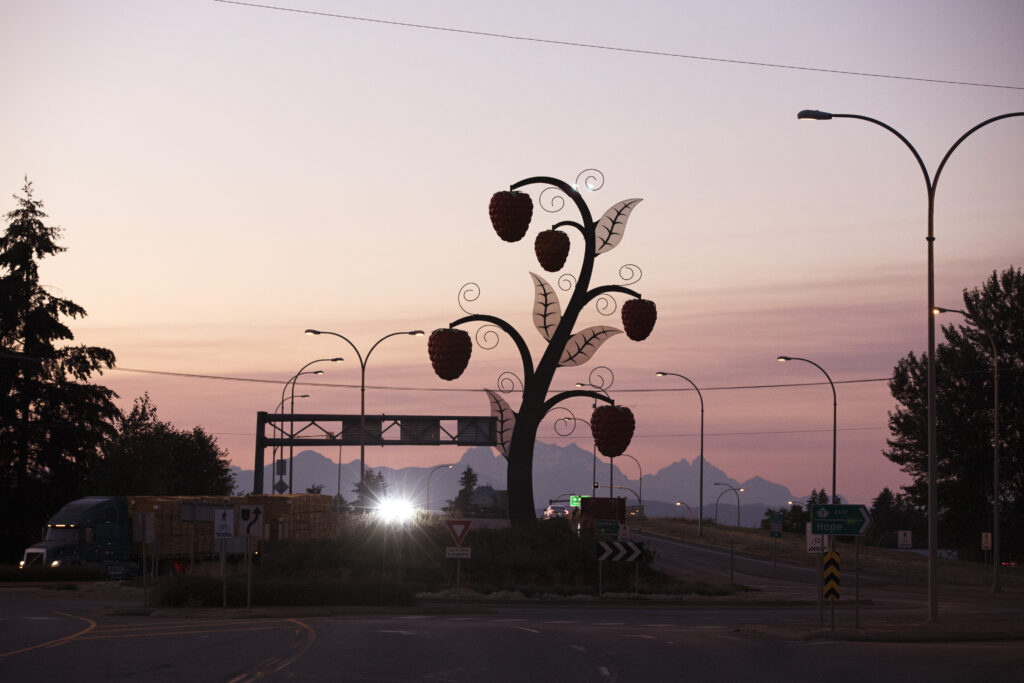
Giant raspberries decorate a roundabout in Abbotsford, British Columbia.
But the province’s farming industry, according to experts, is in dire need of fixing. The Canadian federal government announced in July it was looking for ways to cut fertilizer emissions by 30 percent by 2030. Local fertilizer is already running low. The pandemic and extreme weather of the last few years, which included record-breaking forest fires and destructive floods, compromised common supply chains with the prairies and California, and made fertilizer prices in the province skyrocket, says Lenore Newman, Director of the Food and Agriculture Institute at the University of the Fraser Valley.
“As a result, we’re in unprecedented territory in food loss in B.C. and in Canada: last winter, across the province, we had no lettuce on our shelves,” she says. “The only way we can ensure there is food security here is to produce domestically, more intensively, and year-round.”
For those reasons, using local waste to grow more crops without spewing methane into the air could become paramount. Couple that with a provincial renewable gas subsidy program for B.C. residents to power their homes with biogas, and it would seem that the technology’s moment has arrived.
“At all levels of new farming tech, it takes that sort of government push to see progress,” says Manion. “I keep trying to encourage Chris, because his ideas were about 15 years ahead of the curve, and now the environment is different out there… people just might start paying more attention to his work.”
Manion sees the immediate importance of in-house manure fermentation: making one’s own fertilizer can help protect against global supply issues. But there are still only three working digesters in all of B.C. For the technology to become mainstream, it must first become cheaper and adopted by more trailblazers. If the research efforts at Catalyst lead to installing more industrial-sized, trusted, affordable biogas plants on nearby farms, it could open the floodgates.
“We need solutions to make home-grown fertilizer,” he says. “Agriculture is at a precipice—a turning point—and they might just be at the forefront of it.”
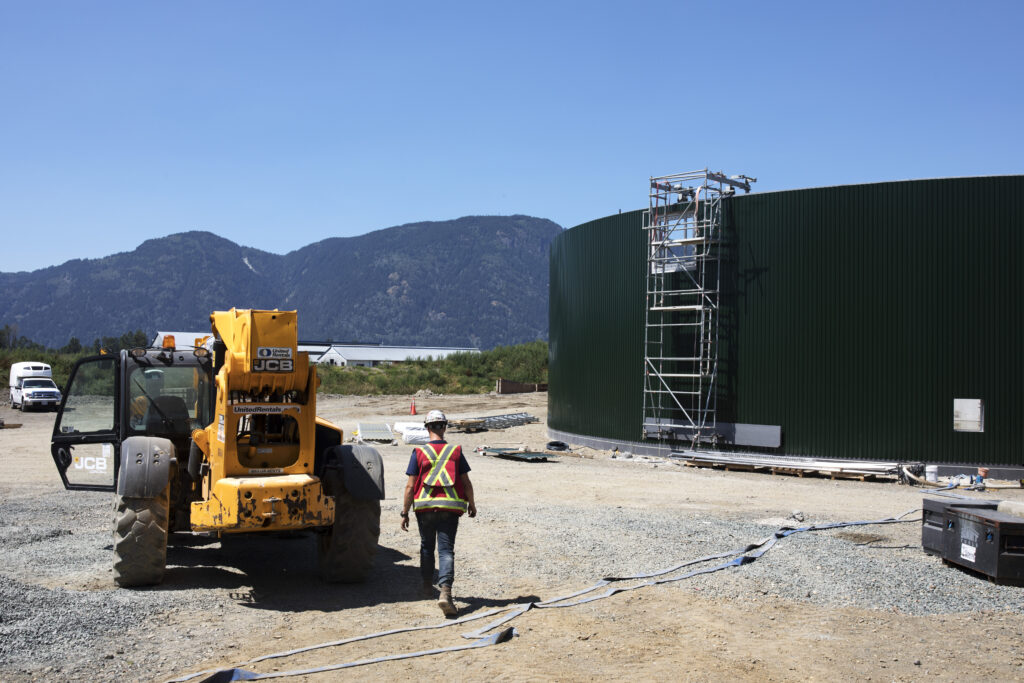
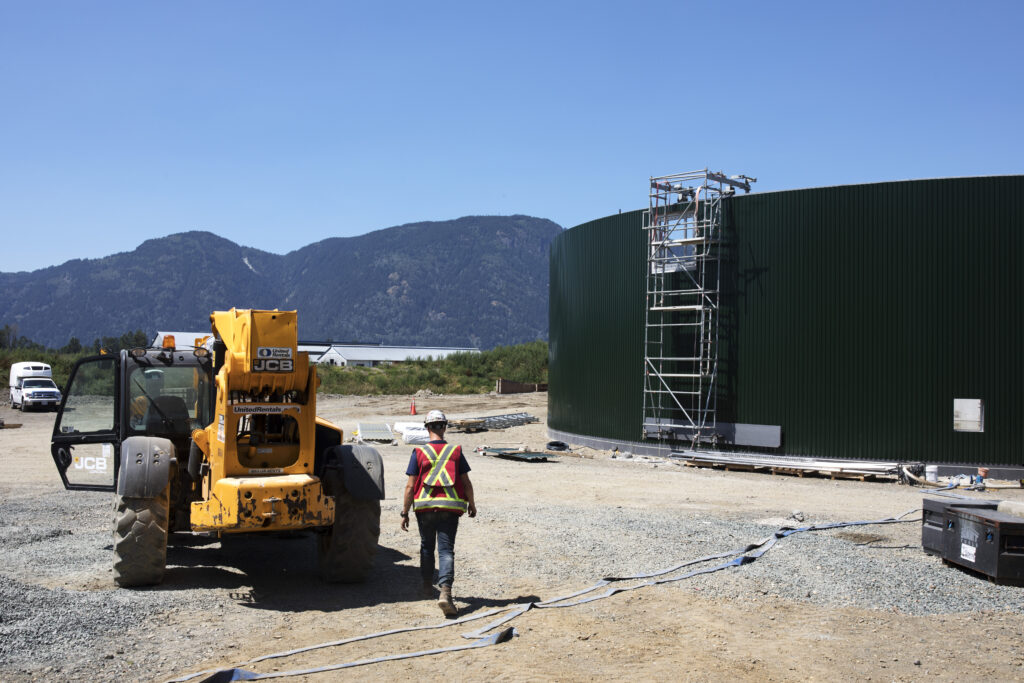
Dicklands Farm in Chilliwack is building an anaerobic digester and biogas plant to produce renewable natural gas. The technologies and solutions Catalyst Agri-Innovations Society is developing are designed to enhance systems like these.
Thirty minutes inland from Abbotsford and the Bakerview eco-dairy, in the mountainside agricultural city of Chilliwack, is a massive construction site that is slowly developing the largest biogas plant in Canada. Once ready, the plant is expected to produce enough energy from manure to power approximately 4,000 homes, and also to recover nine million gallons of water per year from manure remnants via reverse osmosis and mineral rebalancing. Once operational, it will dwarf Bush’s research facility in gas production.
The $40-million CAD ($30.5M USD) project was just an idea in George Dick’s mind back in 2008, when the entrepreneur and dairy farmer at Dicklands Farms came across a magazine article about Bush’s own biogas project.
“I thought, where did this guy come from? We have the same idea!” says Dick. “And he’s going through with it.”
Dick paid close attention to Bush’s trailblazing attempt to build a plant in the early 2010s, and witnessed the project’s first iteration bleed money and go out of business.
“I saw Chris fail… it was such a new technology, and we knew even less about it then than we do now,” says Dick. “Someone had to take those first steps forward, even if they were risky.”
Work being carried out at Dicklands Farm in Chilliwack to build an anaerobic digester and biogas plant.
After a decade of research, fundraising, and building, Dick is now months away from seeing his own years-long project come to life: the Dicklands Farms biogas plant is expected to be up and running by April 2023. If the plant functions as expected, it may be Dick, and not Bush, that will be remembered as the father of biogas in British Columbia, and possibly in Canada.
“The early bird gets the worm, but the second mouse gets the cheese,” says Bush. “Sometimes that’s the price of going first.”
But to Bush, a successful outcome at Dicklands Farms would feel like a win nonetheless. He wants he and his partners at Catalyst to pioneer research into biogas farming and scale their own operation, but more than anything, he wants his city’s manure problem to be solved. Whether he is the face of the movement or the shoulders on which another innovator will stand, he longs to see the vision that pulled him away from his regular life materialize.
Besides, he says, the stakes are higher than personal glory.
“More than anything, this is about a mission: powering the world and solving one of the grand challenges of humanity,” he says.
“I’ll be the guy to lead it, or I’ll be a soldier on somebody else’s team. Either way, I’m calling this my life’s work.”
The team behind the Consupedia app is on a mission to create a more transparent and sustainable food industry, armed with a database of 250,000 products. With only a barcode scan, it tells consumers how sustainable and ethical their food choices are.
GOTLAND, SWEDEN
It’s early July on the vacation island of Gotland, in the Baltic sea between the coasts of Sweden and Latvia. The sun shines on rugged cliffs, white sailboats are packed tight in the marina, and a steady stream of people flock towards the center of its largest city, Visby. But its medieval squares and cobblestoned streets are full of people in suits, not summer dresses.
It’s Almedalsveckan—or Politician’s Week—and Gotland has been transformed into a camp for Sweden’s political elite. Every July, Sweden’s most influential politicians, journalists, businesspeople, and NGOs descend on the island. Officially, they’re here to discuss social issues. Informally, they come to network, to party, and to have lunch meetings that are a lot less casual than they seem.
At a restaurant on Stora Torget, the town’s main square, Roberto Rufo Gonzalez’s eyes scan the menu, searching for something sweet. His lunch companions watch him, showing an unusual amount of interest in what he might be having for dessert. They’ve spent the past hour discussing the connection between the food industry and the climate crisis.
Gonzalez finally places his order. “Can I please have the liquorice pipe,” he says—a traditional Swedish candy.
“Are you sure the pipe is vegan?” asks Göran Blomberg, the CEO of ICA-handlernes Forbund, the trade association of Sweden’s biggest grocery retailer. It’s a fair question: earlier, Gonzalez had to ask for the kitchen to prepare a special vegan dish, because there were no vegan options on the menu.
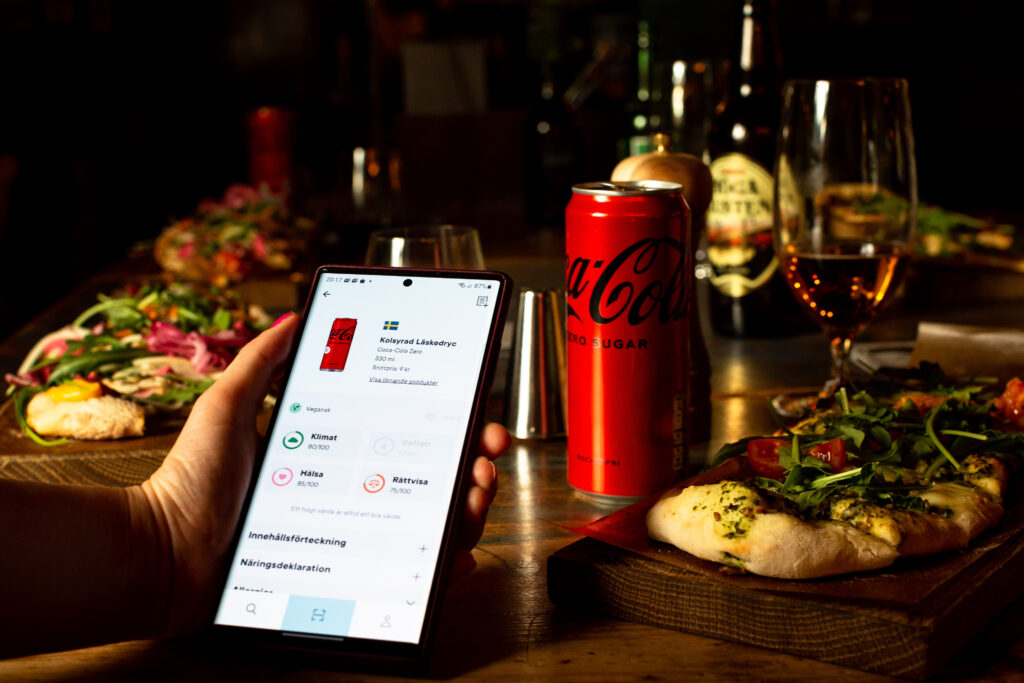
“Of course,” says Gonzalez. He pulls a battered phone out of his white jeans, opens an app, and scans the barcode on the wrapper of the liquorice pipe.
Unlike a lot of liquorice pipes, this one is vegan. Although the text on the wrapper is in Swedish, the pipe was produced in the Czech Republic. The nutrition and ingredient information, in text so small it’s barely readable on the wrapper, is available on the app, too.
The liquorice pipe is rated in four different categories: Climate, Health, Justice, and Water. This pipe scores 38/100 in the climate category—based on criteria such as carbon dioxide emissions and transport involved in the production chain. That’s a below-average score compared to other similar products and packaged food in general, the app informs us. For health (drawing on facts such as ingredients, additives, or the presence of antibiotics in the food chain), the liquorice pipe—perhaps unsurprisingly—scores 33/100, significantly below average for food products in Sweden. The pipe does better on its social justice score—based on markers such as equality, animal welfare, and child labor issues—with 70/100.
Users of the app—named Consupedia—can also read about how the score is determined, which facts the information is based on, and get background information about topics such as greenhouse gas emissions, the use of antibiotics in the food industry, and practice of child labor around the world. The app’s information is drawn from many sources (and acronyms), such as the RISE Food Climate Database, the WHO, FAOStat (the FAO’s data trove), the Gapminder Foundation (a Sweden-based non-profit fighting global misconceptions), the World Wildlife Fund, the European Food Safety Authority, the Proceedings of the National Academy of Sciences (PNAS), the Water Footprint Network, Nutri-score, and the Bertelsmann Stiftung’s Social Justice Index.
Distilling all this information into an app places the world’s largest database of environmental impact, health, and justice related to food at consumers’ fingertips within seconds of scanning a barcode. The database, which currently holds sustainability information about 250,000 food products on the Swedish market, is accessible via the app. Consupedia is connected to the main databases in countries where products are being registered by manufacturers or distributors. As soon as new products or changes are made in these databases, the same change occurs in Consupedia’s database. As a complement to these databases, Consupedia uses information-gathering bots.
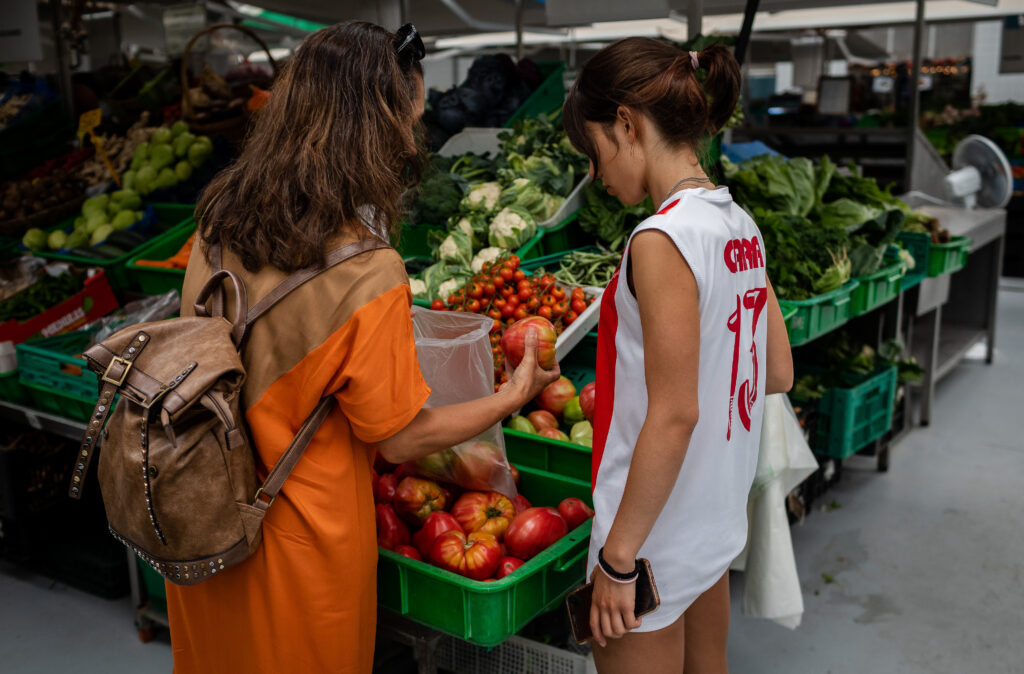
Consumers can walk into almost any grocery store in the country, scan the barcode of almost any product, and see how the product scores—as well as compare them to similar products or other brands.
“That’s a lot of information,” says Blomberg.
But Gonzalez didn’t just pull up the app to prove a point about veganism. The app, and the database on which it’s built, is his life’s work. He’s spent the past six years creating it, with the help of professors from Stockholm’s KTH Royal Institute of Technology and Dalarna University. Now the app is ready to be launched but is still in BETA stage. A test version has been available since 2017, and Gonzalez and his growing team are ready to put the wealth of information behind the app to use.
The goal is to create more transparency in the food industry. He doesn’t just want citizens to be better informed about the products they’re consuming, making it easier for them to choose products based on their values rather than just price and packaging—so far the strongest influences on consumer decision-making. He also wants to use the database to nudge stakeholders, such as grocery retailers, restaurants, hospitals, and policymakers, to make more sustainable choices.
Blomberg leaves the lunch table, seemingly impressed with the app, but without making any promises.
“That went well, I thought,” says Johannes Thomhave, Consupedia’s newly hired COO.
“I know,” Gonzalez says, getting up to go to his next meeting. “I’m just tired of things moving so slowly.”
Gonzalez returned to his native Sweden in 2014, after many years in the United States. He grew up in a tiny timber town in northern Sweden, meters from the pine-covered Bothnian coastline and the Söderhamn archipelago. His father, a Spaniard who’d grown up in an orphanage in Grenada and followed Gonzalez’s mother to her homeland, worked as a plumber, his mother as a school teacher. After high school, he followed his brothers to Stockholm and to KTH, Stockholm’s Royal Institute of Technology. After a few years studying and a gap year spent repairing roads and drinking vermouth in Grenada, he was awarded a grant to move to Los Angeles to study architecture at UCLA. For the next ten years, Roberto lived on and off in the US, working as a model and founding companies with an American friend.
When his father fell seriously ill in 2014, he returned to Sweden and his father moved in with him. Gonzalez wasn’t sure what he wanted to do next. He considered creating similar companies to those he’d built in the US—selling floating homes, designing clothes, or perhaps even launching an AutoGyro company. But the world didn’t really need more clothes, helicopters, or houseboats. What it needed, he thought, was a more conscious way of consuming. That’s how he came up with the idea of creating a consumer database guiding people and companies towards more sustainable consumption patterns.
“Whatever I came up with, nothing compared to Consupedia. It was the only project that was a solution to an existential problem,” says Gonzalez.
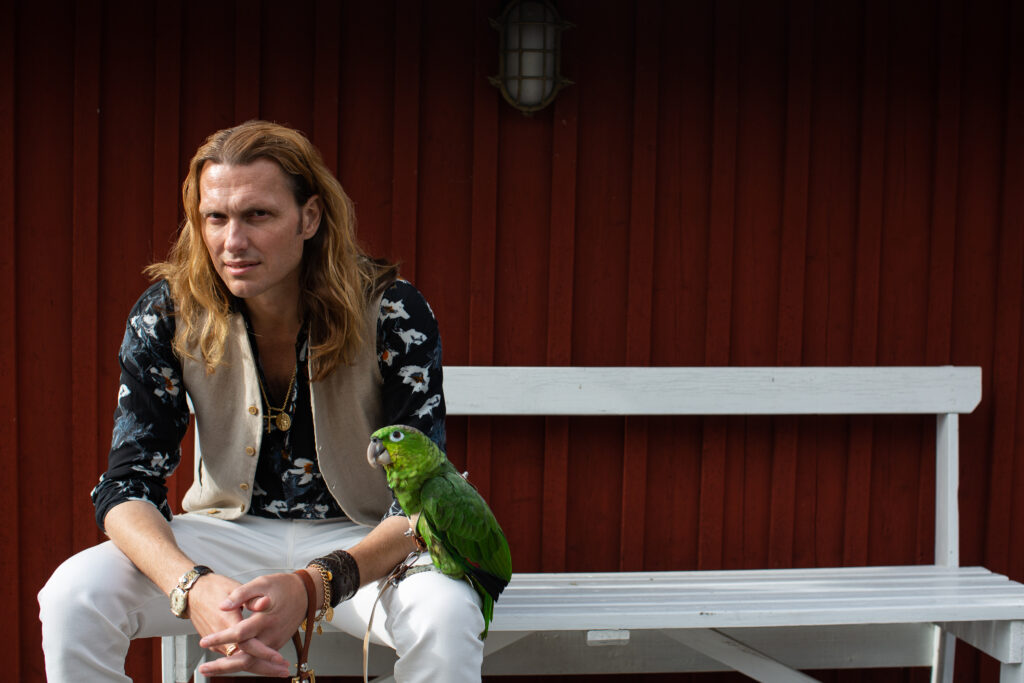
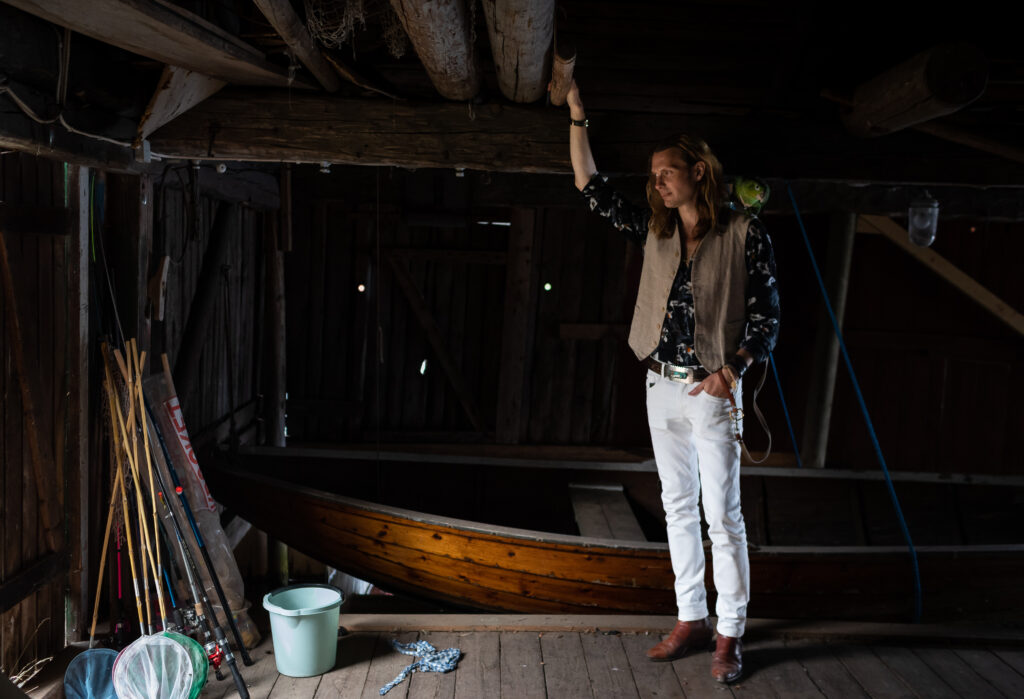
Roberto Rufo Gonzalez and his parrot, Åke, in his hometown, Skärså.
He started looking for more knowledge about the items he was consuming, whether it was food, clothes or electronics, but it was almost impossible to find. And then he started wondering if people would change their lifestyle and their consumption patterns if they were presented with the information he was looking for, and if they knew how it impacted themselves, the animals, and the planet.
“I went back to my university because my professors there are the smartest people I know, and I asked them whether it would make a difference. And they said yes, that research did point in that direction. I said, great, we know that information would make a difference, but how do we gather all this information? They didn’t know the answer to that, so I was left with that problem to solve,” says Gonzalez.
He registered the domain Consupedia.com at the turn of the year between 2014 and 2015, knowing he wanted to create some kind of database about what we consume, but not knowing how. And he got stuck.
It was April, 2016, two years since Gonzalez had left the US, and one since he’d registered the domain. He’d become better at finding the information he wanted before he made his decisions about what to buy and eat, but he still hadn’t figured out how to store the data or make it available to other consumers and companies.
Then one evening, while he was watching television with his father, a program about unknown people doing remarkable things aired. One of them was Sverker Johansson. He wasn’t interviewed because of his position—he’s part of the leadership of Dalarna University—but because in 2014, it had been revealed that he’d written 8.5% of everything ever published on Wikipedia.
“He’d figured out how to teach this bot how to gather huge amounts of information, package it, and automatically write an article that’s published on Wikipedia. On a good day, he said, he publishes 10,000 articles. I got up from the couch. Straight away, I saw that we could use this system to gather and package the information for Consupedia,” says Gonzalez.
He decided to convince Sverker Johansson to help out with Consupedia. He drove south in his 1971 Buick Riviera Boattail—powered by ethanol—bringing his beloved parrot Åke. When he arrived in Dalarna, he found out that Sverker Johansson was as passionate about parrots as he was about Wikipedia. Gonzalez asked him what he was currently writing about on Wikipedia, and Sverker replied that he was building a database that would gather information and write articles about every single beetle in the world.
“He also told me that the reason he’s doing this for free is that he believes in democracy and every person’s equal right to free information. That’s why Wikipedia is the only platform he uses, and why he spends a lot of time translating stories originally written in Swedish or English to minority languages,” Gonzalez explains.
“Don’t you think we could use this to gather information about something that would have more impact on society than beetles—for example on how our consumption impacts the world?,” Gonzalez asked him. Sverker Johansson was quiet for a moment. Then he nodded. “Yes, I think so. Let’s do it.”
Gonzalez had the consortium he’d wanted. Sverker Johansson and his team at Dalarna University would help with the database, and professors at the KTH Royal Institute of Technology would help out with their knowledge of fact-gathering and behavioral science. Gonzalez drove back to Stockholm, typed out a research proposal, and was awarded $400,000 from Vinnova, the Swedish government’s innovation department. With Gonzalez as head of research, he and his team got to work.
They had no idea it would take them six years to build the database.
Roberto Rufo Gonzalez photographed in his hometown, Skärså.
Early on, Gonzalez realized he’d have to work with the grocery retailers rather than against them. His goal isn’t only to inform people about their behavior, but to help them change it. For that to happen, consumers need to be informed about their past behavior, and that requires the cooperation of the grocery retailers who store the information Consupedia wants to use.
These days Consupedia does work with grocery retailers, but the grocery retail business hasn’t always been very friendly to Consupedia.
In 2020, Consupedia was presented with a potential lawsuit. Consupedia had agreed with the Swedish grocery retailers association that the database could access their information in a signed contract. But suddenly the grocery retailers wanted to change the contract and make it illegal for Consupedia to publish the information, arguing that it would discredit some products if they received a low rating in the database. Gonzalez feared for Consupedia’s future. If he signed the new contract, it’d be the end of Consupedia; he’d still have the database, but he wouldn’t be able to use the information it held.
A journalist from Dagens Nyheter, a leading Swedish newspaper, interviewed Consupedia about the conflict, but the story was never published. But in December 2020, Greta Thunberg was asked to serve as the newspaper’s editor-in-chief for one day. Gonzalez bought the paper out of curiosity. To his surprise, there was a huge photo of his face on one of the first few pages.
“The food industry wants to stop warnings about climate-hazardous products,” the headline read, and the article described the climate startup Consupedia’s battle against the powerful Swedish grocery retailers. The conflict died down, the threat of a lawsuit disappeared. Consupedia could continue their work, for now.
As a longtime vegan, Gonzalez might have been a frontrunner when it comes to aligning values with consumption, but he isn’t alone. During the years he worked on building the database, the demand for the knowledge it offers grew. According to a report by the consultancy company Accenture and presented at Almedalsveckan, 57% of people worldwide want to make their shopping habits more sustainable. Eighty-five percent of Nordic grocery consumers want to be more supported in their shopping to make more sustainable choices, and 70% of consumers would swap to a more sustainable retailer if they were presented with the right information.
Despite the rising awareness and the interest in living in a more climate-friendly way, most people struggle to make changes. According to research from Kantar, a data analytics company, 92% of people say they want to live a sustainable life, but the vast majority aren’t actually doing anything to change their lifestyle—only 16% do.
The failure to live according to one’s values has been labeled the intention-action or the ambition-action gap, and across the world people are now trying to understand how the gap can be closed or diminished. Many professors studying the gap turn to behavioral scientists, such as Daniel Kahnemann and Richard Thaler, who won the Nobel Memorial Prize in Economic Sciences in 2002 and 2017 respectively for their work on behavioral economics. One of the main takeaways from their work is that it needs to be easy for people to change their habits, and they need to believe it will make a difference.
“People need to feel agency, and they want to understand what their personal role and impact is. We want people to feel like they have enough information that they can make a good choice. They need to know that if they do make a different choice, that it does make a difference. When people feel disengaged, they feel disempowered, and we want to avoid that,” says Edwina Hughes, who works with food at the World Resources Institute, a global, non-profit research organization.
But research shows that people need more than knowledge. Choosing differently is not only a question of information, but also of expenses, habits, and social questions.
“Knowledge does play a key role, but it can’t stand alone. Unless they’re hardcore engaged political consumers, the biggest factor in what people consume is habits. People do and buy what they’ve always done and bought, and it takes a lot to change those patterns,” Bente Halkier, who researches political consumerism at the University of Copenhagen, says.
It is possible for people to change their ways, though, but often the change is caused by social relations rather than by values alone, she adds.
“Perhaps your daughter comes home and informs you she’s a vegetarian now, your best friend tells you they’re only buying organic food, or the canteen at your office starts offering more plant-based food. For people to change their habits, and especially for those to stick to those changes, it often takes a social push,” says Bente Halkier.
At Almedalen, Gonzalez is wrapping up his day. Whenever he’s had a meeting with someone, whether it’s the suit-clad men at the top of the grocery retail industry or the PR people of NGOs, they’ve made excuses for their lifestyle: for eating meat, flying back to Stockholm rather than taking the ferry, or driving to their vacation house in Spain.
Whenever they do, both Thomhave, Consupedia’s new COO, and Gonzalez try to reassure them: “Consupedia is not about making people live according to Roberto’s values, to become vegan or only drink oat milk,” says Thomhave, who joined Consupedia earlier this year to help with the commercialization of the database.
“The goal of Consupedia is to give people the information they need to start living more in line with their own values, whatever they are. Maybe they care mostly about the climate, maybe they want to boycott products from Israel, maybe they only care about health. How people want to use the information is up to them. We just want them to have the information,” adds Thomhave.
Gonzalez has been at Almedalsveckan every year since he launched Consupedia. He spent the morning debating how to make grocery retail more sustainable. He argued that there should be more legislation, but first of all more information, so that consumers can start making more sustainable choices for themselves until the grocery retailers are ready to do it for them.
“We can leave the responsibility to sustainably transform the food system in the hands of the retailers, the day the Dalai Lama is the CEO of ICA,” says Gonzalez, the ICA being Sweden’s biggest grocery retailer. It’s the third time in a day he’s made the same joke, and the sixth year he’s traveled to Gotland with the same message.
“My message has remained the same, but the group of people I get to talk to has changed. It used to be hard for me to get a meeting with anyone, but now I’m invited to debates with the most powerful lobbying group and having lunch with the biggest grocery retailer in the country,” says Gonzalez.
Still, it’s hard for him to hide his impatience and exhaustion when they repeat their message, arguing that things take time, and that it will take them a while to start taking steps Roberto—and many consumers—are asking them to.
“We don’t need more time, we need more action. We have the information we need. It’s time to start acting on it.”
Category: Shortlist
So much of American life can be improved by reducing food waste. ReFED can help.
TRUCKEE, CALIFORNIA, USA
Dana Gunders is groan-laughing, despite herself. For the last hour, the conversation in a Truckee, California, grocery store café lounge has focused on the impact of food waste on human beings and our environment, “food waste” appearing at first blush to be a mild, if approachable term for a few ingredients not making it into a dinner recipe at their peak. In fact, food waste refers to a massive systemic issue across every aspect of how we make, transport, buy, prepare, and dispose of food and its byproducts. Gunders, as executive director of ReFED, the leading nonprofit in this arena, is constantly thinking about the food we don’t eat: the produce that rots in fields unharvested or in transport to point of sale, the bulk purchases that expire in hotel and restaurant walk-ins, the ugly fruit at the farmer’s market that never gets chosen, the government-mandated portions in school lunches that may not be a fit for your 8-year-old’s appetite.
How to talk about food waste, it turns out, is a major part of resolving a crisis that denies access that millions of people could have to affordable healthy food, contributes to high quantities of greenhouse emissions, and increases the cost of food overall. And so, if there is anything funny to be said about food waste, it’s that the term doesn’t convey the scope of the challenge. “It’s a terrible term,” Gunders says, her laugh extending into a sigh as she slides the base of her palm across her eyelids. “People understand it very quickly, though not always correctly.”
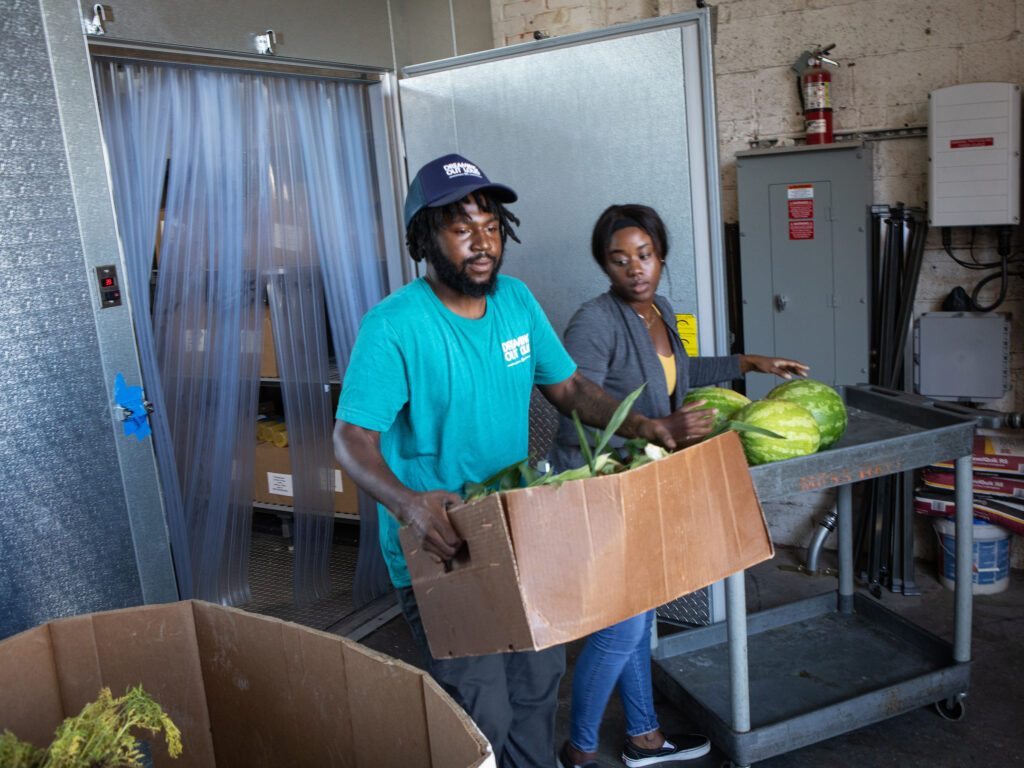
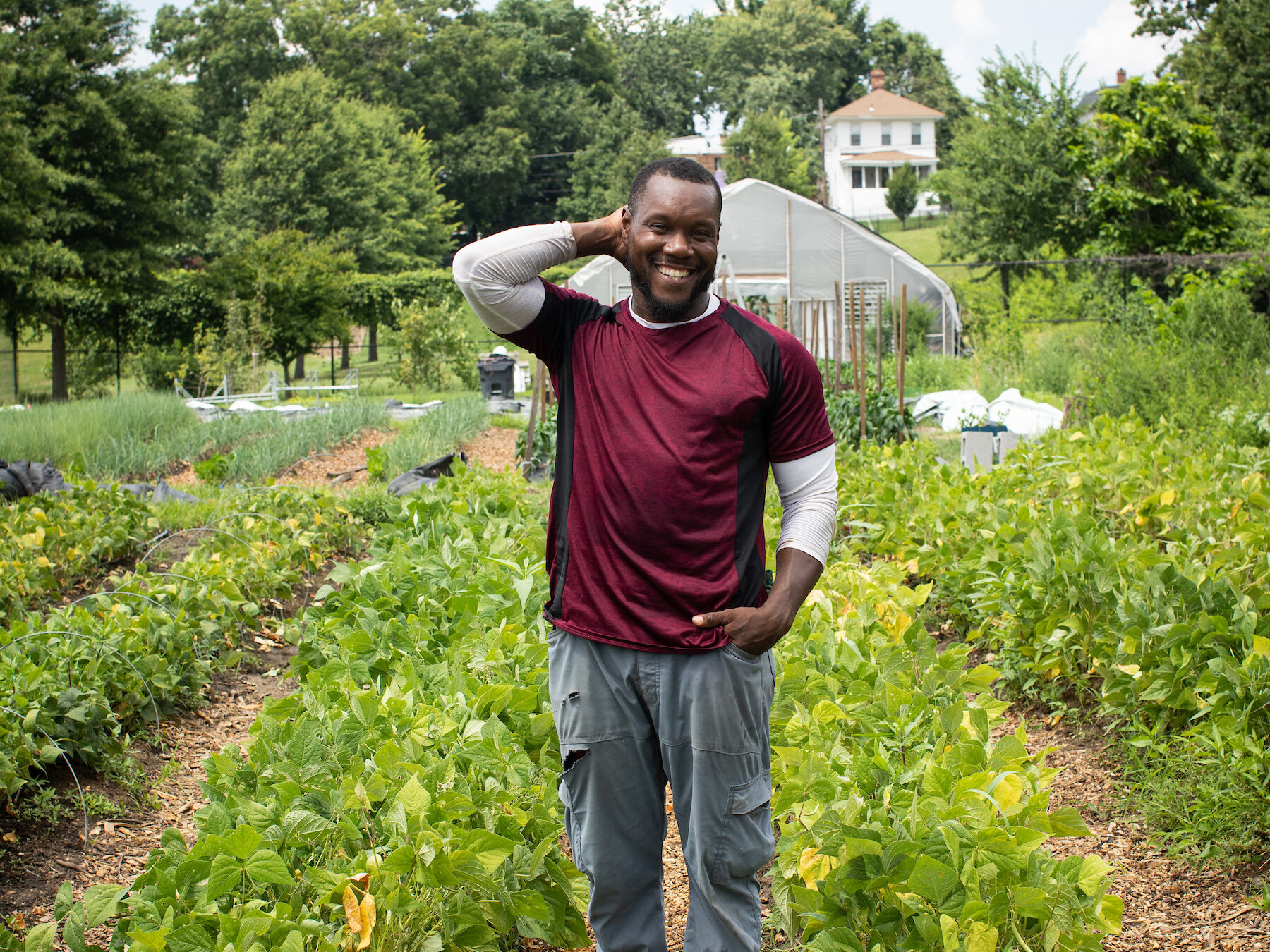
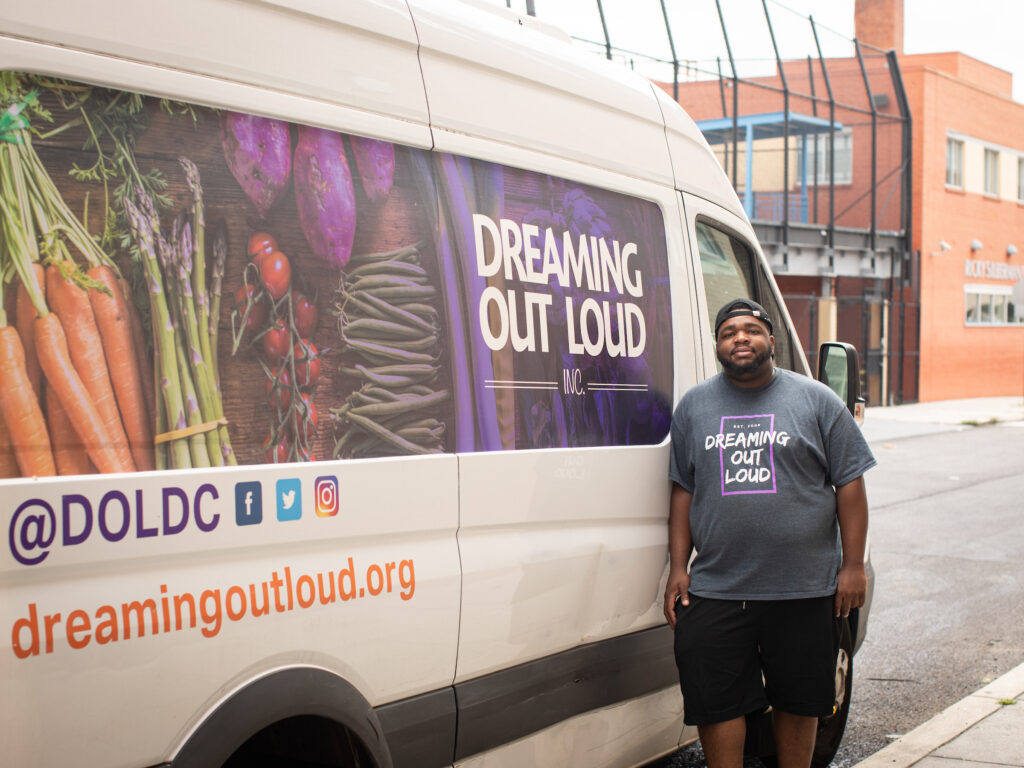
Stocking produce at ReFED grantee Dreaming Out Loud
It could be said that the United States has consistently struggled to manage its food system effectively and consistently. In 2021, as one marker, more than ten percent of Americans (13.5 million households) weren’t sure whether they’d have food on a given day. And yet, the U.S. tosses out about 35% of its food supply, or about 80 million tons, a number that Gunders describes as “ridiculous.” She considers other terms: “We talk about ‘surplus food’ a lot because it’s not waste until you waste it, right? What we really want is for there to be less surplus in the first place, and then for it not to go to waste.”
The good news about food waste is that, at least by Gunders’ standards, nobody wakes up committed to throwing food away. In a society where the bottom lines are treated as gospel, no business wants to buy food unnecessarily and have it not be consumed. Since its beginnings seven years ago, ReFED has been the sole national nonprofit dedicated to significantly reducing food waste, with aims to cut that 80 million ton in half by 2030. This won’t just save food, it could limit global warming and remake the food system into something far more inclusive and not inherently mired in systemic injustices.
To study food waste is to realize how it touches, and is touched by, every part of our lives.
From data to action
ReFED first formed in 2015, but its history really started with a foundational report that came a year later: the 2016 Roadmap to Reduce U.S. Food Waste by 20 Percent. It was part analysis, part action plan, and part acknowledgment of the severity of the issue. “It’s really about examining the food system to understand where waste is designed into it,” Gunders said. “And how do we find ways to design it out?”
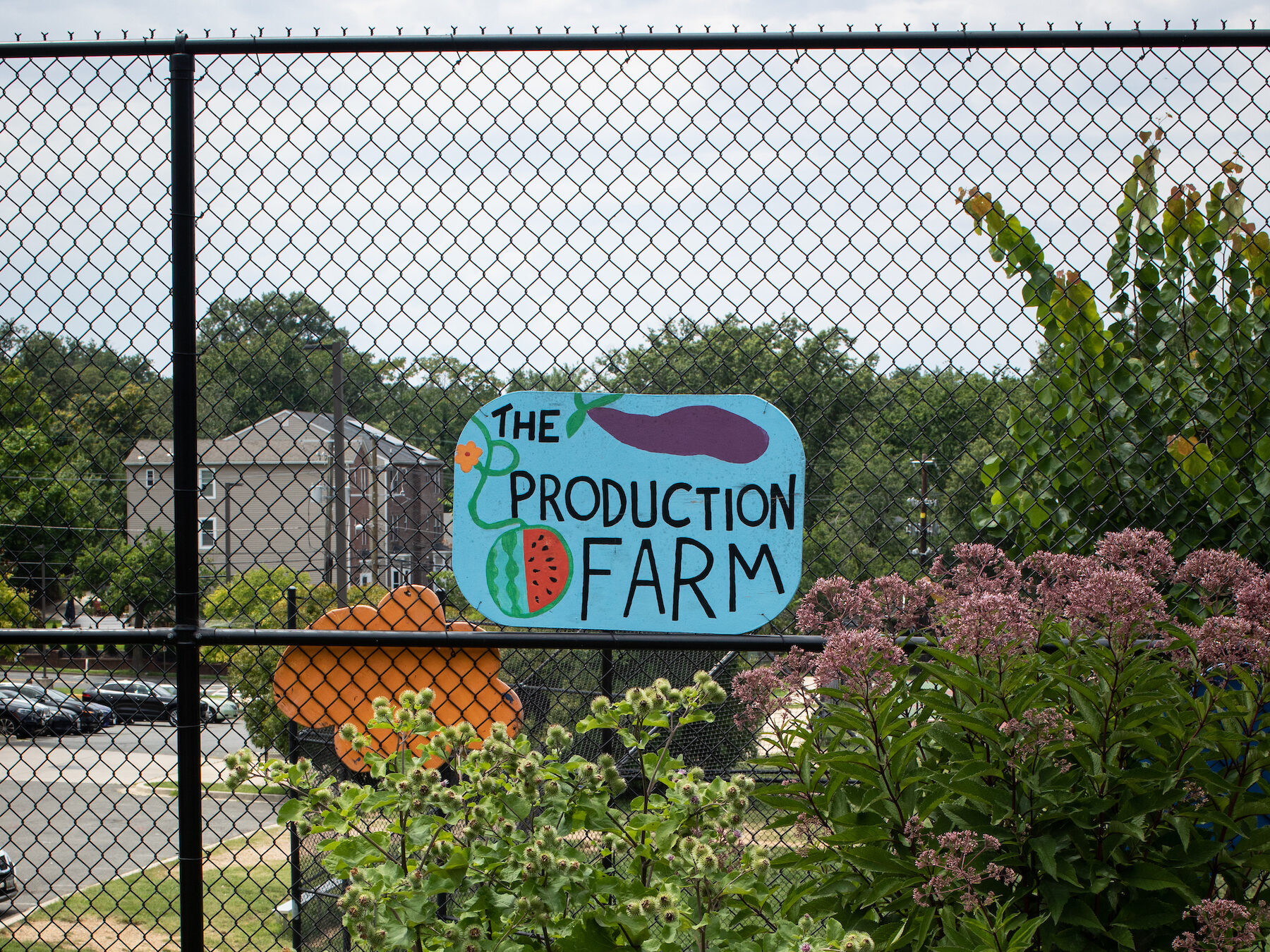
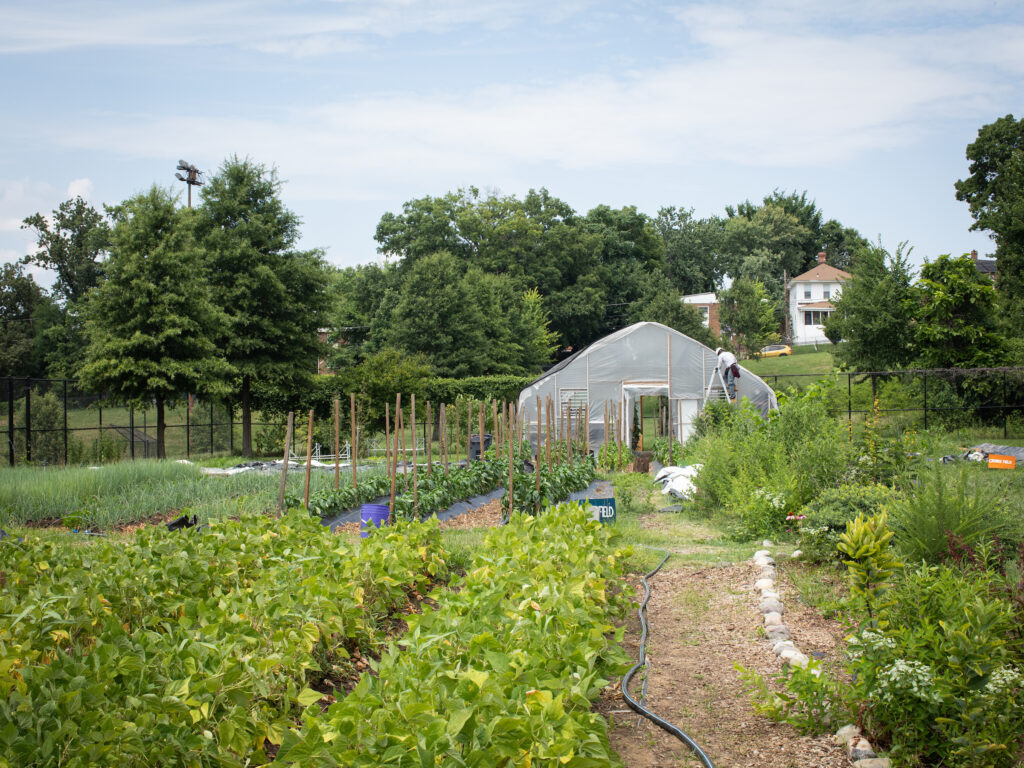
Dreaming Out Loud farm in Washington, D.C.
It also introduced one of the core creative tensions facing the organization: how to produce data, great data even, but always with an eye on making sure that data translates into action. “Lord knows we don’t want to sit around and create reports that sit on shelves and nobody uses,” says Gunders. “Our ultimate goal is to have people do stuff with that information.”
First things first. “You can’t manage what you can’t measure”, as Gunders puts it, so the organization compiled data sets and built an open-source data and insights engine. A robust toolkit that’s been used by government agencies, retailers, farmers, and many other stakeholders, the engine allows users to discover what actual documented issues currently exist, to research existing solutions and providers working on those issues now, and to calculate what impact those efforts may have.
One key action it’s meant to spur is donation. Impact investors, notably Jesse Fink, the founder of Priceline, were at the heart of the organization’s founding. Current funders include huge corporations and foundations like General Mills, Hellmann’s, Deloitte, and the Walmart Foundation. That insights engine? Sponsored by the Kroger Co. Zero Hunger | Zero Waste Foundation. This June’s announcement that ReFED would help launch the $100M Circular Food Solutions Funding Platform was the culmination of years of efforts to build structures around how they channel money.
“Anyone who’s interested in this topic, anyone who’s a funder, can participate in education and deal flow,” says Gunders. “And anytime an organization is looking for money, we put that on a list and send it out to all of these groups and it helps kind of grease the wheels of the whole system.”
Emily Broad Leib, Founding Director of the Harvard Law School Food Law and Policy Clinic, says ReFED is a critical platform for everyone interested in attacking this problem. “ReFED is really at the center of building that ecosystem, of maintaining that network, and keeping all the other stakeholders engaged,” she says. “They’re the group that’s field-building, the hub for all the spokes in this issue.”
Leib helps maintain the policy finder for ReFED, in part because the ReFED site is the most visible space in the food waste community, a digital watering hole for powerful groups who want to help and groups on the ground who are already helping.
So despite their relatively small size—just 20 employees—ReFED seems well positioned to effect change throughout the entire food system. Which would be nice, since, well, the system is so convoluted, so far from ideal. Take, for example, food waste and hunger. Right now, food banks, soup kitchens and churches rely heavily on food donations to feed those who are food insecure, a group that disproportionately comprises communities of color. So food waste… fights hunger?
“If I were going to design the food system from scratch,” says Gunders. “I would not design it so that the way we feed people who can’t feed themselves is to just over-buy and over-consume and then [donate the food] later in its life… what we really want is a food system that’s so efficient that we don’t have that surplus. And acknowledge that it is our social responsibility to have everyone in our country fed.”
She describes meeting a leader in food surplus issues in the Netherlands who was perplexed even at the idea of donating large amounts of uneaten food. There simply aren’t enough hungry mouths to feed in a country that prioritizes feeding the poor. So instead, they can focus sharply on reducing surplus without worrying about downstream impacts on hunger.
Dreaming Out Loud combats food apartheid through education, dignity and support to both farmers and consumers
But that is the Netherlands. In the United States, tackling food waste can involve a very delicate political and economic dance. Gunders recently testified in front of Congress and says that Michelle Obama’s 2012 school lunch guidelines came up, once again. The familiar talking point was that anyone who put more fresh vegetables in school lunches must not be against food waste, since children just throw the vegetables out. “It’s not okay to use waste as this argument against feeding people well,” says Gunders. “How about this: make the food taste better.”
For all the institutional and financial muscle of ReFED, though, one of their greatest assets is the understanding that big fixes in food waste sometimes start small. Yes, there are large-scale packaging solutions, and more private sector technology deployed against food waste than ever (food waste tech companies raised $1.9B in 2021, shattering old records). But according to Harvard’s Leib, small-scale, sometimes even personal, solutions are key.
“The actual process of addressing food waste happens at a local scale,” Leib says. “If we want to meet the 2030 goal of reducing food waste by 50%, we’re not going to get there unless we leverage what other people are doing on the ground. Some solutions are low-tech, and for those it’s about getting the message out. Otherwise, you’re just reinventing the wheel throughout the country.”
As Gunders puts it, ReFED is by design very “manual” on the solutions side. “We’re just reaching out as we hear about cool things that people are doing or cool companies or cool nonprofits that are doing something in this space,” she says. “Then we extrapolate from there: if scaled up, this could actually save, for example, 40 tons of food across the country and here’s how much it would cost to do it, and here’s how many greenhouse gases would be saved… it’s all a model we’re estimating, but we’re trying to paint some kind of picture to help people prioritize what they can do.”
Individual choice is also a confounding factor. Gunders says her favorite stat comes from a survey that found that 75% of Americans waste less food than the average American. That is, people always underestimate how much food they themselves waste. What they don’t realize is that small choices, such as putting out an overabundance of food at a house party, may make them feel good, may even be key to their self-identity as good hosts, but should be viewed also in light of food waste. Your individual desire to not leave any guest potentially hungry is closely related to desire that shoppers have to see supermarket shelves always full, even if that means guaranteed food waste or the resulting higher prices. Expectations and behavior alike need to readjusting, starting with each consumer.
Leib says that’s why the scaling up of all these smaller solutions is so key. “We’ve already seen a lot of preliminary successes coming from ReFED’s work,” she says. “But into the future, the change needs to be exponential.” In a world where food waste is responsible for 8-10% of global greenhouse gas emissions, she says, solutions both big and small need to be expanded as rapidly as possible.
A dream in DC
When the pandemic took root in the U.S. in early 2020, it exposed the vulnerabilities of the American food system—from indefinitely delayed supply chains to forced closures of business that serve or store food, which led to massive losses. ReFED saw an opportunity to create a rapid response fund to get money flowing to organizations already engaged with those communities most affected, ultimately delivering more than $3.5 million to 37 for-profit and nonprofit organizations. The effort helped to collectively keep more than 50 million pounds from being wasted during a critical period of the pandemic. In Washington, D.C, one such organization is Dreaming Out Loud (DOL), which was able to make 70,000 meals and deliver groceries to 1,300 recipients each week through November 2020 thanks to fund resources provided by ReFED.
Dreaming Out Loud’s Farm Manager Taylor Lewis
When Taylor Lewis began at DOL in February of this year, he was tasked with managing the Farm at Kelly Miller, a two-acre urban space atop a grassy hill, tucked behind a middle school in Washington D.C.’s Ward 7. His first mandate: to assess the site’s operations and workflows as the farm had become a beacon of community engagement since his employer launched it in 2018. Amid cordoned off row crops, in-progress digging, irrigation installation, a slew of raised beds, and a compost area, the farm produces fruits, veggies, and herbs to stock DOL’s aggregated farm-share, wholesale markets, and “U-Picks,” where community members of all ages harvest their own goods.
The Kelly Miller property would be Lewis’s first urban farming experience after five years tilling soil, two of them in a rural village in Ghana living with expat friends following a turn in the U.S. Navy. Suddenly Lewis found himself forced to live off the land in ways he hadn’t previously thought about. “For the first time I experienced what it meant to truly reap what you sow,” he said, seated underneath a shady tent one July morning. “You put a single seed in the ground, and it produces pounds of food. I felt fulfilled. I got into a more organic or natural rhythm of doing things and I realized this was something I might be doing for the rest of my life.”
DOL builds community-driven food systems through not only cooperatively supplying healthy foods targeted toward those who are most likely to be exposed to systemic harm, but by creating economically viable opportunities within the food system for those same residents. When Christopher Bradshaw founded the organization in 2008, it was with a clear eye on how food has been politicized in the D.C. Metro area, which is to say, the United States.
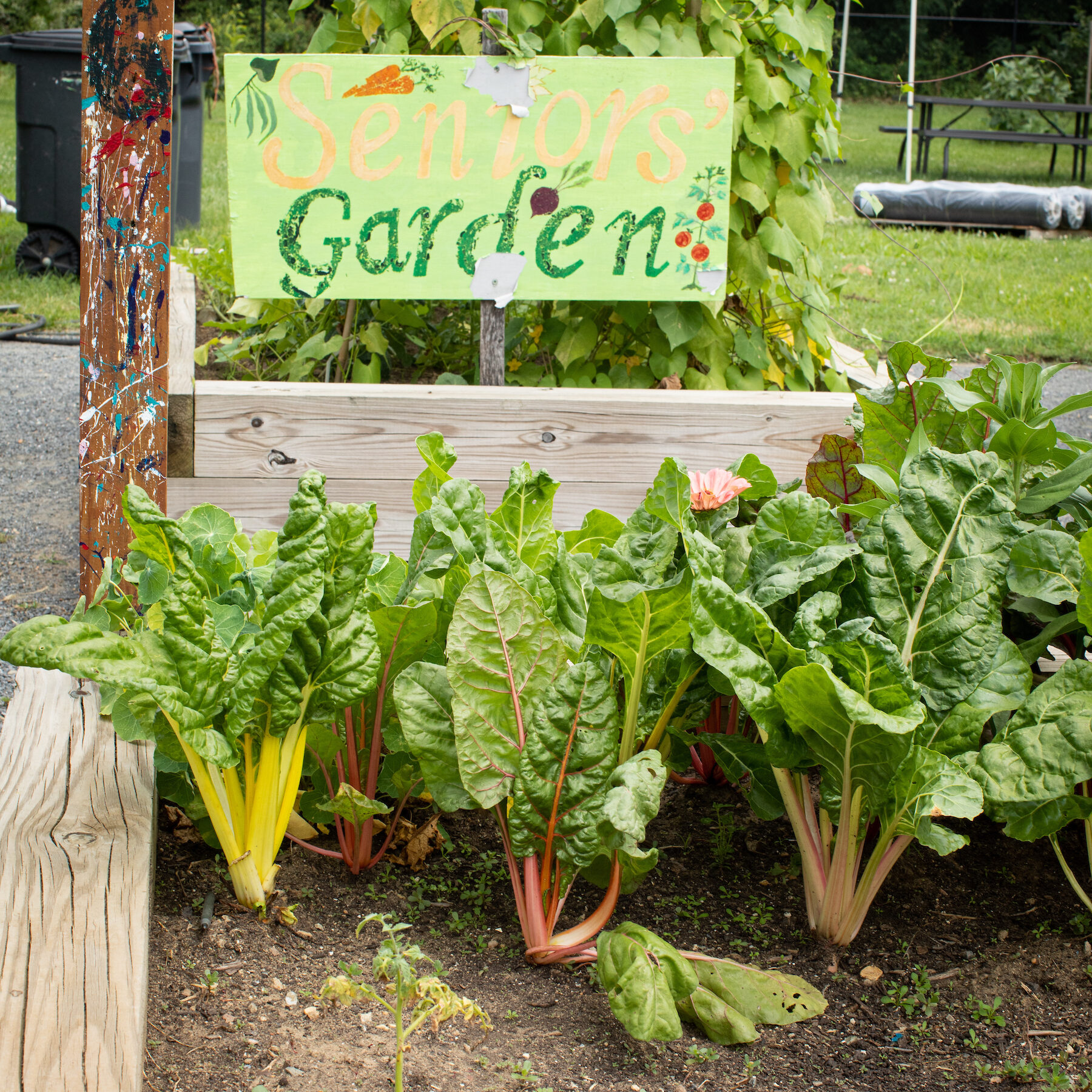
The Farm at Kelly Miller is a Dreaming Out Loud farm in Washington, D.C.’s Ward 7
To understand the mechanisms of how food as a business operates in the U.S. is to understand that this country has never embraced the responsibility of feeding its people—all of its people. From forcibly removing indigenous peoples off of ancestral land in their care, and owing to an agricultural legacy born out of slavery, food was not intended to ensure a country’s inhabitants receive nourishment or delight in pleasure. Rather, food became incentive to expand territories and acted as fuel to extract maximum results from a disposable labor pool robbed of their identities. The social caste hierarchy rooted in the eras of western expansion and enslavement is apparent in the weaponizing of food that brings us through the 21st century: the eradication of indigenous methods of tending to the land as the government pushed Native people to reservations; sharecropping where Black Americans were trapped in cycles of debt and access to food was restricted often to counter efforts to vote; the abuse of migrant farm laborers, many hailing from Central and South America, and the growing doom of food apartheid, the accurate term for what is often misnamed “food deserts,” where folks who are systemically blocked from living in certain areas find themselves miles away from grocers with healthy, appealing options.
DOL assessed the results of this brutal history and envisioned a path toward food security, including teaching urban agriculture skills to residents made vulnerable by these systemic issues. For that to happen, they would need to shepherd farmers, makers, and sellers into an integrated and transparent process that maximizes their effort and limits unnecessary losses. One way to do this is to aggregate produce from smaller farmers in the region to sell wholesale, distribute through the CSA, and retail at their markets. Or pre-purchasing from such farmers, which provides sustainability, lowers the farmer’s operating costs, and prevents them having to add labor to the retail side of their business. Without DOL, most of those farmers would not be able to produce enough food to make the investment worthwhile, or they would get stymied by frustrations like not having the cash to purchase cold storage to reserve and transport harvest waiting to be sold. Such was the case with a farmer in North Carolina whose story a DOL staffer related, who was harvesting his crops all day, leaving them to sit outside overnight, then driving 90 miles to market. Inevitably his routine was unsustainable, both due to the physical strain but also the loss of quality in his hard-earned harvest.
The Farm at Kelly Miller is a Dreaming Out Loud farm in Washington, D.C.’s Ward 7
DOL’s approach is to operate as a food hub that actually has skin in the game and knows the community they’re supporting. For example, they know that many of the heads of household who shop at the market at Kelly Miller are seniors, so they established a convenient drive-thru option. And recognizing that folks who pay with government assistance still want the sovereignty of picking and choosing which carrots or bell peppers go in their box ensures that all DOL staffers and volunteers are trained to know their produce and treat all customers with dignity and respect. It’s these types of efforts, from the herculean physical feats of moving thousands of pounds of food, to the mundane of setting up processes that flow smoothly, that reduce the risk of food waste across every farmer, company, organization, and household that touches DOL’s system. This is the kind of impact ReFED aims to have anywhere people have access to their solutions.
Christopher Bradshaw, Founder of ReFED Grantee Dreaming Out Loud
Food sovereignty, food security, environmental protection, racial justice, better health outcomes: so many things could be improved by what ReFED is trying to achieve.
Harvard’s Leib offers a blunter rationale for supporting ReFED’s mission against food waste. “It’s just a stupid problem,” she says. “Nobody is benefitting from this.”
Category: Shortlist
New Zealand startup BioLumic is producing radically healthier and more productive crops, simply by exposing them to novel “recipes” of UV light.
PALMERSTON NORTH, NEW ZEALAND
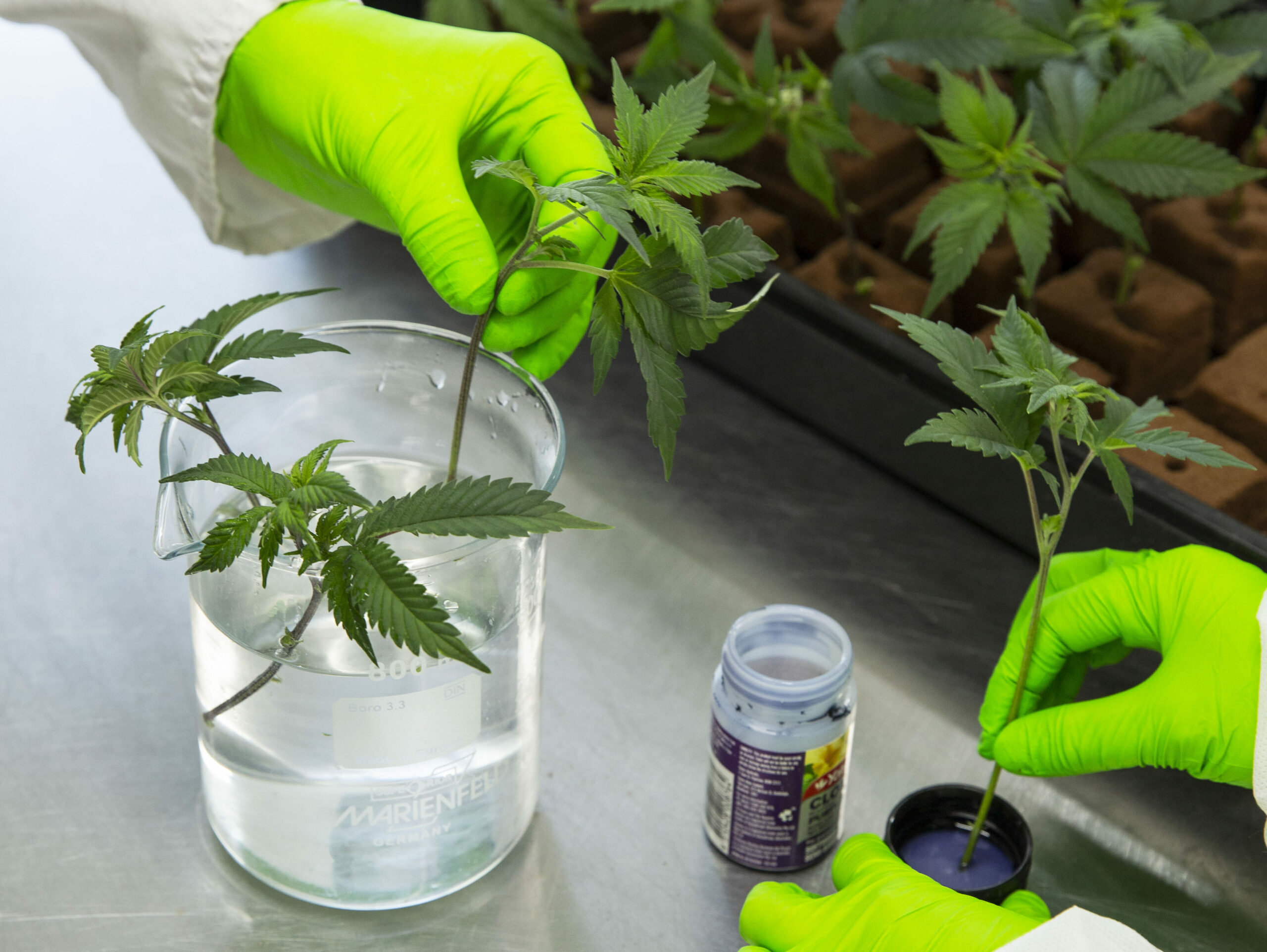
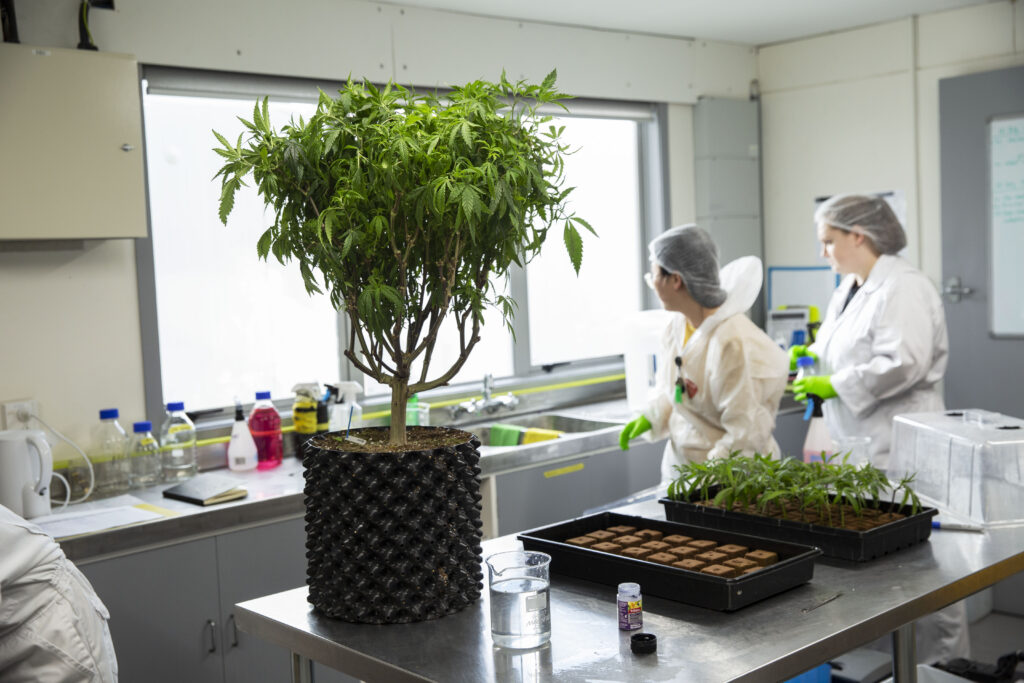
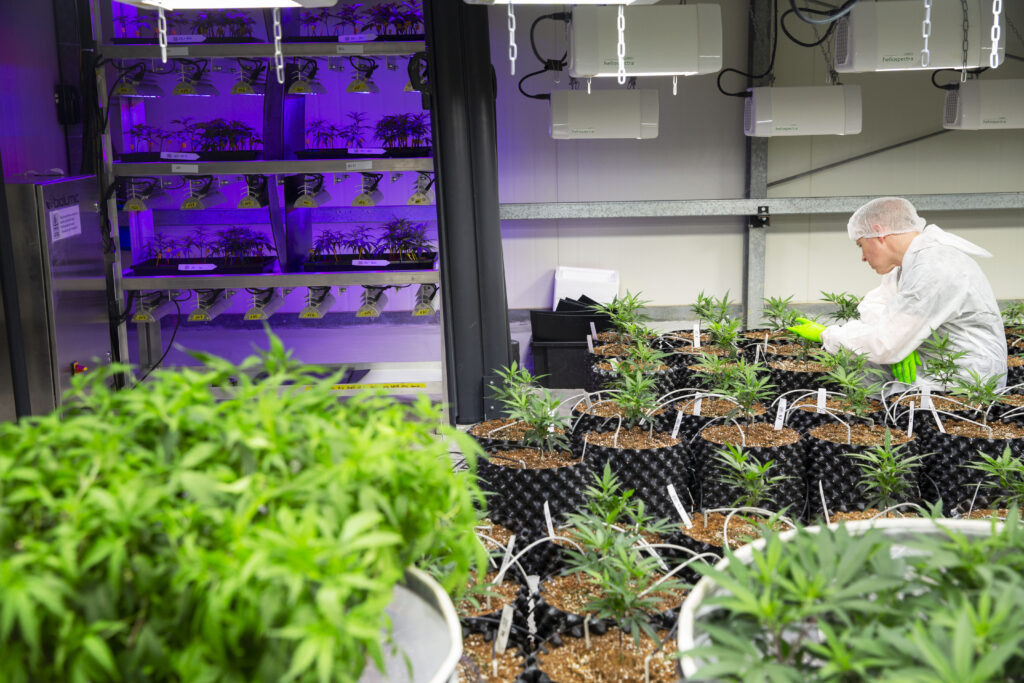
On four narrow shelves in a windowless room in a nondescript building in the New Zealand city of Palmerston North, eight dozen little cannabis clones are quietly and invisibly revolutionizing agriculture.
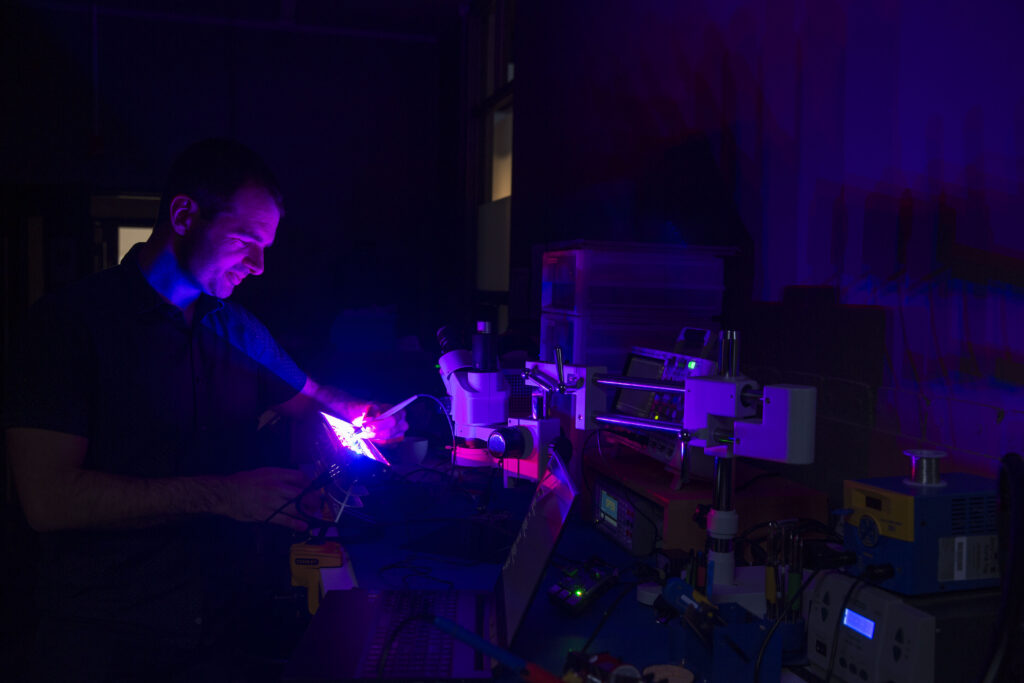
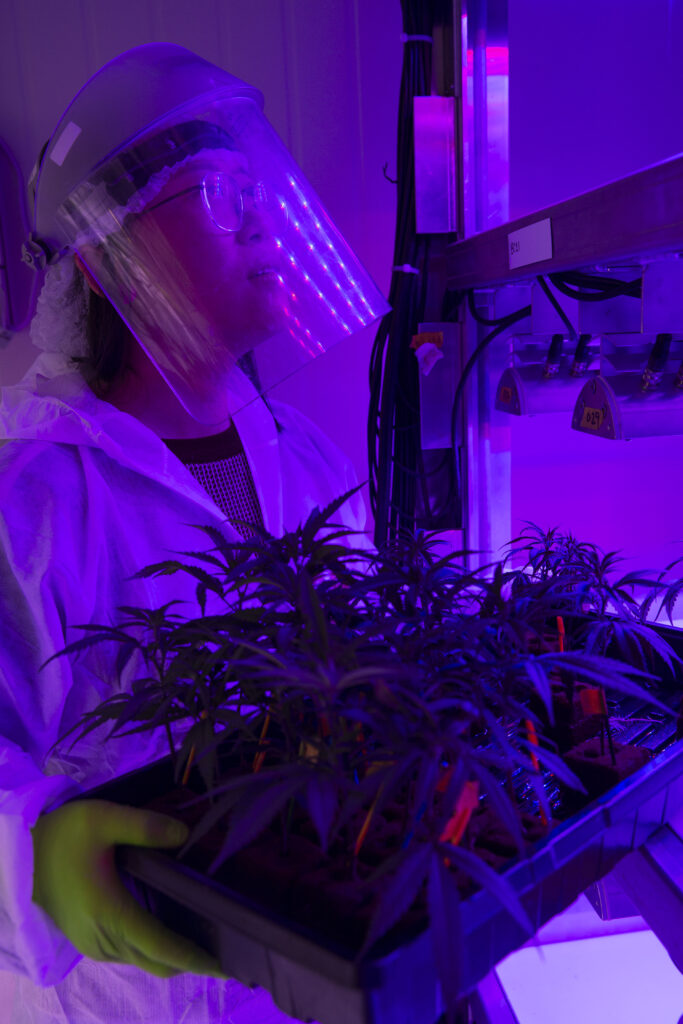
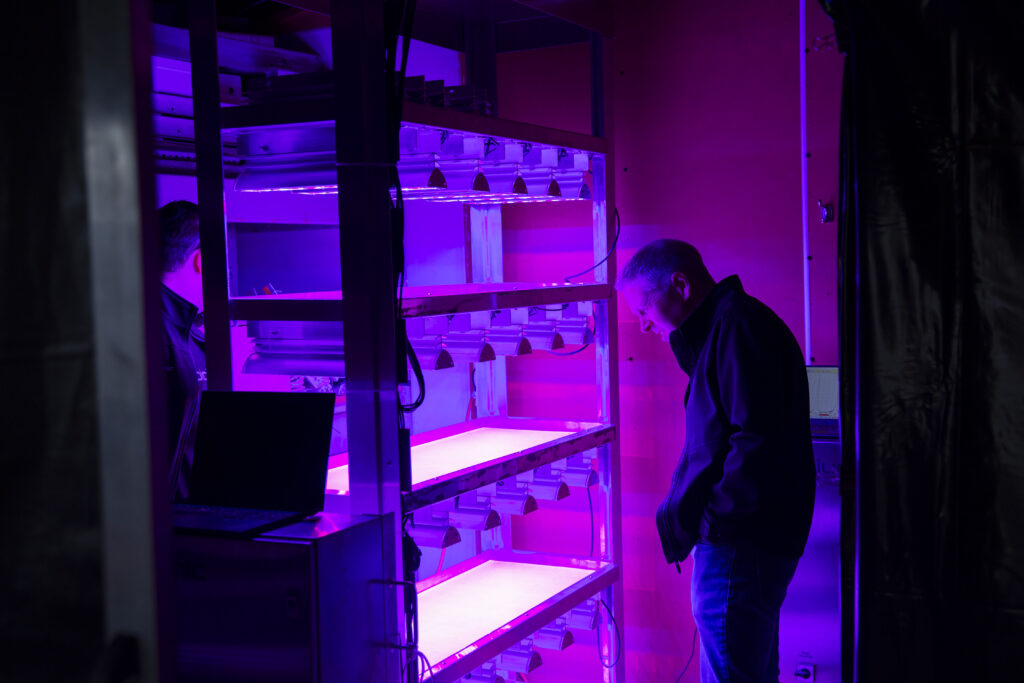
Banks of LEDs sit above each row of plants, bathing them in purple light. Some of the tiny diodes are blue, some are red—standard grow lights that mimic sunlight and enable crops to be grown indoors. But other LEDs are ultraviolet, producing various wavelengths that can’t be seen by human eyes. They’ve been electronically programmed at certain intensities and frequencies, and to turn on and off at particular intervals, according to a commercially-secret ‘light recipe.’
The plants will spend six days on these shelves, soaking up the UV like starlets on sunbeds—and by the end of the week, they’ll be changed forever.
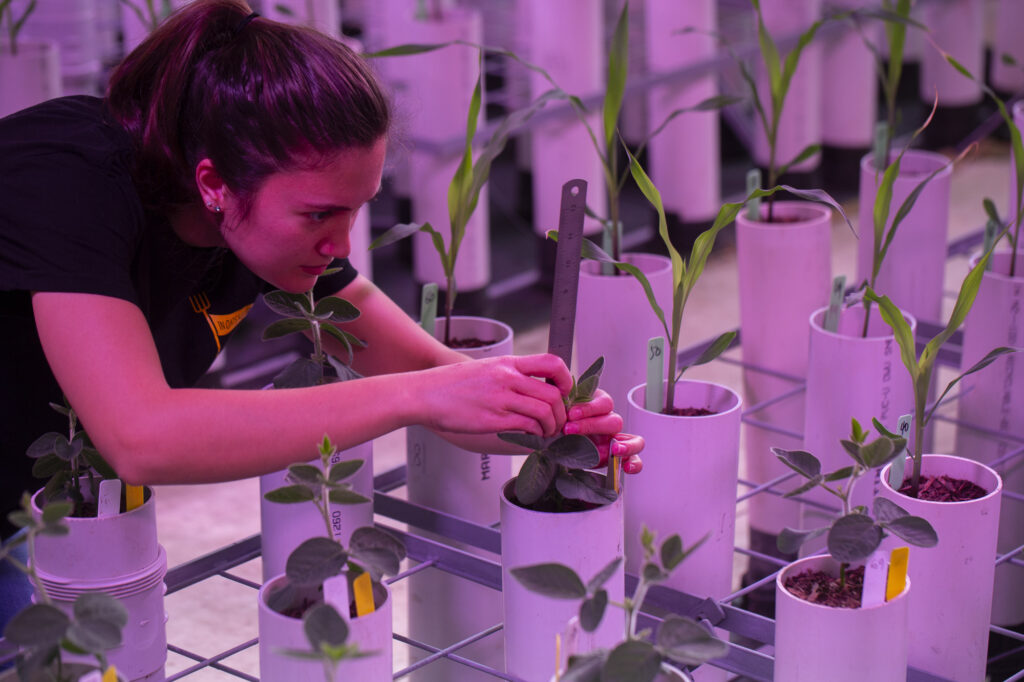
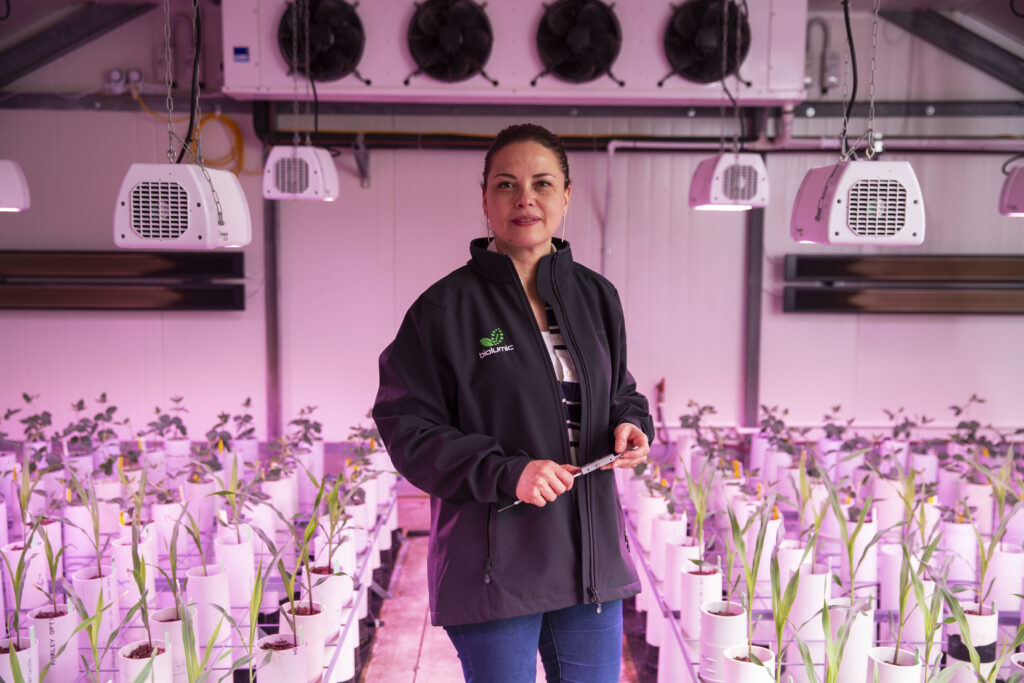
These light recipes are not just for cannabis—far from it. The science on display here is being developed at the international headquarters of BioLumic, a New Zealand-based agritech startup that’s been shortlisted for the Food Planet Prize for its work investigating a big and wild idea: that briefly exposing all kinds of young plants and seeds to specific ‘recipes’ of energy-efficient ultraviolet light can cause physiological changes that result in significantly faster growth, higher yields, and greater resilience to pests and diseases for the rest of their lives.
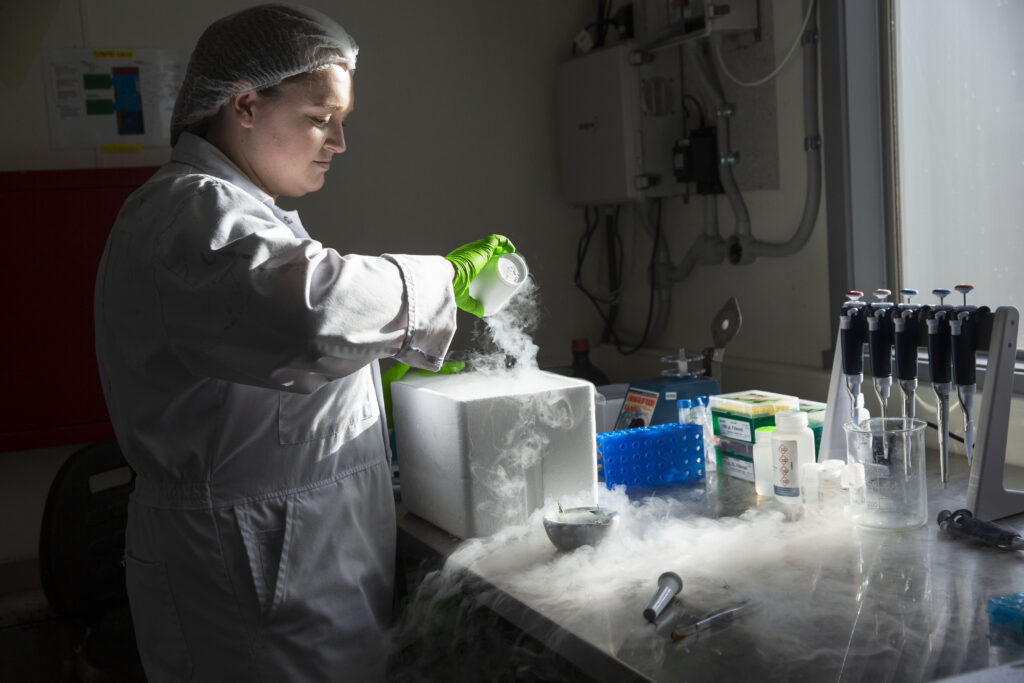
Biolumic technician Monica Topping and scientist Lulu He cloning cannabis plants
So far, BioLumic has proven the technique works with a handful of crops—lettuces, corn, tomatoes, cannabis, strawberries, soybeans—and is experimenting with a dozen more, including many of the world’s staple grains. They’ve already shown that ultraviolet light can boost the yield of strawberries by 47 percent, and increase the vigor of soybean plants by 39 percent.
Best of all, it’s completely organic. No extra fertilizer or pesticides, no genetic modification, no energy-intensive hydroponics or lifelong grow lights. All the plants need is a few days—or in the case of seeds, a few seconds—of light.
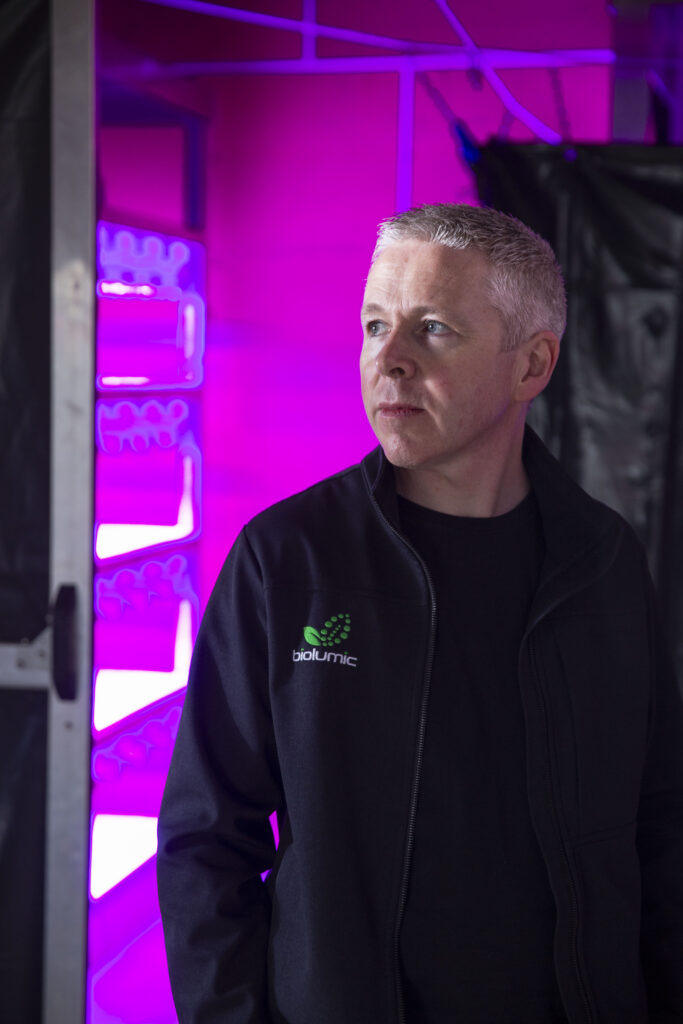
It does sound too good to be true, admits BioLumic founder and Chief Science Officer Jason Wargent—but the science is sound. “The idea of programming plants with light to express their potential? Yeah, it’s a sales pitch, but it’s an amazing one. It’s like a whole otherworldly future.”
The explanation for how it all works, however, begins in the deep past—around half a billion years ago, back when the first terrestrial plants began evolving
“The company’s story was actually 600 million years in the making because that’s when the first mechanistic changes occurred in plants,” Wargent says.
Ultraviolet light is not just one ‘color’—there’s a whole invisible rainbow of it. Scientists generally split the rainbow into three groups of wavelengths. UVC waves are the shortest and strongest, but are completely absorbed by the ozone layer and atmosphere. UVA wavelengths are the longest and weakest. The ozone layer in the stratosphere blocks most of the UVB waves, but those that sneak through are responsible for sunburn in humans—and in high concentrations, they can damage DNA, cells, and crucial proteins in plants. They can’t penetrate far into water.
Around 600 million years ago, the fledgling ozone layer had developed enough for organisms to venture out of the deep sea and into the shallows, resulting in the Cambrian Explosion—a massive diversification of life. By about 400-500 million years ago, the ozone layer was thick enough that the first plants could emerge onto land. But it was still a lot thinner than it is now, says Nick Albert, who studies the evolution of UV protection in plants at the New Zealand Institute Plant and Food Research, and is not connected with BioLumic.
Those protections enabled plants to multiply, evolve leaves and trunks and flowers, and spread across the landscape. Ultraviolet radiation gradually fell to roughly modern levels, but has periodically spiked numerous times since then due to geomagnetic reversals or ozone-layer depletion from climate change, potentially even leading to mass extinctions in the past.
Geoff Hunter, Biolumic Lead Electronics Engineer working in the electronics lab.
Even under normal conditions, Albert points out, a tree can fall in the forest and suddenly expose the understory to a blaze of unaccustomed UV. It makes evolutionary sense, then, that plants have held on to the ability to sense ultraviolet light and to change the way they grow in response. “Measuring and responding to UV light has been something that plants have been doing for a long, long time,” Albert says. “If it’s been retained throughout, then it must be really important.”
Research into plants and UV began in the 1970s and 80s, when scientists discovered that chlorofluorocarbon (CFC) emissions were severely depleting the ozone layer—the so-called ozone ‘hole’. Seeking to understand how the corresponding rise in UVB radiation might affect the world’s crops and ecosystems, they initially focused on its harmful environmental effects at high concentrations.
However, after CFCs were banned under the Montreal Protocol in 1987—signed by all 198 United Nations member states and without which, scientists have calculated, plants worldwide would have suffered and climate change would be a lot worse—scientific interest shifted to the more subtle ways in which exposure to ultraviolet light helps to regulate plant growth on a daily basis.
That’s what Jason Wargent was working on when he moved to Palmerston North from Lancaster in the United Kingdom in 2010 for an academic job as a plant photobiologist at Massey University. In 2011, scientists in Germany and Scotland discovered a protein called UVB resistance 8 (UVR8) that enables plants to perceive UVB. At around the same time, the development of ultraviolet LEDs made it possible to conduct much more fine-tuned experiments.
Research at Massey and elsewhere confirmed that when plants perceive the everyday presence of ultraviolet light with the UVR8 protein, they make minute adjustments to the way they grow in response. “Like they’re getting ready,” says Wargent. “Like they’re putting their armor plating on a little bit. And that gave us a toolkit to think about actually programming plants with UV.”
Scientist Veronica Kinsman phenotyping maize and soy plants treated as seeds with Biolumic light recipe in one of Biolumic’s controlled environment rooms.
Wargent founded BioLumic in 2013. Early tests on lettuce in California showed that exposing young plants to specific recipes of ultraviolet light could cause a doubling of yield once they were planted out in fields that had half the typical amount of fertilizer applied. The treatments also reduced the plants’ susceptibility to downy mildew, a crippling fungal disease that deforms leaves and kills plants, by around 50 percent. Wargent’s theory was that the UV prompted them to make flavonoids—plant-based chemical compounds—that helped to resist the disease.
At the same time, trials on strawberry seedlings led to each plant producing 43 percent more strawberries without any loss of fruit size or sweetness.
Clones being made from cannabis mother plant in Biolumic cannabis facility.
More recently, the company also began trials on cannabis. Unlike strawberries, cannabis plants are cloned and grown year-round, meaning there’s a consistent commercial opportunity for light-treatment. Wargent was also excited about the science.
Cannabis’ status as an illegal drug for the past half-century has meant there’s been limited research into the plant’s potential benefits—until now.
The treatments for cannabis are generally the same as for other BioLumic seedlings. Wargent’s team takes small cuttings from the mother plants, then places each clone in a sterile foam cube. Once the little plants have grown some roots, at around 2-3 weeks old and 4-5 inches high, they’re moved to the UV treatment shelves, where BioLumic’s (mostly female) scientists trial different light recipes on the various strains. The simplest way to think about the recipes, Wargent says, is that they’re unique combinations of wavelengths, time, frequency of timing, and strength. He won’t reveal any more detail—the rest, for now, is confidential.
After six days—“just a tiny amount of their life,” he says—they get transplanted into larger pots, and when they’re big enough, they’re moved to the ‘flowering room’, where the (non-ultraviolet) lights mimic the shorter days of autumn, triggering blooms to form.
The company started cannabis trials in early 2020. As the flowers ripened, the coronavirus spread around the world. In March, New Zealand Prime Minister Jacinda Ardern announced the country would be placed in lockdown, one of the world’s strictest at the time. “We thought, what are we going to do? Our babies!” says Wargent. The evening before the restrictions came in, the entire team pulled together to harvest the marijuana flowers and send them off for analysis.
As they all isolated at home, the results came through: the flower yield—the mass—had increased by an average of 44 percent in the treated plants compared to controls.
Biolumic scientist Caitlin Elborough extracting RNA from cannabis leaves.
Since then, the scientists have refined the recipes, and have had more success with some cultivars than others. BioLumic treatments have boosted the yield of the ’White Cheese’ strain by 59 percent, increased the cannabinoids in its flowers by 27 percent, and the THC by 94 percent. Wargent points out that they’re not being grown for recreational purposes, but for medicinal cannabis companies that harvest the active ingredients for health products. Greater yield could make for cheaper products for those that need them.
Increasing yield is the “holy grail” of agricultural research, Wargent says. If you can make a plant produce more with the same inputs (water, fertilizer, pest and disease control) you can feed more people more quickly with less land. Fewer forests need to be cut down, less energy is needed, farmers can earn more, and food will cost less. The techniques BioLumic is perfecting on cannabis could have far wider implications for global food security.
Biolumic scientist Lulu He removes cannabis plants following six-day Biolumic light recipe treatment.
Treating tiny plants with light is one thing—leaves are light-detection machines, after all—but seeds are another. Discovering that the recipes worked even with seeds was a ‘eureka moment’, says Wargent, which significantly broadens the technology’s potential global impact: most staple food crops are grown from seed, and are sown en masse directly where they will grow.
The team started by treating already-germinated seeds for 24 hours, placing them on a tray under the UV LEDs in a fridge-like cubicle. Further experiments revealed it was enough to treat a dry seed for a matter of minutes, even seconds, to change the trajectory of its life. “Almost by the time you shut the door, the treatment’s over,” says Wargent.
And it doesn’t seem to matter what kind of seed it is. So far, the team has experimented with soybean, corn, canola, lettuce, and broccoli seeds, with tests just beginning on peas, ryegrass, wheat, oats, barley, and rice.
“So far, all the seeds we’ve tried, it’s worked,” says BioLumic New Zealand R&D lead Ana Pontaroli, who was previously a wheat breeder in Argentina. It seems incredible, but seeds are not dead, just inert, she says. They lie in wait for a signal—light, water—that tells them to start growing. It seems BioLumic’s treatments simply provide an additional stimulus to which the seeds respond.
Field trials with BioLumic-treated soybeans in the United States showed they grew faster, resulting in a 25 percent yield increase compared with controls. Commercial breeding programs would typically invest in a variety that showed a 2 percent yield, says Wargent. “So to get double-digit percentage gains by just turning a little switch…”
In addition, when the US team deliberately inflicted a pest attack on the leaves of the fully-grown plants, they found that those that had been light-treated as seeds had half the amount of insect predation than the control plants did.
“Crops with early vigor can be more efficient in uptaking nutrients and water and competing with weeds,” says Pontaroli. “And if that translates into final yield, that’s obviously a gain for the farmers. That’s something that gives us hope it can be translated into a product.”
The few farmers with direct experience of BioLumic seeds are already impatient to get their hands on more of them.
West of Palmerston North, the landscape is flat, farming heartland. Dairy cows stomp mud across neon green paddocks. On one horizon, hundreds of wind turbines are strung along the Tararua Range. On the other, the massive snow-draped volcanic peaks of Taranaki and Ruapehu loom surreally above the plains.
Near the agriculturally-named town of Bulls—adorned with bovine statues on every street corner—is Waitatapia Station. The name means ‘plenty of good water’ in Māori, and the farm stretches across 2200 hectares of sandy country in five blocks near the Rangitikei River.
Three generations of Hew Dalrymple’s family have farmed here for a century. Around 25,000 lambs and 2000 beef cows are fattened here each year, the paddocks interspersed with forestry blocks of radiata pine. The Dalrymples also grow maize, barley, and wheat, and vegetables for the frozen and fresh markets—sweetcorn, peas, beans, cabbages, broccoli, cauliflower, and parsley.
New Zealand farmer Hew Dalrymple checks his commercial broccoli and cabbage crops during winter 2022. Dalrymple has trialed Biolumic broccoli and corn seeds previously, although the crops are not treated with Biolumic light recipes.
The scale allows Dalrymple to be an early-adopter of new technology, equipment, techniques and crops. “In the last 25 years, we’ve had some form of trial on the farm every single year, and quite often multiple trials on different things.”
So when Wargent came to him a few years ago asking to test BioLumic corn on the property, Dalrymple immediately agreed. Light affecting plants’ growth seemed logical, he thought, but seeds? “I thought to myself, now we’re getting a little bit extreme—light treatment on a seed? But I did think that if it works, that’s outstanding, because there’s only a limited amount you can do with treating plants. You can’t efficiently go and treat a paddock of maize with light.”
Wargent’s team treated around 1000 corn seeds with UV, and planted them in a 10×20 meter patch inside one of Waitatapia’s cornfields. In every other way, the seeds were identical to the rest of the crop. But at harvest time, when Darymple walked out among the swaying green stems and came to the BioLumic patch, he was staggered at what he saw.
“It struck me down,” he says, shaking his beanie-clad head. “It was unbelievable. Unbelievable.”
In a typical maize paddock, he explains, the plants are uneven. Although they’re genetically identical, some are taller and stronger, while others are weedy and small. But in the BioLumic area, all the plants were the same. The best plants weren’t any better than the biggest control plants, but there weren’t any that were stunted.
When the scientists lifted the corn from the soil, the BioLumic plants had much larger root systems. And when they analyzed the yield, the treated plants produced at least 10 percent more kernels by weight. (A second trial in 2022 recorded a 15 percent increase.) It wasn’t that the cobs were bigger, it’s just that they were all big. The plants had maximized their potential. “It came from lifting the bottom ones up,” says Dalrymple.
A ten percent yield increase would equate to hundreds or thousands of extra dollars in his pocket, he says, and if the treatment costs less than that, “why wouldn’t you do it?” That’s without even considering the other potential benefits. BioLumic hasn’t conducted fully organic trials yet, but even having to apply less fertilizer and pesticide would have environmental as well as economic upsides, he says.
“This is game-changing stuff in my opinion—it is extraordinary tech.” He was so impressed by the results, in fact, that Waitatapia Station made a small investment into BioLumic. “People could say you have a biased view, but I wouldn’t have said anything different to you if I didn’t have a cent in it,” he says.
Biolumic Founder and Chief Science Officer Dr. Jason Wargent during a software and engineering test of the Biolumic light recipe system.
BioLumic can now show that their recipes work, but they’re still unraveling exactly how. We know that plants sense UVB with the UVR8 protein, which then triggers a bunch of genes to be expressed. But plants have many different receptors to sense visible light, so it’s possible there are other UV receptors we haven’t discovered yet.
The company’s scientists also aren’t yet sure exactly what is going on inside the plant that leads to increased yields or increased cannabinoids—just how the UV light “unlocks its potential”, as Leyla Bustamante, BioLumic R&D Science Manager puts it. “You could be an athlete, you just need to train—so likewise, there’s this potential in the plants to do the things that normally they don’t.”
Originally from Colombia, Bustamante is a molecular biologist who worked on malaria in the UK for 17 years before moving to New Zealand and joining BioLumic in 2019. Although she had never worked on plants before, as a biologist, she was “interested in anything that has a good question and a good hypothesis and good data to answer those.” She found BioLumic’s question fascinating: “Just like, what is happening inside that is telling this little organism to change, to be better? As a biologist, that’s just beautiful.”
Leyla Bustamante, Biolumic R&D Science manager in controlled environment room for maize and soy seed treatment testing.
The company’s scientists are beginning to glimpse the genetic basis of the changes wrought by the light treatments, Wargent says. They take a tiny leaf sample the day after the plants come off the UV shelf, crush it up in a mortar and pestle, and run the genetic material through a desktop PCR machine.
That’s enabled them to identify ‘marker’ genes that are expressed in the treated plants, but not in the controls. Wargent hopes those markers may allow them to play detective, and investigate the pathways that lead to increased yield—or even reduced inputs of fertilizer, fungicides, or pesticides.
As the genetic data mounts, he plans to use machine learning to predict which recipes are likely to be successful for which varieties. “We think there are billions of these potential recipes, even just in the UV space—different timings, intensities, durations, wavelengths. Billions. So how are we going to test all those? We have to predict them.”
The knowledge gained in the process could even have much broader implications.
“We’ve got a reasonable chance of understanding [how] yield might be controlled in a way that no one understands today,” Wargent says. And light might only be one route to influencing it. “There could be other ways you could pull instantaneous within-lifetime levers in crops.”
Biolumic founder and Chief Science Officer Dr. Jason Wargent checking cannabis plants in the vege grow room.
If Hew Dalrymple could plant entirely BioLumic corn tomorrow, he would. But the start-up is only on the cusp of commercialization. To illustrate the problems of scale, Dalrymple does a few sums. Waitatapia alone uses around 105,000 seeds per hectare of maize, and last year, they planted 115 hectares. That’s more than 12 million corn seeds every year, just on one New Zealand farm. Globally, “there’s trillions, there’s kazillions of seeds grown a year.”
Reaching that scale isn’t impossible, it will just take time, Wargent says. In the US, BioLumic is experimenting with a conveyor belt system to treat more seeds at once. In 2021, they trialed light-treated soybean seeds on 1700 field plots in 74 locations. The company is close to commercializing a cannabis product in collaboration with an Auckland medicinal marijuana company.
The business model is not selling devices or hardware. Instead, BioLumic plans to license the light recipes, providing the hardware for free or through partnerships with manufacturers (they have just signed a deal with global grow light company Fluence.)
That means farmers wouldn’t have to make an expensive investment up-front; they would simply pay a royalty on top of the cost of their seeds, just as they do already for other common treatments and coatings. The price of the BioLumic treatment would be similar, too, Wargent says. “It has to work for the farmer.”
Ultimately, he envisions a future where a seed cooperative in Africa can take out a license to provide a BioLumic UV treatment locally to smallholders, with the confidential recipes beamed wirelessly from New Zealand to the LED device at the push of a button.
But in addition to logistics and scale, and developing the precise products for each crop, a few more years of field trials are needed, Wargent says. “Having repeated seasons in different varieties of each crop, proving beyond doubt that your technology provides benefits to farmers.”
“Farming is hard, and it takes time, and science is also hard and takes a long time. You don’t go from promising work to something that is scaled across the planet in 12 months. We’ve developed the technology. Now we’re developing the product.”
Sitting in his farm truck on a winter morning in June, looking out over the stubble where the latest BioLumic corn trial was harvested, Dalrymple is as close to excitement as a Kiwi farmer typically allows himself to be. “Ten years ago, if someone said to me, we’re going to alter the yield of plants just by zapping light onto a seed, I’d have said, I don’t think so. But here we are—there’s no debate about it. It’s just a fact now that light treatment of seed is going to be part of the farming world.”
Category: Shortlist
Deep in the Ecuadorian Amazon, an organization called Yakum is seeding a better, cleaner, greener future for the Siekopai people.
SIEKOPAI REMOLINO, ECUADOR
Antonio Francisco Noteno and his wife Liliana had a plan. They were going to clear the forest on their property to finally be able to make some money. They would bring a bunch of cattle up to their plot in the Amazon, and they would plant African palms for palm oil, a hugely popular cash crop in their corner of Ecuador. But in the middle of the process—they had already cleared 8 of their 20 hectares—Liliana heard a cry for help.
Actually, they were both drinking yagé—better known as Ayahuasca, a psychedelic medicine sacred to many peoples in the Amazon and an important part of the Siekopai culture. In the middle of their ceremony, a tiny tick entered Liliana’s vision.
The tick had a question for Liliana: “This is my home, my life. Why are you destroying my house?”
As Noteno tells this story later, he places his palm on his chest. “At first, I didn’t agree with my wife. I said, ‘Do you think the money is going to fall from the leaves? Do you think our daughters are going to study for free because their parents plant trees? No! We need money.’”
But then, he says, he reconsidered. “How could I not change my mind and support my wife, when she told me about this? Eventually, planting fruit trees will be useful for me. I have two daughters, they’re eight and nine. One day, when they grow up, their children and families will be able to consume what we plant today.”
The Seed is planted
And so, just like that, Noteno became a partner with Yakum, an organization that supports Ecuador’s indigenous communities by helping them restore and strengthen their forests. In Noteno’s case, that meant planting unguragua and camu camu for food, balsamo of Peru for wood and blue huaryruro for crafts.
Yakum’s on-site nursery in Siekopai Remolino. Below: Yakum team members at one of their community gardens, in the Sachawaysa Kichwa community.
Nick Ovenden, a British biologist and educator, first launched Yakum—the name comes from the Shuar language word for howler monkey, of which the cry was a metaphor for Yakum’s call to action—as a GoFundMe in 2018. The following year, Mike McColm, an experienced environmental organizer and activist originally from California, joined the effort. Together they legally established Yakum as an NGO and set out to figure out how to help indigenous families like Noteno and Liliana’s make sustainable, regenerative land use a reality on their lands in the Ecuadorian Amazon.
The idea is a powerful one: help the people of the Amazon ensure their food supply—including the Siekopai community—without destroying the forest in the process. By planting trees for food as a viable alternative both to processed foods and to fast-cash but destructive crops such as palm oil, Yakum hopes to support to improve food sovereignty and nutrition—with so-called Food Forests. The forces they are fighting against are complex and relentless—industrialization, deforestation, urbanization, culture and language loss—but Yakum thinks seeds can be a potent countermeasure.
Thankfully, the Amazon is home to superhero seeds. The fruit of the camu camu has 100 times the vitamin C of lemons. The morete palm produces a thousand pounds of fruit a year, with 11 times the vitamin A of a carrot, provides habitat for up to 900 living species, and has leaves that can be used to make thatched roofing. The jaboticaba fruits six times a year and is used to make jelly, desserts, wine, soft drink, ice cream, even wine. The inga ilta tree has pods up to three feet long with edible pulp like its cousin the ice cream bean, but also has edible seeds that provide much needed protein. As a bonus, its leaf litter is an abundant nitrogen fixer, like a “fertilizer factory for the soil”, says McColm.
Yakum has a nursery in Sachawaysa, near Tena, where McColm lives. He personally provides many of the seeds to Yakum from his own land, but the 12 member Yakum team also forages for seeds—for fruit trees, hardwood trees, medicinal plants. They have planted 223 different species, including several on The World List of Threatened Trees, such as the mahogany tree. McColm’s eyes shine when he recalls the first time he saw mahogany seeds in nature, back in the 1990s: “It was like picking up gold.”
McColm has an avuncular, effusive enthusiasm for these plants and their powers. If you ask him to start describing the work, you’ll get a flowing river of facts and asides and bon mots and place names and phylum names and names of people he cares about deeply and thinks Yakum can help. Since he first came to Ecuador in 1983 he has worked with the Awajún people in the Peruvian Amazon, and with reforestation throughout Ecuador, from the inlands to the coast. In total, he estimates, he has contributed to planting approximately seven million trees over his career. “I really just enjoy getting to plant a lot of trees all the time,” he says with a smile as we sit down for a lunch of, of all things, falafel in Tena.
Ruth Payaguaje, Mike Mccolm, and Arley Piaguaje are part of the Yakum team helping to reforest communities in the Amazon basin
Ruth Payaguaje, Mike Mccolm, and Arley Piaguaje are part of the Yakum team helping to reforest the Amazon basin.
Bridging distances
The name of the Siekopai roughly translates as “multicolored people”. The Spanish called them los encabellados—the long-haired—after the way their men wore their hair. There are 14 indigenous nationalities of Ecuador, totaling 1.1 million people. Kichwa is the biggest group, followed by the Shuar people, with 100,000 inhabitants. Only a quarter of indigenous Ecuadoreans live in the Amazon, and those include some of the country’s most vulnerable populations, like the Siekopai, who number a little less than 700 people, according to the last census made three years ago.
Their lands can also seem remarkably remote. The settlement of Siekopai Remolino, population 250, is only accessible by canoe, and a recent monitoring mission with Yakum took five days, much of it traveling on the river past endless plantations belonging to the country’s biggest palm oil company, Palmeras del Ecuador (Ecuador is now the 11th largest palm producer in the world). These logistical challenges are constant for Yakum: having run out of room in the canoe for saplings, they began transporting the germinating seeds instead.
Distances notwithstanding, Yakum is committed to monitoring the trees they plant. Every two or three months after planting, they return to measure height and circumference and viability. It is a source of extreme pride, and a key to their success, that their plantings have a survival rate of 95% or higher in those initial check-ins.
Gilberto Piaguaje, an elder from the Siekopai community of Remolino who lends his great knowledge of plants and trees to the Yakum team to expand the variety of plants and trees in deforested parcels.
Gilberto Piaguaje, a Siekopai elder, meets our group when we arrive and we join him while he plants corn, an increasingly important crop for the Siekopai (they make flatbread with corn flour as well as cassava flour). Piaguaje tells a story about how his grandparents drank ayahuasca, which gave them the ability to travel far away as spirits, and then how they came back with the first Siekopai corn. But it’s soon clear these were not grandparents, but ancestors, and he’s speaking of events that happened centuries or more ago.
It’s not just his stories that seem suspended in time. Traditions are everywhere. Before leaving to work in the forest he always paints his face with red tincture. This is, Piaguaje says, to protect him from the wild spirits.
But at some point, the romantic notions of indigenous life in the Amazon also collide with the reality that Piaguaje, like all Siekopai, are living in modern times, and they face some very modern problems.
The Amazon Basin is a place where people live. It is the world’s biggest tropical forest, of great importance for the rest of the world. But it is also everchanging—not something pristine, but an enormous area with many footprints from humans, cities, villages, television, clothes, money, drugs, alcohol, dreams, contaminations, deforestation, plastics, malnutrition. It is also home to millions of people, with big cities like Manaus and Iquitos. And the people living in the Amazon need something to live off. They need money.
So even as Piaguaje looks to his dreams for information about when to sow the corn, he is also worried about the present-day political and economic threats to Siekopai territory and the Amazon in general.
There is much to worry him. The government seems failing in its fight against illegal gold mining throughout the Amazon region. The river that flows alongside Siekopai Remolino—the Aguarico river—is severely contaminated from decades of oil extraction and pollution in nearby oil fields. Upstream raw sewage is dumped into the Aguarico from Lago Agro, and then there’s oil NNdischarge, mercury from mining, toxic agrochemicals for palm oil. And yet oil extraction in Amazon continues to be Ecuador’s most important source of income, as it has been for decades. Even smaller incursions, like a band of violent cattlemen and squatters who crossed in from Colombia in the beginning of September, are a serious threat to the Siekopai, requiring a concerted vigilante effort to keep them from destroying the forests.
Diana Quilumba of the Yakum team participates in a traditional kichwa dance in the community of Sachawaysa
For Piaguaje, the key to the Siekopai standing strong against all these forces is reinforcing their own lands. “For me, forests with animals and rivers is a wealth. The forest covers us, it is like a house for us… that’s why we always talk about conservation, because in other communities they already see more the money, they want to change to a new way of life. Money in exchange for logging the forest and to plant African palm,” says Piaguaje. “This is what we always talk about, and now in the meetings. We could look for someone who can pay us because we are guardians and caretakers of the forests. Because in other parts of the world you say that this forest is purifying the air, that they are the lungs of the world. That is why we are planting fruit trees and reforesting. We are resisting with our way of thinking,” he says.
Gilberto Piaguaje breaks an achiote fruit to extract red coloring used for face paint.
Piaguaje tells the story of how he has been bitten by the so-called X snake, a type of pit viper that is one of the most venomous snakes in Ecuador. Several of his dogs were also bitten. If it is not treated, it is deadly. But he shows me a medical plant, which he used to heal himself and the dogs. Piaguaje reflects on the value of the forest and the wildlife within it. “If I cut down my forest I have nothing. I will totally lose my way of life. Seeing the forest being cut down elsewhere feels like a strong pain to me,” says Piaguaje.
Growing to the challenge
Yakum has grown quickly to meet the challenge. Today they have a broad range of donors, from Belgium’s BOS+ ($115,000), the US-based Regen Network ($100,000), Lush cosmetics ($100,000), Rotary International ($65,000), and many more. In total, they have Yakum planted approximately 30,000 trees, at an ever-increasing pace. In 2021 they planted 10,000 trees in total. In just the first six months of 2022 they planted the same amount.
But their real innovation lies in listening. “We support the community,” McColm says. “We listen to what they need and try to help.” Staffers like Arley Orlando Payaguaje, a 23-year-old Siekopai, make Yakum what McColm says is the most diverse NGO in Ecuador.
Payaguaje has always been intrigued by economic alternatives for his people. He describes how things have changed since he was a teenager watching Ovenden and Yakum begin their outreach. “In the beginning, people were not really interested in planting trees,” says Payaguaje. “What’s the idea of planting a tree and then waiting 15 years for its fruits, if I’m hungry today and I need money to send my children to school now?” But these days he’s already showing people results, how the trees grow, and now Siekopai people are asking him when they too can get their seeds, he says.
Another Yakum ally, a biologist named Lexie Gropper, runs the Amisacho Restauration center close to the jungle city of Lago Agrio, which is known mostly for years and years of oil extraction. Gropper says that if you want to support the land, you have to think about people’s financial situation. “The economic part is essential. People make decisions based on finances,” she says. “They might like to conserve the forest and plant trees, but if they lack money to send their children to school, then they will cut down the forest anyway.”
It is, inevitably, all related. The old ways of maintaining food security didn’t involve currency at all; it was based on the chakra system of small gardens along with a little bit of livestock and a lot of hunting and gathering. But as even those hybrid agrarian and indigenous lifestyles fall to modern pressures, nutrition has become a crisis. In Yakum’s most recent study of four Kichwa villages near Sachawaysa, they found that 68% of the population suffers from malnutrition, eating just one meal a day and that almost entirely processed foods. Even in Siekopai Remolino, which is near Yasuní National Park, known as one of the most biodiverse places on earth, fruitful agriculture is hard to come by.
“Many have this wrong idea that the soil in the Amazon is nutritious,” says McColm. “But really it is bad, and often there have been bad practices for decades. That’s why we also work with soil regeneration,” says McColm. Restoring the soil is Gropper’s scientific specialty; improving the soil before planting is a large part of Yakum’s success. Hence the nitrogen-fixing plants, and Gropper’s use of bokashi, the fermentation-driven composting technique.
Roberto Piaguaje prepares yoko at dawn in the community of Remolino. Yoko is an energetic beverage made from the husk of a vine that is consumed by the Siekopai people before the start of the day.
But there is more the biology at play in feeding people well. Processed foods have taken over much of Amazonian life. They first arrived with the oil exploration roads in the 1970’s, and soon small markets opened up throughout indigenous lands. Now processed foods are the cheapest and most readily available foods in the Amazon.
“You have to look at it in a holistic way.” says McColm. “You must support their culture, for them to continue to be connected with their territory and forest.” That is why Yakum also supports cultural activities in communities, such as ceramics. It’s why, when bandits attack or illegal miners encroach, Yakum sees it as part of their mission to offer material support, even just money for food or transport. “The palm growers are knocking on the door in Remolino,” he says. “They’ve been holdouts, protecting forests where other native communities haven’t.”
Looking to the future
Back in Siekopai Remolino, Noteno is trying to strike the right balance.
“We need money to educate our children. We must work to educate our children and be able to send them to good schools and universities. We also need money to buy gasoline to be able to move on the river, and we need to buy groceries, like cooking oil, salt, and soap,” Noteno continues. But he couldn’t imagine turning his land over to palm oil. Not anymore.
The yagé vine, one of the components of traditional ayahuasca ceremonial drinks, and other foliage
Noteno still has six cows, and also pigs. He shows me some marks on the bark of a tree: it’s from the tigrillo—the northern tiger cat, a threatened species. Yes, it comes through occasionally and eats some of Noteno’s chickens. But it’s a valued visitor nonetheless, a sign of health of the land.
“When you grow oil palm, you use a lot of chemicals. We would destroy the soil and it would be detrimental to us. Also, I would get sick faster because of the chemicals. The oil palm is destroying more and more—as Siekopai we are cornered. If someone plants oil palm, this is going to go a long way. Others will say, I want to plant oil palm, like him. Being affected by oil companies and oil-palm plantations is really sad. I changed my mind and now I am reforesting with joy,” says Noteno.
Since February, Noteno and his wife have planted around 600 trees. His goal is to reach 4,000 by the end of the year. He also wants to build a small lodge to receive tourists here; some of the fruit trees are particularly good for attracting monkeys. They also have toucans and macaws. The tree planting is urgent, says Noteno: “We must do this, before people start to think that the African palm is good. Otherwise, we are going to lose this forest,” he says.
Category: Shortlist
Wonderbag is an insulated slow cooker designed to reduce cooking time, fuel use, deforestation, and carbon emissions. It also lightens the load for women as cooking and other hours of unpaid labor still fall to them.
TONGAAT, SOUTH AFRICA
Maita Usai was asleep when the floods came. “Maita,” her husband Cuthbert whispered, shaking her awake. “There’s water coming into the house.” It was around 11 p.m. on April 12, and the couple had gone to bed to the sound of rain falling thick and fast against their tiled roof.
Presenters on the evening news had warned of the worst flooding in four decades in KwaZulu Natal, the province of lush green rolling hills that hugs South Africa’s eastern Indian Ocean coastline. The rains were being made worse, experts were saying, by climate change, which was turning the weather here more extreme, more mercurial, and more dangerous by the year.
Still, Usai hadn’t expected it to happen like this: water pummeling her house from all sides in the middle of the night. When she looked out her window, she could see the water roaring down the scrabbly hillside above her house, choked with garbage and rocks. At the same time, from the other side of the house, at the bottom of the hill, water was spilling up from a nearby riverbed, as though an enormous tap had been turned on and left unattended. And it was still falling from the sky too, a rain so cacophonous across her roof that she could barely hear Cuthbert’s voice.
Together, they ran out of their room to the living room, where their three boys slept together on a fold-out couch. Water was sliding in through the crack beneath the front door. Usai pulled it open so that her husband could go outside and dig a makeshift moat around the house. “It flooded us like a river,” she says.
She spent the rest of the night scooping knee-high water out of the house with buckets as Cuthbert dug a shallow trench around their property to stop more from getting in. Some of their neighbors went further, drilling holes in the downward-facing side of their houses to allow the water to pour through like a sieve.
A bridge washed away during floods that affected Tongaat, Kwazulu Natal, South Africa. Tongaat suffered infrastructure damage due to floods that affected the area, leaving residents without running water for months.
But in recent years, the actions of the world’s biggest polluters and women like Usai have been connected by a novel mechanism—a big bean bag.
It’s a cloth bag stuffed with squishy insulation made from recycled insulation from cars and houses, but from afar, it looks like something a giant might use to play hacky sack. Inside this contraption, each morning, Usai places a hot, half-cooked meal she has been preparing for the children at her daycare—a bean stew, a pot of rice, a fish curry. Then she pulls the bag shut and walks away. A few hours later, when she returns, the food is ready, having finished cooking in the bag’s insulated padding.
This low-tech slow cooker—which according to the company, can slow-cookfood for up to eight hours—is called a Wonderbag, and the one Usai uses wasbankrolled by a carbon credit—a mechanism by which people and companiescan “offset” their own contributions to climate changeby paying into projectsthat help reduce carbon emissions elsewhere.
Maita Usai places a large emphasis on the role of nutrition at the daycare she runs, which serves the community of Burbreeze.
The Wonderbag, for instance, saves its users—most of them women in Africa—from burning carbon-emitting fuel sources such as electricity, gas, or wood. The company—which is shortlisted for the 2022 Food Planet Prize— claims that annually, each unit saves up to 70% of cooking fuel, reduces indoor air pollution by 60% (thereby also health problems caused by smoke and fuel toxins), diverts 1,000 hours of unpaid labor (for example for cooking and gathering firewood and water), saves five large trees from deforestation (by using less wood fuel for fires), up to a ton of carbon emissions per year, and can boost household incomes by $2 per day.
In return, the companies that fund its production can claim to reduce their overall contribution to global emissions—and do a bit of social good too. It is a simple but profound way to show how carbon credits can be used in practice for the people living through climate change’s worst consequences. Companies including the energy giant Sasol, the fast food chain Nando’s, and the French state-run energy utility EDF have purchased offsets from Wonderbag in recent years.
It’s a linkage that the Wonderbag’s founder hopes will have wider implications for food security globally. “If people can’t cook, they can’t eat,” says Sarah Collins, the Wonderbag CEO. “The power is in the hands of these corporations and their consumers.”
Wonderbags at Gertrude Ndlovu’s factory in Tongaat.
The Wonderbag is not a new idea. It’s probable that for as long as people have been cooking, there has been some version of the concept. In fact, cooking “pits”—where food can be buried over smoldering rocks or coals to slowly roast—are often one of the first signs archeologists look for in determining if an area was inhabited by humans. Today, earth ovens remain common in many parts of the world, from the pit barbecues of the American South to the imus used to cook pig and other traditional luau foods in Hawaii.
In nineteenth-century Europe, meanwhile, so-called “hayboxes”—which used hay or straw for insulation—were a common slow cooking method. They later enjoyed renewed popularity during the Second World War as a way to conserve scarce fuel.
Wonderbag’s founder, Sarah Collins, had grown up with something similar ona farm in the South African Midlands. Her grandmother would remove hotpots from the stove and wrap them in cushions and blankets. Hours later, shewould return to fully-cooked meals. In the 1970s, another South African outfithad distributed a similar product called the “wonderbox,” which used bagsfilled with polystyrene chips.
Sarah Collins at the Wonderbag factory in Tongaat. Collins founded the Wonderbag in 2008 as a solution to the South African energy shortage forcing blackouts across the country.
The seed for Collins to develop the Wonderbag version was the rolling power outages that gripped South Africa in the winter of 2008 as the country’s creaking apartheid-era power grid began to crumble. Cooking, it seemed to her, needed to be less reliant on electricity. But the idea also emerged in part from her time working with rural communities living near national parks in southern Africa. For people living on the margins, she knew, even small gains— like having to spend a few dollars less on gas for cooking, or a few fewer hours searching for wood—could make an important difference to their quality of life.
“I had started to see how food and fuel were at the root of so many problems,” she says. And this was particularly true for women, to whom the burden of preparing food usually fell. They were the ones exposed to violence and theft when they went to collect wood. They were the ones who couldn’t go to school or work outside the house when there was cooking to be tended to. They were the ones inhaling fumes from gas and smoke from charcoal as they bent over pots of food. If a better way of cooking could move the needle even a little on those problems, she thought, it was worth throwing herself behind.
“Heat retention cooking was something that needed to be mainstreamed… in the twenty-first century,” Collins says. “It’s so obvious. But everybody wants a button to press, something fancy.”
There was also another small problem. Collins didn’t want to run a charity. But the women to whom she was distributing Wonderbags also couldn’t afford to buy them at market rates. So who was going to bankroll these beanbags?
In the company’s first few years, she scraped together funding from personal sources, corporate sponsorships, and philanthropy. The company also sold Wonderbags at market rates to consumers in the West. But then she began to hear rumblings about the market for carbon credits, which allowed big polluters to offset their damage to the environment by buying various forms of “unused” emissions.
The idea had emerged from the Kyoto Protocol, the 1997 international climate accord implementing the United Nations Framework Convention on Climate Change (UNFCCC), which set up a system for companies with lower emissions to sell so-called “credits”—unused metric tons of carbon—to higher-emitting ones. But it had gradually expanded to include the purchase of other kinds of carbon sinks as well—the term for anything that stores carbon instead of releasing it. Like forests. Or mangroves.
Or perhaps, Collins thought, like a Wonderbag.
When the flood waters receded back in April, Usai counted herself lucky. Her house was still standing. Her family was still alive. She’d seen how the flood waters had torn chunks out of the hillside around her, taking down entire houses. She remembered the screams of those living along the river banks as they stood on their roofs, watching the water rise. The floodwaters had dragged powerlines under, snapped bridges in half, severed sewage pipes.
Recycled foam is prepared and broken down into chips at the Wonderbag factory in Tongaat.
But even for the lucky ones, life had become that much more difficult. And it wasn’t just the lack of running water. Usai’s garden by the river, where she had grown spinach, corn, sweet potatoes, and onions for the daycare, had been completely destroyed.
Some days, the worry over that lost garden gripped her chest. Food was essential to the work she did at the daycare. She’d trained extensively in early childhood development in her home country of Zimbabwe, and taught it at a teacher’s college in South Africa. She knew that the brains of young children are hungry—quite literally. A five-year-old’s brain uses twice as much glucose as that of an adult.
And for the kids at Breeze, their days were crammed with lessons: numbers, colors, days of the week, what sounds a cat makes, what kinds of animals live on a farm. “I love how easily children accept new knowledge and perspectives,” she says, “as compared to adults who think they know everything when they don’t.”
And no one learns well, she knew, on an empty stomach. So she’d also made it a part of the daycare’s mission to make sure its pupils were well fed. The math of that, however, threatened to undo her. Each family who sent a child to her daycare paid her 350 rand ($20) a month. In total, she brought in around 8000 rand ($467). From that, she had to pay her assistant and herself, buy equipment for her lessons, and feed 25 children.
She had cut food costs every way she could. But at times, the task felt nearly impossible. Since February, when Russia invaded Ukraine, food prices had been shooting up in South Africa, as they had around the world. By mid-2022, the price of cooking oil here was up 50 percent from the previous year. Potatoes were up 22 percent.
The garden had been a huge help. And now it was gone.
In fact, one of the few ways Usai had left to cut costs were her two Wonderbags, which she had received during distributions the organization did in her area.
Each day, as the first kids trickled into her daycare and the sun rose in pastel shades of strawberry yogurt over the nearby hills, she began prepping lunch on her small gas stove.
On a recent winter morning, she sloshed a bit of cooking oil into a hot pan and then tossed in a chopped onion. The pan hissed back at her as she added water and rice to another. A few minutes later, she took her half-cooked tinned fish stew off the stove, and quickly placed it inside one of her Wonderbags. She slid the pot of rice into the other.
Usai estimates that the bags save her about 300 rand ($17) a month on gas canisters and electricity.
It isn’t much, but then again, Usai never expected something like the Wonderbag to be a revolution. It was just a tool to smooth out a few of the creases, make life a little lighter, a little easier. After tucking in her pots, she picked up her two Wonderbags and walked the short distance to her daycare down the road.
Maita Usai walks to her school after preparing lunch in the Wonderbag
Women like Usai mostly receive their Wonderbags during “activations,” events at which the company sells the bags for a nominal sum—generally $1 to $3— and teaches owners how to use them for cooking. In South Africa, the company approaches community organizations and asks them to arrange for their members to come to these activation events. Collins says she prefers to sell the bags at a below-market rate, rather than give them away, so that owners literally buy into the project, rather than being passive recipients of aid. To date, about 90 percent of the three million Wonderbags distributed have been handed out this way, with the remainder being sold online to consumers in South Africa and the West for prices between $30 and $75.
The Wonderbags last around ten years, they claim, although the company replaces old ones and recycles the insulation where possible. The Wonderbag has so far been sold and distributed internationally, including South Africa, Kenya, Rwanda, Syrian refugee camps in Jordan, the United Kingdom, the United States, Australia, New Zealand, in continental Europe, Reunion Spain, Sweden, and Switzerland.
But in order to subsidize the bags sold below market rates, Collins devised a system for estimating the Wonderbag’s carbon savings.
She consulted with carbon offset consultants, who estimated that for each Wonderbag in use, between 0.5 and one metric ton of carbon was being saved annually, depending on the fuel source it replaced. In 2011, Wonderbag registered its first two carbon offset projects—in Rwanda and South Africa. That meant that companies could buy carbon credits from Wonderbag, and the money would be used to manufacture and distribute them to women who otherwise could not afford to purchase one. Beneficiaries had to agree to provide their contact information so that auditors could follow up to make sure the bags were being used as advertised.
Wonderbags are assigned a serial number and scanned using their app before distribution in Tongaat.
For Collins, the model was nearly perfect, because it sidestepped the need for donor funding and connected her project to the people most responsible for climate change, which was tearing through the lives of the women to whom she distributed Wonderbags.
She saw it in refugee settlements in East Africa where the Red Cross distributed
Wonderbags to displaced people who had fled natural disaster after natural disaster, and in the rural South African communities where women had to walk farther and farther to find kindling for their fires. It made sense, she reasoned, that these women should get something back.
But almost as soon as Wonderbag began to fund itself with carbon credits purchased by Microsoft, the global carbon credit market collapsed in 2012, and the company was back to square one. It spent the next several years bouncing between partnerships with companies such as Unilever and Pfizer, and working with humanitarian organizations such as the Red Cross.
Then, in 2019, South African lawmakers signed the carbon tax act, which allowed companies to buy carbon credits to offset some of their taxable emissions. Overnight, the carbon market in the country rebounded. By October 2020, demand was three times supply.
And many of those companies—from the oil company Sasol to the fast food chain Nando’s—were suddenly knocking at Wonderbag’s door. “These companies basically told us they will take as many carbon credits as we are capable of giving them,” Collins said.
Today, the company sells between 200,000 and 250,000 tons of carbon annually. Some experts question the utility of these kinds of offsets, given the scale on which major polluters are contributing to planetary warming. But for companies like Wonderbag, they have been a lifeline—suddenly, its problem isn’t not having enough funding. It’s finding ways to expand quickly enough to meet the new demand.
Each Wonderbag is carefully measured with the appropriate amount of foam chips in each bag.
At the end of a long corridor in a rundown shopping center near Tongaat’s downtown, a burnt-out neon sign advertises a nightclub called The Cellar.
But inside, instead of a bar, a dozen women are bent over sewing machines, stitching together Wonderbags. The walls around them are still a dark, lacquered wood that evokes long nights of drinking and dancing. But pasted to its walls are cheery reminders of The Cellar’s new identity. Company Rules, reads one. Arrive early. Respect each other. No Dating in the Factory. Love your Work. Reach your Target.
This operation is run by Gertrude Ndlovu, a former seamstress at the company’s main factory who struck out on her own in early 2021. On a recent morning, she sat hunched over one of her machines, sewing seams into a Wonderbag as she took calls on a portable headset.
Ndlovu’s factory is one of six small factories to which Wonderbag now contracts across South Africa, allowing the company to step up production while also helping kick-start small businesses.
Staff producing Wonderbag at former bar The Vellar and now Gertrude Ndlovu’s factory in Tongaat.
When the floods came, the waters didn’t reach the factory but washed out roads all over the city, keeping most of Ndlovu’s 28 workers trapped at home for more than two weeks. She’s still paying back the $1400 rent she owes from that month, when she says she made almost no money.
And after the floods came load-shedding, South Africa’s euphemism for the rolling blackouts that have gripped the country this winter as its aging power grid inches closer to collapse. Some days, when the power goes out, Ndlovu simply sends her workers home. On others, they sit in the dark and wait.
“What else can we do?” she says. “Hunger is with us now. People are suffering. People need to make their income. What can we do but try to work?”
Gertrude Ndlovu runs a factory that produces items for the Wonderbag Carbon Project in Tongaat.
In the middle of Tongaat’s rumpled downtown stands a massive, empty socket in the ground. Until a year ago, this was the site of one of the town’s largest grocery stores, a chain store called Shoprite. Like in many parts of South Africa, grocery stores were one of the first things looted here when the riots began last July.
As images circled the country of people fleeing grocery stores with huge loads of staple foods—giant sacks of rice and maize meal, tins of beans, trays of milk cartons—it was hard not to read a certain symbolism. When given the chance to steal anything they wanted, many people here chose food. South Africa, the world’s most unequal country, is a place of aching extremes, where 6.5 million people are “food insecure.”
On weekends, Usai often looks out her window and sees the kids from her daycare wandering by, playing in the streets. She knows on those days, many of them might eat one meal a day, “or maybe just a packet of chips,” she says.
A mural painted on a wall of the property where grocery chain, Shoprite, was destroyed during the 2021 looting.
She’s trying to teach them to feel about food the way she did growing up in a small town outside Harare, Zimbabwe, when her mother rose before anyone else in the family to make sure her six children had something hot to eat when they woke up. It was never anything fancy—a bit of porridge, some plain rice. But the message to Usai and her siblings was clear: you are loved. “She told us, a kid who isn’t fed doesn’t excel in school,” she says.
Lately, she’s been teaching a lesson at the daycare about trees.
“I tell them oxygen is a gas that comes from trees,” she says.
“I tell them we get a lot from those trees: air, fruit, shade, wood for building.”
“I tell them they have to protect the trees.”
And when the lesson is finished, she gathers the kids around her, and they repeat back a prayer.
“Before I eat my food, I like to stop and say, thank you, Lord, for my food today,” they all chant. “Amen!”
Then the kids gather around her in a knot, holding empty bowls and tupperwares, as she opens her two Wonderbags. Steam billows out. She dishes out a serving for each of them, and together, they eat.
Category: Shortlist
How a 141-year-old waste management company is pioneering the recycling—rather than mining–of phosphorus and other nutrients we need to keep feeding the world.
UPPSALA, SWEDEN
The person who discovered phosphorus was hoping to find something else. In Hamburg in 1669, the self-styled chemist Hennig Brand was, like many of his peers at the time, trying to turn base metals into gold. Believing that the human body was the key, he boiled large amounts of urine and heated the residue, eventually producing a white, waxy substance that glowed in the dark. Brand called his discovery phosphorus, from the Greek for “light-bearer.” (He later sold his supply for 200 thalers—about $13,300 in today’s money—when he needed some cash.)
For more than a century phosphorus was made through this method, for example to produce an early version of matches, until the 18th century when a couple of Swedish chemists discovered that calcium phosphate could be sourced from bones, which became an early fertilizer. This and other discoveries eventually led to the development of commercial fertilizers, by far the largest global use for phosphorus, and enabled the Green Revolution and a massive global population boom.
But the way we source phosphorus—mining it from reserves in a handful of countries and importing it—is unstable and unsustainable. Phosphorus feeds the world but also pollutes it, and phosphorus prices and conflict are disrupting food production. There’s a race on, once again, to revolutionize how we get our phosphorus, and scientists are, as they were at the beginning, looking at human waste for answers.
In 2005, Yariv Cohen, then a 34-year-old chemical engineer, was working on this problem when he made his own accidental discovery. While conducting PhD research in recovering phosphorus from sewage sludge ash—a byproduct of incinerating sewage sludge—at Sweden’s University of Agricultural Sciences, he set up an experiment to recover phosphorus in the form of a highly concentrated ammonium phosphate solution. “I was testing a new idea for concentrating the solution without water evaporation—by circulating the ion exchange regeneration solutions and adding ammonia in a particular way to obtain a final product with as high a concentration as possible,” he says. He then left it to run overnight.
“I came to the lab in the morning, and instead of finding a highly concentrated solution as I expected, the system was completely clogged with white crystals, like it was covered with snow,” says Cohen.
“Initially, I was disappointed that the experiment failed,” he says. But it hadn’t: the white stuff turned out to be pure ammonium phosphate crystals, and he realized he had indeed found a method to recover solid phosphorus crystals without the need for evaporation—a new, more energy-efficient way.
Dr. Yariv Cohen, EasyMining’s Head of Research and Development.
Cohen’s PhD research and years of investigating phosphorus recovery techniques led to his current role as head of research and development at Sweden’s EasyMining. The company now holds several global patents for the extraction and recovery of resources from wastewater, sewage, and fly ash—a byproduct of incinerated waste—for which the company, along with its parent, Ragn-Sells, is shortlisted for the 2022 Food Planet Prize. Their technologies can potentially improve food security by recovering nutrients—producing better quality than mined ones—from waste to reuse in fertilizer and other uses, instead of relying on unstable global supply chains.
“The whole value chain needs to be changed,” says Cohen. There are many ways to recover nutrients from our food and waste cycle, but it’s not being done at a large scale—yet. “Quantities matter, and quality matters,” says Cohen, when it comes to making recovery viable. Both are a challenge.
A piece of crystallized phosphate salt (or Mono Ammonium Phosphate) at the EasyMining laboratory in Uppsala, Sweden.
Put simply, there is no life without phosphorus. Phosphates are essential for bones and teeth, for DNA, and for every living cell. As an essential ingredient in all fertilizers, it’s also crucial for crop growth. “Plants need all three–nitrogen, phosphorus, and potassium—to grow,” says Cohen. But unlike nitrogen, phosphorus is finite: it cannot be replaced, substituted, or manufactured.
The world’s phosphorus supplies—which took millions of years to form— are depleting, with reserves of phosphate rock concentrated in a handful of countries. Morocco, China, Egypt, Algeria, and Syria control 85% of the world’s phosphate rock reserves. About 80% of mined phosphate rock—sedimentary rock containing fossilized deposits composed of remains of animals, algae, and sea creatures—is converted into mineral fertilizers for global food production.
As earth’s population grows, we will need more phosphorus to produce food at a time when it’s becoming more scarce and much more expensive. The biggest need is in developing countries, which are already affected by rising prices. One large study released this summer states that global phosphate prices have risen 400% since 2020 and 1 in 7 farmers can’t access or afford phosphorus.
According to the latest US Geological Survey, the largest share of the world’s phosphorus reserves—around 70%, —is located in Morocco and the Western Sahara. China’s 5% of phosphorus reserves is a distant second, but China is the world’s largest producer, and if it keeps producing at the current rate, its reserves will be depleted in the next 35 years. There is only one operating phosphorus mine in the European Union, in Finland. This mine produces 1 million tonnes annually, about 10 percent of the EU’s need, and is projected to be depleted by 2035.
Along with having the most reserves, Morocco is the world’s largest exporter and the second largest producer of phosphates, if one includes Western Sahara, a long disputed territory where the remote Bou Craa mine is located. This mine has one of the world’s largest phosphorus deposits, at 1.7 billion tons, and currently produces 3 million tons annually. The mined rock is transported on the world’s largest conveyor belt system from the mine to the coast 61 miles away, from where it is shipped all around the world.
A sample of the recovered phosphate product generated by EasyMining’s Ash2Phos process.
“Most of us, most days, will eat some food grown on fields fertilized by phosphate rock from [Bou Craa] mine,” environmental author and journalist Fred Pearce noted in Yale’s University’s Environment360 blog. Conflict and high costs have already disrupted production in Morocco. Unless we can recycle more phosphorus or access other sources, Morocco’s share of worldwide production could be 80% by 2100, a level of concentration that is inherently dangerous to global supply chains.
There is now another pressing problem with phosphorus and food security on the European continent. Russian-mined phosphate dominates the European import market, and the war in Ukraine was a looming topic at the 4th European Sustainable Phosphorus Conference (ESPC), held in Vienna in June 2022.
“Currently, the phosphorus price is so high because of a shortage we already had, and [Ukraine’s invasion by] Russia,” says Ludwig Hermann, President of the European Sustainable Phosphorus Platform, which organized the conference. Mining is precarious, but phosphorus needs are rising. That is why phosphorus recovery, long discussed but little implemented (at least not at scale), is having its moment. Phosphorus mines may be finite, but the substance can be recovered in several different ways from sources such as human waste, plant matter, manure, and the waste of food that has been treated with phosphorus fertilizer.
In 2019, over 500 scientists signed ‘The Helsinki Declaration,’ calling forfood, agriculture, waste, and other sectors to improve global phosphorussustainability.
At the ESPC in Vienna, over 300 people gathered at the Andaz Hotel conference center to discuss the latest in phosphorus sustainability—from across science and academia, industry, energy companies, fertilizer companies, researchers, journalists, politicians, EU policymakers. At the hotel’s conference center, attendees mingled around standing tables with coffee and Viennese pastries, but also among jars containing samples of fertilizer pellets, sewage sludge ash (which resembles ground coffee) and calcium phosphate (a white powder) that had been recycled, rather than mined.
Their goal: to arrive at what Christian Kabbe, CEO of EasyMining’s Germany office, calls the “reality stage.” That means not just recovering phosphorus, in large enough amounts and good enough quality—scrubbed of a lot of the toxic heavy metals such as cadmium and uranium that exist in sewage sludge ash—but also finding the market for it.
“Recovery tends to still be technology focused, and few have explored the market side,” says Kabbe. The amount of recovered phosphorus is also crucial: “There must be volume for recovered phosphorus to be viable. It can’t be pocket dust.”
Cohen’s lab “accident” as a PhD student resulted in EasyMining’s first patent, for Clean-MAP, a method for extracting ammonium phosphate from mining industry waste. Cohen and his colleague, Patrik Enfält—plus one investor—founded EasyMining in 2007 to commercialize its technologies. Since then, EasyMining has produced several patents, with the help of investment and support from its much older parent company.
Ragn-Sells is Sweden’s biggest waste management, recycling, and environmental services company. The three-generation family business has a waste management pedigree dating back to 1881, when Amandus Zakarias Leonard Sellberg set up a haulage company—at first, with just one horse—transporting latrines from central Stockholm to farms in the countryside.
Väderholmens Gård, the old Sellberg family farm dating back to the late 1800s, and now headquarters for the Sellberg-owned Ragn-Sells Group.
In 1928, on his wife Julia’s family farm, Amandus and Julia’s son, Ragnar Sellberg, started a waste collection service for local home-owners. In the 1960s, Sellberg steered the company’s activities into waste management and recycling.
Ragn-Sells’ head office remains at the bucolic (but updated) Väderholmens Gård (farm) in Sollentuna, 11 miles north of Stockholm. On an early June afternoon, birdsong accompanies the hum of a robotic lawn mower ambling over manicured gardens in front of the company’s executive offices in an airy, sunny building. Electric car charging ports adorn the farm buildings—a cluster of wooden barns painted the “Falu red” pigment common in Scandinavia.
Left, Jan Svärd, CEO of Ragn-Sells innovation company EasyMining, and right, Erik Sellberg, owner and chairman of the board of Ragn-Sells Group.
“I saw that what they do fit into our thinking of how to save resources,” says Erik Sellberg, Chairman of Ragn-Sells
Ragnar’s son, Erik Sellberg, Chairman of Ragn-Sells, explains that he never intended to go into the family business: he was studying economics when he seriously injured his knee in a boating accident. In his convalescence, he started working with the family firm, and in 1981 he joined Ragn-Sells full time. He invested in EasyMining in 2008, at first only privately, based on a “gut feeling,” In 2014, Ragn-Sells bought EasyMining outright. “I saw that what they do fit into our thinking of how to save resources,” says Sellberg.
“The long-term perspective of a family-owned company is what enables EasyMining to grow and develop,” says Cohen. Ragn-Sells, with its extensive experience in environmental management, is also willing to take the risks and challenges associated with producing new technology at large scale, he adds.
The acquisition of EasyMining, which now has 40 employees based between Uppsala, Gothenburg, and Berlin, aligns with Ragn-Sells’ long-held values. A banner in the office lobby displays a quote by Ragnar Sellberg: I see a beginning where others see an end. Ragn Sells’ and EasyMining’s mission is to help transform our linear economy—in which raw materials are collected, used, and dumped—to a circular economy in which we re-use and recirculate resources as much and for as long as possible. Our waste products contain valuable materials.
“Our strategy as a company is the belief that in the future, there will be no waste,” says Lars Lindén, Ragn-Sells’ CEO.
View from the rooftop of Ragn-Sells’ Ash2Salt treatment plant at Högbytorp—a waste and energy recycling center northwest of Stockholm, Sweden.
EasyMining’s roots are in phosphorus recovery, but it also holds patents for recovering other nutrients. Project Nitrogen (a working title) is currently being applied in partnership with BIOFOS—Denmark’s largest wastewater utility—to recover ammonium from wastewater at a demonstration plant in Copenhagen.
Ash2Salt recovers commercial salts from fly ash, which is produced from incinerating waste and usually exported or landfilled, neither of which are sustainable. The new Ash2Salt plant at Högbytorp, a few minutes from Väderholmen, will be fully operational in late 2022 through a licensed agreement with Swiss-Japanese energy-from-waste company Hitachi Zosen Nova. The plant will wash and treat fly ash at large scale to recover several types of commercial salts for de-icing roads and fertilizer, among other uses, and reduce dependence on mined salt.
Stockpiled fly ash, which is cleaned and treated at the Ash2Salt plant to recover commercial salts.
But perhaps the largest opportunity for recovering nutrients such as phosphorus, right now, is in wastewater. “We want wastewater treatment plants to be the resource plants of the future,” says Pär Larshans, Ragn-Sells’ Director of Sustainability.
Dealing with wastewater—of which sewage is a subset—has been a challenge for as long as humans have gathered in great numbers. In Europe and North America, municipal sanitation systems grew out of the need to reduce typhoid and cholera outbreaks during the Industrial Revolution. London’s Great Stink of 1858—when hot weather and untreated sewage flowing into the Thames resulted in a major cholera outbreak, and made the city smell so bad that Members of Parliament soaked their curtains in chloride of lime—led to the construction of an extensive underground sewage system to convey sewage away from the population.
In the 19th century some cities began treating sewage—by settling it in lagoons, adding oxygen to reduce odor, or adding chemicals—in an effort to reduce water-borne disease outbreaks—a development that led to a huge increase in life expectancy. Starting in the 1840s, some sewage started to be applied to agricultural land as a fertilizer, with some success.
Ferric chloride recovered from sewage sludge ash, purified by solvent extraction, at EasyMining’s lab in Uppsala, Sweden.
Even today’s treated wastewater contains large amounts of nutrients such as phosphorus and nitrogen—passed from agriculture and fertilizers to food and to our own waste—which is a waste disposal challenge, because they contribute to water pollution and eutrophication, an overgrowth of algae that can turn water bodies toxic. Sewage sludge, a semi-solid byproduct of wastewater treatment, is rich in nutrients but also in pathogens, so it has to be treated before disposal or reuse for agriculture. In most cases it is incinerated, a process that started in the 1930s.
Today, “there are three reasons to incinerate sewage sludge,” explains Cohen. Incineration detoxifies the sludge of pathogens, it increases the concentration of phosphorus (there is 0.8% phosphorus in sewage sludge, but 9% phosphorus in sewage sludge ash, as compared to 1.8% in rock phosphate from Finland’s phosphorus mine), and it reduces weight and volume by 90 percent, making logistics and transport simpler.
18.07.22, Sweden, Uppsala
The EasyMining laboratory in Uppsala, Sweden, where new solutions for nutrients recycling are developed and tested.
Sample of incinerated sewage sludge from which the pure and clean phosphate is recovered through the Ash2Phos process patented by EasyMining.
EasyMining’s Ash2Phos process—which involves treating sewage sludge ash with a series of chemical reactions employing hydrochloric acid, alkaline, and lime—can recover 90 percent of the phosphorus in sewage sludge ash, with a more than 96% reduction in contaminant heavy metals such as cadmium and uranium. The main substance it recovers is calcium phosphate—equivalent to mined rock phosphate, but with higher purity (mined Moroccan phosphate for instance is high in cadmium).
The process also has lower carbon dioxide emissions compared to sourcing virgin resources. A life-cycle assessment study by the IVL Swedish Environmental Research Institute concluded that producing the same amount of calcium phosphorus from ash with the Ash2Phos process compared to sourcing it from non-renewable phosphate ore would save 20,000 tons of carbon dioxide annually.
Ehsan Mosleh (front left), lab and pilot engineer at EasyMining, and Sara Stiernström, product manager (front right) at EasyMining’s Uppsala laboratory.
The first Ash2Phos plants—the first in the world that will recover phosphorus at this scale—are in development in Germany and Sweden. The German plant, in Schkopau, is a partnership with utilities company Gelsenwasser and is projected to be completed in 2024.
That’s the recovery side; regulations make the market side a greater challenge. There are three potential routes for the recovered phosphorus that EasyMining obtains: fertilizer, animal feed, and food additives. While the EU is facilitating a move to a circular economy, there remains a legal barrier to achieving this because current EU laws prioritize origin, rather than quality, of phosphorus and other recycled nutrients.
“EasyMining’s recycled phosphorus cannot be used for feed, no matter the quality, and cannot be used for food additives, no matter the quality, because of its origin,” says EasyMining’s Kabbe, in Vienna. This despite that the recycled phosphorus is of higher purity than that in traditional fertilizers.
Products recycled from waste can’t be used for agricultural feed for animals or for food additives. This legal taboo is a relic from the BSE (“mad cow disease”) crisis in the United Kingdom in the 1980s and 90s. Back then, however, there was no significant nutrient recycling from waste to be used. “When these laws were written, nobody was doing what we are doing yet,” says Anna Lundbom, EasyMining’s marketing manager.
Ragn-Sells training facility at Sätra Gård adjacent, to the Ash2Salt treatment plant at Högbytorp.
While there is a market for recycled nutrients for fertilizers in conventional farming, there is also still a ban on their use in organic farming. This would seem to deprive recovered phosphorus of a natural target market. What better evangelists and early adopters of a circular economy than organic farmers and their consumers?
The needle may be slowly moving on that front. The 2022 working program of the EU’s Expert Committee on Organic Farming includes the consideration of allowing some recycled nutrients in organic farming. Should the EU decide to open the directive, it will be possible to apply for an exemption from the law, explains Larshans, although ideally the law itself would change.
This change in attitude, says Larshans, could be “an important starting point for future sustainable farming.” With that shift, by 2025, EasyMining could be able to supply organic farmers with recycled organic fertilizers.
Ludwig Hermann of the European Sustainable Phosphorus Platform is a little more cautious in his optimism. “So far, nothing has happened, but some movement seems to be detectable,” he says.
Testing facility at the Ash2Salt plant, which is projected to be operational by the end of 2022.The silos from of the Ash2Salt plant at Högbytorp, which will take in fly ash to be cleaned and treated.
There are other challenges to the wider application of nutrient recovery technology. Hermann mentions two: cost and risk perception.
“There will be a cost increase, albeit small, for phosphorus recovery, and a debate about who pays, which will probably be citizens, probably through wastewater treatment,” says Hermann. “In Austria, we have an annual bill for wastewater treatment. From 300 euros a year, it might be 303 euros,” he says.
But politicians will be reluctant to impose costs, no matter how little, he points out, particularly with the current energy and inflation issues.
At present, there is also limited experience with large-scale phosphorus-recovery. “Because it is not yet widely available, there is an additional risk perception,” says Hermann. Still, his feeling is that EasyMining’s plants in Germany and Sweden will set the ball rolling in the rest of Europe, and elsewhere. “It is quite challenging to set up large-scale production of new processes to move to a circular economy,” says Cohen. “In addition to the main recovered product, you need to develop and find offtakes for all by-products, and in contrast to the mining industry, any disposal of residues will require, in several countries, paying landfill tax.”
It’s difficult to compete with the traditional way of producing fertilizers, he adds. For example, OCP, Morocco’s largest phosphorus producer, simply discharges the waste into the sea at low cost.
Legislation for recovering phosphorus is creating a market—in Europe at least—for wider implementation. In 2006, Switzerland enacted a law to make the recovery of phosphorus from slaughterhouse waste and sewage sludge obligatory. Germany—which has the most sewage sludge ash in Europe—has introduced a phosphorus recovery law stipulating that wastewater treatment plants above a certain capacity will have to recover phosphorus from sewage sludge by 2029, and have a plan for doing so in 2023.
Austria has been considering a law for phosphorus recovery, but it is not yet mandatory. Stll, on June 19, 2022—the day before the city hosted the ESPC—Vienna’s City Hall announced its own plans to recover phosphorus from sewage sludge ash. The City of Vienna’s local authority and Wien Energie, Austria’s largest energy provider—which already incinerates wastewater and garbage for reuse at its surreal, Hundertwasser-designed Wonka’s Chocolate Factory of a plant in Vienna’s 9th district—plan to build and operate a plant to process sewage sludge ash by 2030.
Nicole Puzsar, head of public relations for Stadt Wien, or City of Vienna, says the first crude plans for recovering phosphorus in Vienna date back to 2015. “A well-functioning waste management economy has always been a high priority for Vienna, which also considers itself a pioneer in the field of the circular economy,” says Puzsar.
Above all, partnerships across fields and borders are necessary for moving towards nutrient recovery and to a circular economy. “Cooperation, knowledge, technology, and expertise-sharing is the key to making this work,” says Larshans. “Market demand is there, policies are on their way, but we need to speed up the process,” he adds.
EasyMining’s Kabbe describes it as a “push-pull” process between industry, innovation, and science, and getting regulators and policymakers on board. “The costs on the market level are competitive,” he says. “Now, it’s a political question.”
“ The costs on the market level are competitive.
Now, it’s a political question.”
– Christian Kabbe, CEO of EasyMining’s Germany office
Category: Shortlist
Thousands of tons of avocados (and other fruits) rot before they have a chance to reach our plates. By creating an edible, protective second ‘peel,’ Apeel Sciences wants to get more and better produce to our tables.
PAUMA VALLEY, CALIFORNIA, USA
Balancing precariously on the 41st rung of a ladder propped on the bough of an avocado tree, an avocado picker extends a 12-foot (3.6 meter) pole and deftly strips the branches of their fruit. His right leg wrapped around two rungs, torso twisted 180 degrees, he works from branch to branch, filling the navy canvas pouch slung across his chest.
He nimbly descends the ladder, which wobbles in the breeze providing fresh relief on the scorching mountainside, tugs on the cord to collapse the ladder, and maneuvers it to the next branch. He repeats the process again, and again, day after day, zigzagging across San Diego’s North County until Cal Pacific Growers’ entire avocado crop is stripped.
This is the very beginning of the food production chain that provides 6.25 billion avocados to millions of Americans every year. After they’re picked, the avocados are sent to a packing warehouse, distributed to grocery stores, taken home in brown paper shopping bags, and, if they’re lucky, smashed onto toast.
But thousands of tons of avocados are left in the fruit bowl just one day too long, and never reach the plate. Apeel Sciences, a Goleta, California-based biotechnology company, has devised a way to extend avocados’ fleeting window of ripeness (and freshness) by creating an invisible coating—a kind of second peel that mimics the way plants naturally protect themselves—applied post-harvest to avocados and other produce. This step could make a dent in one of the most pressing problems of agriculture: food waste. For this initiative, they are shortlisted for the 2022 Food Planet Prize.
Avocados ready to be packed at West Pak Avocado, Inc, in Murrieta, California. West Pak is a family-owned avocado grower, packer, shipper, and distributor that works with over 1,000 avocado growers across California, Mexico, Chile, and Peru.
Each year, around 40% of all food in the US goes uneaten, equating to around $165 billion of food that could have been used to make more than 58 billion meals. According to ReFED—a US non-profit working to reduce food waste, and a fellow finalist for the 2022 Food Planet Prize—if just half of that food was recovered, every hungry person in the US could be fed three meals a day, every day.
Although some of this “surplus food” is recycled in various ways, the majority goes straight to landfill or incineration. ReFED estimates that 24% of all food—54 million tons—goes to these waste destinations. Food waste has a huge impact on the environment: producing food is an energy-intensive process, and food that ends up in landfills produces large amounts of methane, and households are the largest generator of food waste. For every 100 lbs of food waste in landfills, 8.3 pounds of methane is emitted into the atmosphere.
Food waste is one of the most preventable challenges of our time. The climate-focused nonprofit Project Drawdown recently affirmed that food waste reduction is a top solution for mitigating climate change. As a result, nonprofits, city councils, and tech start-ups across the US have been pioneering ways to save as much food from landfills as possible.
The Topa Topa avocado ranch in Ojai, California
Just over a decade ago, James Rogers, a graduate student at the University of California, Santa Barbara, was driving home through the region’s patchworked farmlands, listening to a podcast about global hunger. As his car curved through the winding roads that cut through lush green fields, he wondered in a world where food was so simple to grow, how could 820 million people be going hungry? And if so, many people were going hungry, where was all this food going?
Over the next few weeks, the question stuck with Rogers. Although his Ph.D. focused on solar power, he began to ponder whether food waste was a more pressing issue.
He began tinkering with fresh foods, studying crops that had a long shelf life, such as citrus fruits, and comparing them against those that didn’t, such as strawberries and cucumbers. “It simply doesn’t make sense that so many people are struggling with the compounded effects of climate and hunger when there is such an abundance of food available. This is a solvable problem,” he says.
Rogers’ background was in metallurgy—the study of the properties of metals. He took inspiration from metallurgists who discovered the chemical reaction to stop steel from rusting and wondered whether he could use a thin barrier to protect produce–in the same way a chemical barrier is used to protect the iron and carbon compounds that make up steel.
Rogers enlisted the help of college friends Lou Pérez and Jenny Du, two fellow UC Santa Barbara graduates, and the three of them got to work in his father’s garage, trying to create an edible coating that would keep water in and oxygen out of fruit and vegetables.
Rogers was convinced there was a way to use the peel of a lemon to sustain strawberries for longer, but he just wasn’t sure how. “I knew I didn’t want to synthesize something in a lab,” Rogers says. “I wanted to develop something that would work with nature, rather than against it.”
After much trial and error, which involved the team experimenting with various compositions made up of the lipids and glycerolipids from different fruit and vegetables, they finally found a formula that appeared to extend a strawberry’s shelf life for days. Their success prompted them to think of the bigger picture: “How would it ripple through the system? Instead of food going bad in days, it could now last weeks without refrigeration. That was big.”
The three friends applied for a $100,000 grant from the Bill & Melinda Gates Foundation, with “a philosophy, rather than a product,” to develop a food-based coating that could be sprayed onto fresh produce. Using the hypothesis that food could be used to preserve food they won the grant. In 2012, Apeel—now valued at more than $2 billion and with investors like Katy Perry and Oprah Winfrey on board—was launched. Rogers was 27.
The Apeel Sciences laboratory in Goleta, California, where Apeel coatings are tested on a variety of fruits and vegetables. The coating is derived from discarded peels, pulps, seeds, and stems, which the company sources from numerous suppliers
Today, Apeel is based in a 110,000-square-foot laboratory in Goleta, just a stone’s throw from the garage where it all began. Since launching its first product commercially in the US market in 2019, Apeel now offers FDA-approved coatings for four fruits and vegetables in North America—avocados, organic apples, limes, and cucumbers—and five in Europe—avocados, lemons, grapefruit, mandarins, oranges, and mangoes. The Apeel product is carried by around 40 retail partners, including Kroger, the UK’s Tesco and Asda stores, and Europe’s Edeka, Rohlik, and Eroski stores.
Apeel’s coating is a powder which is then dissolved with water. It is derived from discarded peels, pulps, seeds, and stems, which the company sources from numerous suppliers, including winemakers for leftover grape skins and seeds or sauce-makers for tomato remnants–known as feed. This feed would not have been used for human consumption, and so is spared from the landfill.
The coating is edible, completely natural, and works by slowing the water loss and oxidation that contributes to produce deterioration—it is made up of the materials that plants naturally produce to protect themselves. Apeel pulls the desirable properties from plant material and creates a barrier specific to each piece of fruit or vegetable. “We are at this unique time in human history where we don’t need to make something new, but we can instead identify the building blocks that nature has been using and reusing,” Rogers says.
In addition to working with stores to introduce Apeel-protected produce, the company partners with suppliers across the US, South America, and Europe, where its trademarked coating can be sprayed onto produce at the beginning of the supply chain. With thousands of tons of avocados being grown and consumed in the US—among the most thrown-away produce in the US—seemed like a good place to start.
Spraying nitrogen on avocados at the Apeel Sciences lab. Avocados oxidize quickly, so freezing them this way preserves their properties, giving the scientists an opportunity to study their potentially valuable characteristics and compounds.
Savannah Braden stoops over a wrinkled, darkened avocado, caressing its callused skin. “What have you lived?” she asks the fruit, pondering its previous lifetime before its imminent end on a lab table. Braden, the associate director of technology at Apeel, is nicknamed the “avocado whisperer,” for her fascination with the fruit.
“If you really spend time with an avocado, you can learn about weather patterns, extreme events. It’s really kind of amazing.”
The brightly lit corridor of Apeel’s Goleta headquarters runs through the building like an artery, laboratories branching off left and right. Each room is a hive of activity, scientists milling around clutching clipboards and trays of strawberries, peering over slides of smashed avocado, and squinting at computer screens displaying intricate webs of compounds. They’re working on their latest project: whether they can devise a coating that would keep certain nutrients from leaching out of fresh produce.
Apeel develops specific coatings for each piece of produce. The company’s work has been so pioneering that they have had to develop many of their own measuring technologies, and in 2021 purchased a company that focuses on hyperspectral imaging, so they can see inside a piece of fruit to determine how fresh it is.
Savannah Braden, Apeel’s associate director of technology, at Apeel’s headquarters in Goleta, California.
Fruit and vegetables behave differently depending on where they are grown and when they are grown; there’s no one-size-fits-all. Each coating can take anywhere from six months to a year to develop for produce that behaves in a straightforward manner, or between three and five years for more complicated produce, for example, anything that’s fragile, like berries.
“We’re constantly seeking to figure out what else we are throwing away that we could potentially use,” explains Matt Kahlscheuer, a bioscientist who has worked for Apeel for the past seven years, heading up the research and development program. “For example, this fruit has great antifungal properties, how can we take that to protect a strawberry that goes moldy very quickly?”
Another branch off the arterial hallway leads to the impossibly bright photography room, where fruit is primped and prepped for photoshoots.
Each piece of fruit is lined on a white sheet of paper under tiny cameras which take hundreds of pictures as the fruit changes. “We can measure the shrink in produce over time, discoloration, and how the produce deteriorates. At the beginning of our work we knew Apeel was working but we couldn’t really measure how well it worked. If you just leave produce out on the counter and go back a few days later, you can tell it’s changed but you miss everything in between.”
This way, the team can watch in slow motion how produce degrades, day by day. “We wanted to know when rot onset, when colors started to change,” Braden adds. “And so by using this timelapse system we’ve been able to gather a lot of data and fill in the gaps.”
Matt Kahlscheuer, head of Apeel’s research and development program, is a bioscientist who has worked for Apeel for seven years.
The R&D team consists of 10 engineers and scientists, with a further 30 in the company’s development team. In one lab, a begoggled scientist deftly chops up avocados, then pours liquid nitrogen over the fruit, the cloud of water vapor billowing across the sterile countertop.
Avocados oxidize very quickly, and freezing them this way preserves their properties, meaning they behave like a pre-cut avocado, giving the scientists an opportunity to study their potentially valuable characteristics and compounds. In one corner lies a respiration chamber, monitoring the amount of carbon dioxide produced as fruit ripens.
“Because it’s not attached to a tree, it only has a certain amount of breaths left before it uses all of its carbon and it begins to decay,” says Braden. “Apeel dampens out that rate and basically extends how many breaths left it has before decaying. That’s a really important metric for us.”
Avocados are an especially interesting fruit for the team because of the way it ripens, and its protective skin.
“They’re the hardest to work with due to their biology,” says Kahlscheuer. “But there is so much to be learned from them that we don’t know yet. If we learn a lot about how avocados behave we can apply those learnings to other produce. From a technical perspective, avocados are the most interesting. But yeah, they’re difficult to work with.”
“Ripeness prediction is really difficult for avocados,” adds team member Juliet Nwagwu Ume-Ezeoe, explaining the team’s choice of focus. “Because they are so valuable, it is really a critical point for retailers.”
By the time an avocado is picked, shipped, and displayed at a store, it may only have a few days left until it spoils. Avocados treated with Apeel coating tend to achieve peak ripeness for four to six days, compared to the usual fleeting window of two to three days.
Workers at the West Pak Avocado, Inc facility in Murrieta, California sort and label avocados before packing them.
The only possible time to apply the coating is at the packing house, where produce is shipped once it is picked to be analyzed for quality control, then sorted, labeled, and packaged. Apeel had to convince packing houses that their product was instrumental in the supply chain—a difficult task, considering the agriculture industry that is notoriously slow to change.
“The food industry is so fragmented it is incredibly difficult to modernize,” Rogers adds. “When everyone is optimizing for themselves and not the efficiency of the system as a whole, we end up with massive amounts of waste and very little incentive for anyone to change.”
Last year, Apeel began working with West Pak, an avocado packer that works with over 1,000 growers across California, Mexico, Chile, and Peru. Its packing facility is in North County in San Diego, where Apeel is sprayed onto avocados as they journey through the packing process, arriving straight off the trees in large crates, rolling down conveyor belts to be measured, weighed, coated with Apeel—about as thick as 110th of a piece of paper—and stamped with the Apeel label.
In West Pak’s end-of-year sustainability impact metrics for 2021, the company estimated 1.8 million avocados had been saved from landfill in retail stores, conserving 130 million liters of water, and avoiding 660 megatons of carbon emissions, the equivalent of planting 110,000 trees.
Avocados being washed and packed at the West Pak warehouse in North County, San Diego.
Once Apeel had its product ready for market, they faced a new challenge: how to get it onto shelves? Rogers quickly found there wasn’t a market for longer-lasting produce, with most businesses informing him that fresh food going bad quickly meant their customers came back for more sooner.
As a result, the company has had to prove that longevity actually boosts sales. A pilot scheme launched in 3,000 German stores owned by the Edeka Group found that selling Apeel avocados in store resulted in a 50% waste reduction, as well as a 20% rise in sales, according to statistics from Apeel and Edeka. Shortly after the scheme, Edeka signed on to carry Apeel avocados, oranges, and clementines across all of its stores. According to Apeel’s latest research, its produce is already having a significant impact on the climate, with a 10-25% lower environmental impact than non-Apeel produce. Its EU avocados, for example, withdraw 15.3% less water and use 12.4% less fossil resources than an ordinary avocado.
In 2020, Apeel announced Walmart would begin selling its Apeel-coated English cucumbers—a huge win for the company.
In spite of their business success, Apeel still had one last hurdle: convincing customers to buy a piece of fruit sprayed with a new, unfamiliar substance.
Education remains key to reaching shoppers, and is one of the focal points for Apeel moving forward. The company is investing in social media outreach, targeted marketing campaigns and in-store educational displays. Only time will tell if this will be enough to shift consumer awareness.
It’s nearly impossible to collect data on what food households throw away, but supermarkets do keep count, and Apeel has partnered with numerous stores across the US and Europe to collect data on food waste. They then use the data to determine which product to work on next—the team is currently developing coatings for berries, asparagus, and cherries.
“Our coating doesn’t yet address mold, and so we are developing methods of protecting produce from fungi,” says Kahlscheuer. He adds that the company is also trying to understand how Apeel’s coating impacts the nutrition of produce, and how it could be developed to preserve nutrition after a fruit or vegetable has been harvested. Research has found vegetables can lose up to 77% of their vitamin C within a week of harvest, while spinach can lose up to 90% within just 24 hours. The warmer the temperature, the faster the degradation. Scientists also believe that B vitamins similarly degrade.
Avocados on their way to be packed at the West Pak facility in Murrietta, California.
There has been little development in the space Apeel is working in, although numerous tech start-ups have launched to measure and prevent food waste. Leanpath works in commercial kitchens by scanning food that’s thrown into the trash. Spoiler Alert works at the buyer and supplier level, using software to help manage and move inventory to save food from spoiling, which is particularly useful when unexpected surpluses happen.
The challenges of persuading key stakeholders to come on board with Apeel may already be taking its toll. An undisclosed number of employees were laid off in July and the company announced it would be scaling back operations after years of continued growth.
If there really is to be a significant difference made, Gunders adds, manufacturers will need to implement these technologies upstream before reaching stores in order to slow down the spoilage process sooner.
“[There’s] no incentive to worry about what happens after you’ve passed food on to the next link in the chain,” Rogers says of the flaws in the current food chain. “The food system is like a game of hot potato, but unfortunately the music always stops after the potato is thrown to the consumer. Some producers and retailers even think this is good for business.”
And, if Apeel’s scientists can figure out how to preserve nutritional value of fruit and vegetables, their product may be able to tackle far more than just food waste, such as retaining nutrition in fruit and vegetables, which could prove life-saving in countries affected by famine. The longer an avocado develops on a tree, for example, the higher its oil content. This could make a huge difference in regions where malnourishment is endemic, and to the 14 million children under five who suffer from acute malnutrition.
The technology could drastically change the way people consume fresh food. “And that’s the key point,” Kahlscheuer adds. “Changing an industry that has been set in stone for so long.”
“We could unlock so much potential. In today’s world, food that goes to waste is just as valuable as food that is sold—and that’s a behavior we need to change.”
Nominate yourself or someone else, it takes three minutes and could change the world!